What Is the Law of Sines and How to Use It?
TL;DR
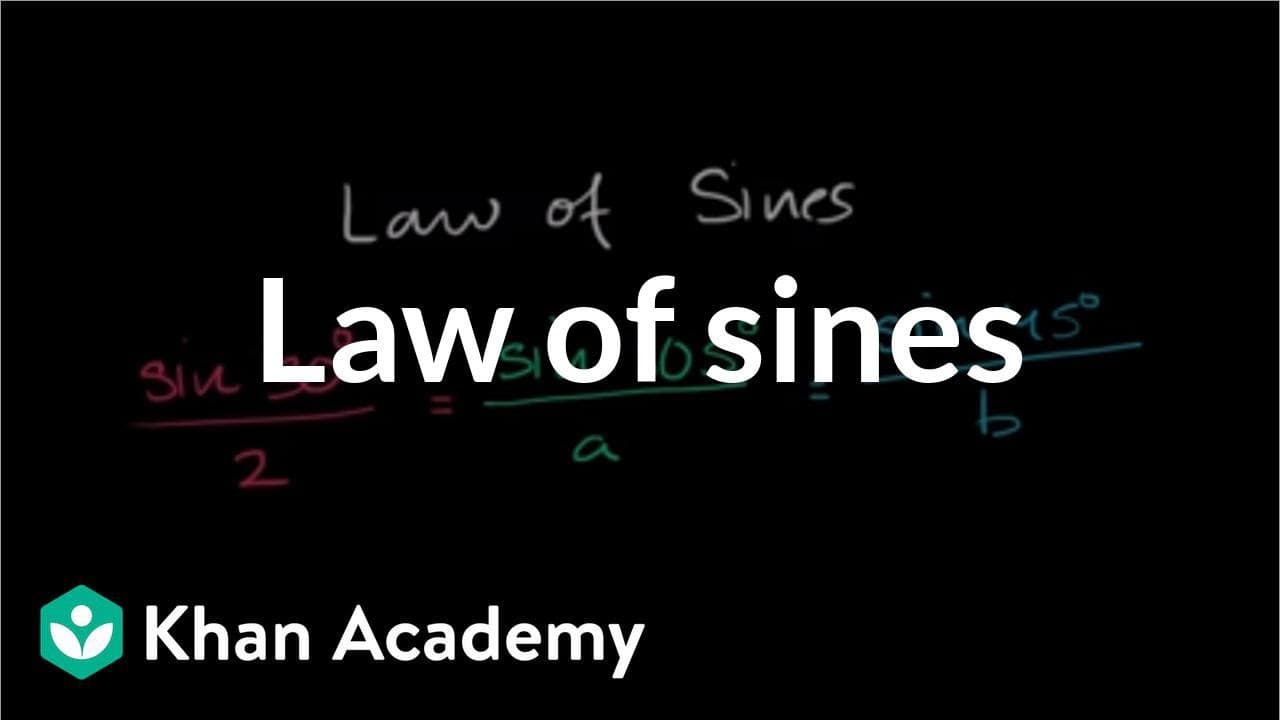
The Law of Sines allows you to find missing sides and angles in a triangle when you know two angles and one side. It states that the ratio of the sine of an angle to the length of the side opposite that angle is constant. By applying this principle, you can solve for unknown values in any triangle.
Transcript
Voiceover:We've got a triangle here where we know two of the angles and one of the sides. And what I claim, is that I can figure out everything else about this triangle just with this information. You give me two angles and a side, and I can figure out what the other two sides are going to be. And I can, of course, figure out the third angle. So, l... Read More
Key Insights
- 🔺 The Law of Sines relates the sine of an angle to the length of the side opposite it, allowing for the determination of missing triangle measurements.
- 🔺 The Law of Sines is applicable to all types of triangles, not just right triangles.
- 🙃 By knowing two angles and one side, the lengths of the other two sides can be found using the Law of Sines.
- 🔺 The Law of Sines can also be used to find a missing angle when two sides and one angle are given.
Install to Summarize YouTube Videos and Get Transcripts
Explore YouTube Video Summarizer or Get YouTube Transcript Extractor
Questions & Answers
Q: How does the Law of Sines help in solving triangles?
The Law of Sines allows us to find missing side lengths and angles when given two angles and one side or two sides and one angle. It establishes a relationship between the sine of an angle and the length of the side opposite it.
Q: What is the formula for the Law of Sines?
The formula for the Law of Sines is sin(A)/a = sin(B)/b = sin(C)/c, where A, B, and C are the angles of the triangle, and a, b, and c are the lengths of the sides opposite those angles.
Q: Can the Law of Sines be used for any triangle?
Yes, the Law of Sines can be used for any triangle, regardless of whether it is acute, obtuse, or right-angled. It provides a way to solve triangles that do not have a right angle.
Q: Can the Law of Sines be used to find all three angles of a triangle?
Yes, the Law of Sines can be used to find all three angles of a triangle. By knowing two angles and one side, the third angle can be calculated by subtracting the sum of the known angles from 180 degrees.
Summary & Key Takeaways
-
The Law of Sines states that the ratio between the sine of an angle and the length of the side opposite it is constant in a triangle.
-
By using the Law of Sines, the lengths of the other two sides of a triangle can be determined when two angles and one side are known.
-
The Law of Sines can also be used to find a missing angle when two sides and one angle are given.
Read in Other Languages (beta)
Share This Summary 📚
Summarize YouTube Videos and Get Video Transcripts with 1-Click
Try YouTube Summary with ChatGPT & Claude or YouTube Transcript Generator
Explore More Summaries from Khan Academy 📚



Summarize YouTube Videos and Get Video Transcripts with 1-Click
Try YouTube Summary with ChatGPT & Claude or YouTube Transcript Generator