Chi-square goodness-of-fit example | AP Statistics | Khan Academy
TL;DR
This analysis examines the results of a chi-squared goodness-of-fit test for a sample of 24 rock-paper-scissors games to determine if the distribution of outcomes disagrees with an even distribution.
Transcript
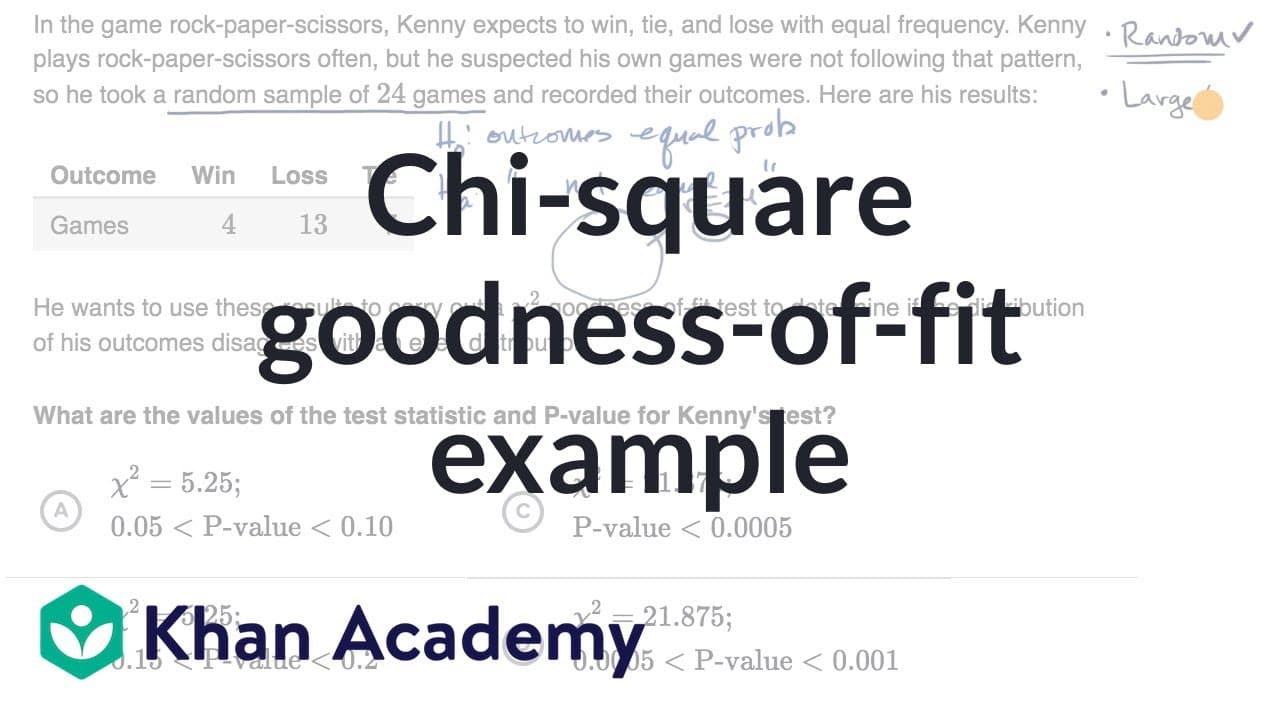
- [Instructor] In the game rock-paper-scissors, Kenny expects to win, tie, and lose with equal frequency. Kenny plays rock-paper-scissors often, but he suspect his own games were not following that pattern. So he took a random sample of 24 games and recorded their outcomes. Here are his results. So out of the 24 games, he won four, lost 13, and tie... Read More
Key Insights
- 🤏 Kenny's chi-squared test statistic is 5.25, indicating a deviation from an equal distribution of outcomes.
- 🏆 The P-value for the test falls between 0.05 and 0.10, suggesting that there is not enough evidence to reject the null hypothesis at a significance level of 5%.
- 🤏 The analysis demonstrates the process of conducting a chi-squared goodness-of-fit test and highlights the importance of meeting the necessary conditions.
- 🪡 This type of analysis can be applied to other scenarios where the distribution of outcomes in different categories needs to be assessed.
Install to Summarize YouTube Videos and Get Transcripts
Explore YouTube Video Summarizer or Get YouTube Transcript Extractor
Questions & Answers
Q: What is the null hypothesis in Kenny's chi-squared goodness-of-fit test?
The null hypothesis is that all outcomes in the rock-paper-scissors games have equal probability.
Q: How many categories are considered in this test?
There are three categories: wins, losses, and ties.
Q: What are the conditions that need to be met for a chi-squared goodness-of-fit test?
The conditions are: 1) random sample, 2) large counts (expected number in each category is at least 5), and 3) independence (sample size is no more than 10% of the population).
Q: How is the chi-squared test statistic calculated in this analysis?
The chi-squared test statistic is calculated for each category by taking the difference between the observed and expected values, squaring it, and dividing by the expected value.
Summary & Key Takeaways
-
Kenny took a random sample of 24 games of rock-paper-scissors and recorded the outcomes: 4 wins, 13 losses, and 7 ties.
-
He wants to use these results to determine if the distribution of outcomes deviates from an equal probability for each category.
-
The analysis calculates the chi-squared test statistic and the corresponding P-value to make inferences about the null hypothesis.
Read in Other Languages (beta)
Share This Summary 📚
Summarize YouTube Videos and Get Video Transcripts with 1-Click
Try YouTube Summary with ChatGPT & Claude or YouTube Transcript Generator
Explore More Summaries from Khan Academy 📚



Summarize YouTube Videos and Get Video Transcripts with 1-Click
Try YouTube Summary with ChatGPT & Claude or YouTube Transcript Generator