How Did Reconstruction Shape Jim Crow Laws?
TL;DR
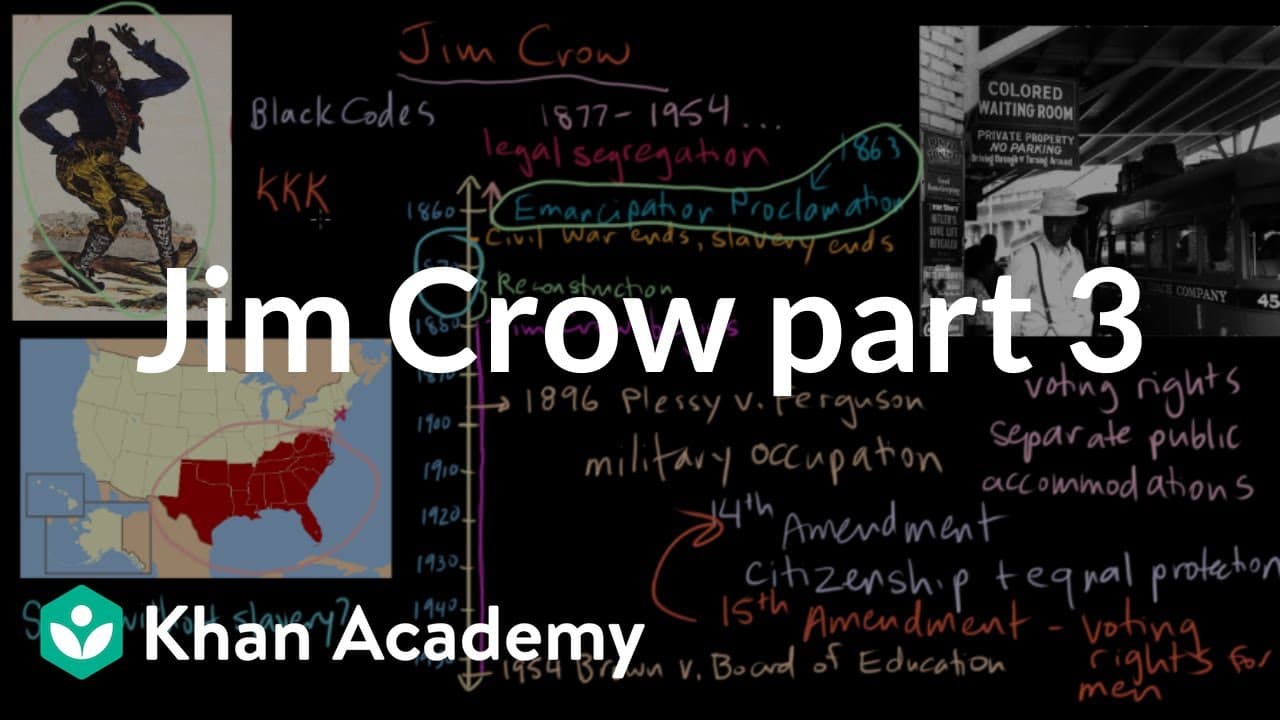
Reconstruction prompted the 14th Amendment, ensuring full citizenship and equal protection for African Americans after the Civil War. However, Southern states resisted, enacting black codes and facing military occupation until 1877, which marked the transition into the Jim Crow era.
Transcript
- [Voiceover] In the last video we were talking about the era of reconstruction and how after the Civil War when the 13th Amendment to the Constitution outlawed slavery many Southern states enacted laws known as black codes, which in many cases were really just slavery by another name. They prevented African Americans from voting, from owning firea... Read More
Key Insights
- 🖤 The black codes implemented after the Civil War were essentially a continuation of slavery, as they restricted the rights and freedoms of African Americans.
- 🖐️ The 14th Amendment played a crucial role in guaranteeing full citizenship and equal protection under the law for African Americans.
- 🎖️ The enforcement of the 14th Amendment required military occupation and federal troop presence in the South.
Install to Summarize YouTube Videos and Get Transcripts
Explore YouTube Video Summarizer or Get YouTube Transcript Extractor
Questions & Answers
Q: What were the black codes enacted by Southern states after the Civil War?
The black codes were laws implemented by Southern states after the Civil War that aimed to restrict the rights of African Americans. These codes prevented African Americans from voting, owning firearms, being involved in labor contracts, and subjected them to forced labor or incarceration for vagrancy.
Q: How did Congress respond to the black codes?
In response to the black codes, Congress passed the 14th Amendment to the Constitution. This amendment granted full citizenship and equal protection under the law to all individuals born in the United States, regardless of their previous condition of servitude.
Q: What measures did Congress take to enforce the 14th Amendment?
To enforce the 14th Amendment, Congress sent federal troops to the states in the South. The Southern region was divided into military zones, and the South was occupied by federal troops until the states rewrote their constitutions to recognize the 14th Amendment and grant equal citizenship to African Americans.
Q: When did the military occupation in the South end?
The military occupation in the South ended in 1877 when the Southern states rewrote their constitutions to acknowledge the 14th Amendment. By this time, only two states remained with federal troops, signaling the end of the reconstruction era.
Summary & Key Takeaways
-
After the Civil War, Southern states implemented black codes that effectively continued to restrict the rights of African Americans.
-
Congress responded to the black codes by passing the 14th Amendment, guaranteeing full citizenship and equal protection under the law for all individuals born in the United States.
-
Military occupation of the South and the presence of federal troops were necessary to enforce the 14th Amendment until Southern states rewrote their constitutions to recognize equal citizenship for African Americans.
Read in Other Languages (beta)
Share This Summary 📚
Summarize YouTube Videos and Get Video Transcripts with 1-Click
Try YouTube Summary with ChatGPT & Claude or YouTube Transcript Generator
Explore More Summaries from Khan Academy 📚





Summarize YouTube Videos and Get Video Transcripts with 1-Click
Try YouTube Summary with ChatGPT & Claude or YouTube Transcript Generator