Concave lenses | Geometric optics | Physics | Khan Academy
TL;DR
Concave lenses diverge light rays, creating a virtual image that is smaller and closer to the lens.
Transcript
We've talked a lot about convex lenses, so I thought I would do a quick video on concave lenses, although there aren't as many combinations of what a concave lens can do. So just remember, concave has the word 'cave' in it so I always imagine that it's kind of caving inwards caving inwards It's a little bit of an exaggerated drawing but you get the... Read More
Key Insights
- 🙂 Concave lenses diverge light rays, creating a virtual image.
- 💁 The image formed by a concave lens is upright and smaller than the object.
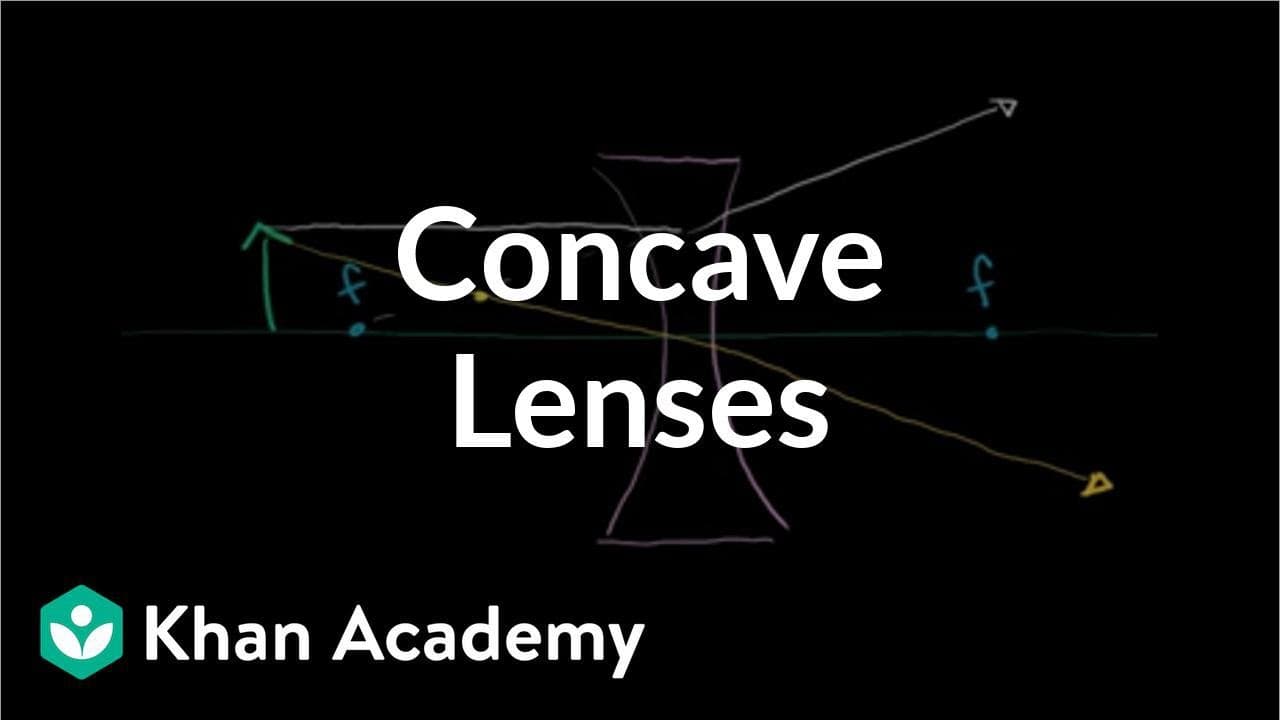
- 💨 Parallel rays passing through a concave lens are diffracted away and appear to come from the opposite focus.
- 🙌 Rays passing through the center of a concave lens remain undiffracted and continue in a straight path.
- 😚 The virtual image formed by a concave lens appears closer to the lens than it actually is.
- ❓ Concave lenses have surfaces that curve inwards, resembling a cave.
- 🫥 The principal axis of a concave lens is a straight line that passes through the center of the lens.
Install to Summarize YouTube Videos and Get Transcripts
Explore YouTube Video Summarizer or Get YouTube Transcript Extractor
Questions & Answers
Q: How do concave lenses differ from convex lenses?
Concave lenses have surfaces that curve inwards, causing light to diverge, while convex lenses have surfaces that curve outwards, causing light to converge.
Q: What happens to parallel rays passing through a concave lens?
Parallel rays are diffracted away from the principal axis and appear to come from the focus on the opposite side of the lens.
Q: How do rays passing through the center of a concave lens behave?
Rays passing through the center of a concave lens remain undiffracted and continue in a straight path.
Q: What type of image is formed by a concave lens?
A concave lens forms a virtual image, which is upright, smaller than the object, and appears closer to the lens than it actually is.
Summary & Key Takeaways
-
Concave lenses have surfaces that curve inwards, causing light rays to diverge.
-
When an object is placed on the left side of a concave lens, parallel rays are diffracted away and appear to come from the focus. Rays passing through the center of the lens remain undiffracted.
-
The image formed by a concave lens is virtual, upright, smaller, and appears closer to the lens than it actually is.
Read in Other Languages (beta)
Share This Summary 📚
Summarize YouTube Videos and Get Video Transcripts with 1-Click
Try YouTube Summary with ChatGPT & Claude or YouTube Transcript Generator
Explore More Summaries from Khan Academy 📚



Summarize YouTube Videos and Get Video Transcripts with 1-Click
Try YouTube Summary with ChatGPT & Claude or YouTube Transcript Generator