More on Newton's third law | Forces and Newton's laws of motion | Physics | Khan Academy
TL;DR
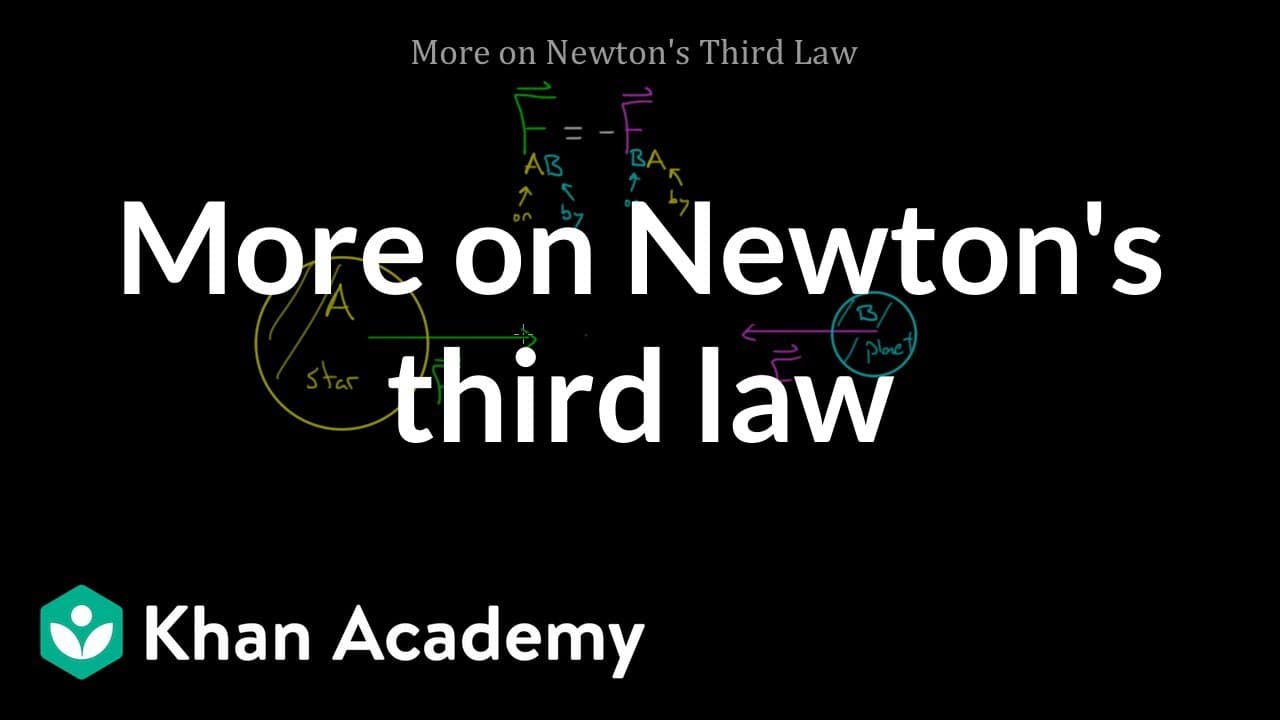
Newton's Third Law states that for every force, there is an equal and opposite force, but these forces are exerted on different objects.
Transcript
- [Voiceover] We should talk a little more about Newtons's Third Law, because there are some deep misconceptions that many people have about this law. It seems simple, but it's not nearly as simple as you might think. So people often phrase it as, for every action there's an equal and opposite reaction. But that's just way too vague to be useful. S... Read More
Key Insights
- ❓ Newton's Third Law is often misunderstood and requires a clear understanding of forces being exerted on different objects.
- 🟰 The partner forces in Newton's Third Law are always equal in magnitude but have opposite directions.
- 👮 The size or properties of the objects involved do not affect the magnitude of the third law partner forces.
Install to Summarize YouTube Videos and Get Transcripts
Explore YouTube Video Summarizer or Get YouTube Transcript Extractor
Questions & Answers
Q: What is Newton's Third Law?
Newton's Third Law states that for every force, there is an equal and opposite force exerted on a different object.
Q: Why can't the third law partner forces cancel each other out?
The third law partner forces are exerted on different objects and cannot cancel because they have opposite directions.
Q: Do the third law partner forces have to be of the same magnitude?
Yes, the third law partner forces are always equal in magnitude, even if the objects involved have different sizes or properties.
Q: Can the third law partner forces be exerted on the same object?
No, the third law partner forces must be exerted on different objects to adhere to Newton's Third Law.
Summary & Key Takeaways
-
Newton's Third Law states that for every force, there is an equal and opposite force, but this statement is often misunderstood.
-
The third law partner forces must be exerted on different objects and cannot cancel each other out.
-
The partner forces are always equal in magnitude, even if the objects have different sizes or properties.
Read in Other Languages (beta)
Share This Summary 📚
Summarize YouTube Videos and Get Video Transcripts with 1-Click
Try YouTube Summary with ChatGPT & Claude or YouTube Transcript Generator
Explore More Summaries from Khan Academy 📚



Summarize YouTube Videos and Get Video Transcripts with 1-Click
Try YouTube Summary with ChatGPT & Claude or YouTube Transcript Generator