Energy at the microscopic scale | Introduction to energy | High school physics | Khan Academy
TL;DR
Forms of energy such as kinetic, potential, thermal, and electromagnetic can be understood by examining the movements and interactions of particles on both macroscopic and microscopic scales.
Transcript
- [Instructor] Welcome. Today, we're going to take a look at forms of energy, such as kinetic, electrical, thermal, gravitational, potential energy. It turns out when you start thinking about energy on smaller scales, or the microscopic level, all of these forms of energy are basically two things: one, kinetic energy, particles moving around, and t... Read More
Key Insights
- 💁 Energy can be categorized as either kinetic or potential, and various forms of energy can be explained by these two fundamental types.
- 💁 Temperature is a macroscopic manifestation of the kinetic energy of particles, while chemical reactions involve the conversion of chemical potential energy to other forms.
- 👋 Sound waves and elastic potential energy are examples of energy transferred through the motion of particles on the microscopic level.
- 🙂 Radiant energy, such as light, can be explained by the interactions of electric and magnetic fields or by the particles (photons) carrying the energy.
Install to Summarize YouTube Videos and Get Transcripts
Explore YouTube Video Summarizer or Get YouTube Transcript Extractor
Questions & Answers
Q: How is temperature related to kinetic and potential energy?
Temperature is related to the kinetic energy of particles, as their movement and speed increase with higher temperatures. Potential energy is stored in the bonds between atoms or molecules, and temperature affects the vibrational and rotational motion of these particles.
Q: What is the source of chemical potential energy in a chemical reaction?
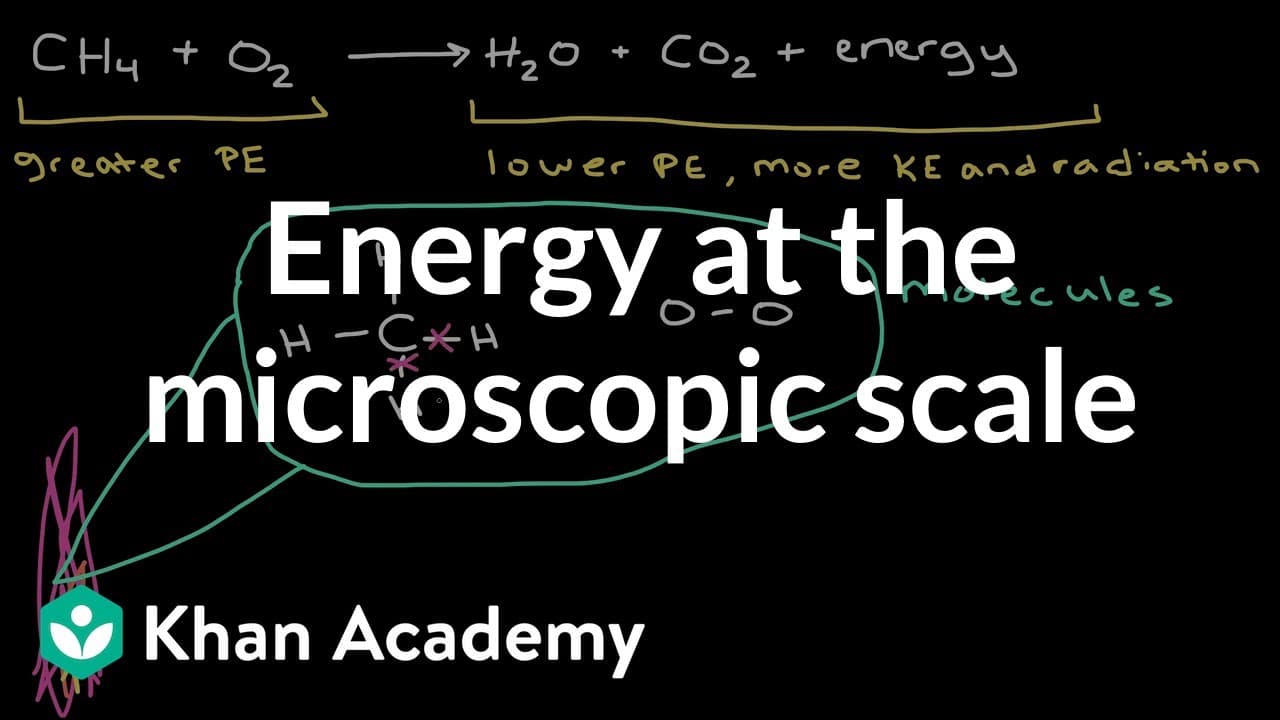
Chemical potential energy is stored in the bonds between atoms. As these bonds are broken and reformed during a chemical reaction, the potential energy is converted to kinetic energy and radiation.
Q: How is sound energy transferred?
Sound energy is transferred through vibrations, which are caused by the back and forth motion of molecules in the air. These vibrations create sound waves that carry energy.
Q: How is elastic potential energy stored?
Elastic potential energy is stored in a spring when it is stretched or compressed. At the microscopic level, this involves pulling the atoms of a solid out of their equilibrium position and gaining potential energy from the electromagnetic force holding the solid together.
Summary & Key Takeaways
-
Energy on a macroscopic scale can be observed in forms such as temperature and light emission, while energy on a microscopic scale involves the kinetic and potential energy of particles.
-
Temperature is related to the kinetic energy of water molecules, which determines their speed and thermal motion.
-
Chemical reactions, like burning methane gas, involve the conversion of chemical potential energy to kinetic energy and radiation.
Read in Other Languages (beta)
Share This Summary 📚
Summarize YouTube Videos and Get Video Transcripts with 1-Click
Try YouTube Summary with ChatGPT & Claude or YouTube Transcript Generator
Explore More Summaries from Khan Academy 📚



Summarize YouTube Videos and Get Video Transcripts with 1-Click
Try YouTube Summary with ChatGPT & Claude or YouTube Transcript Generator