Classification of Transducers
TL;DR
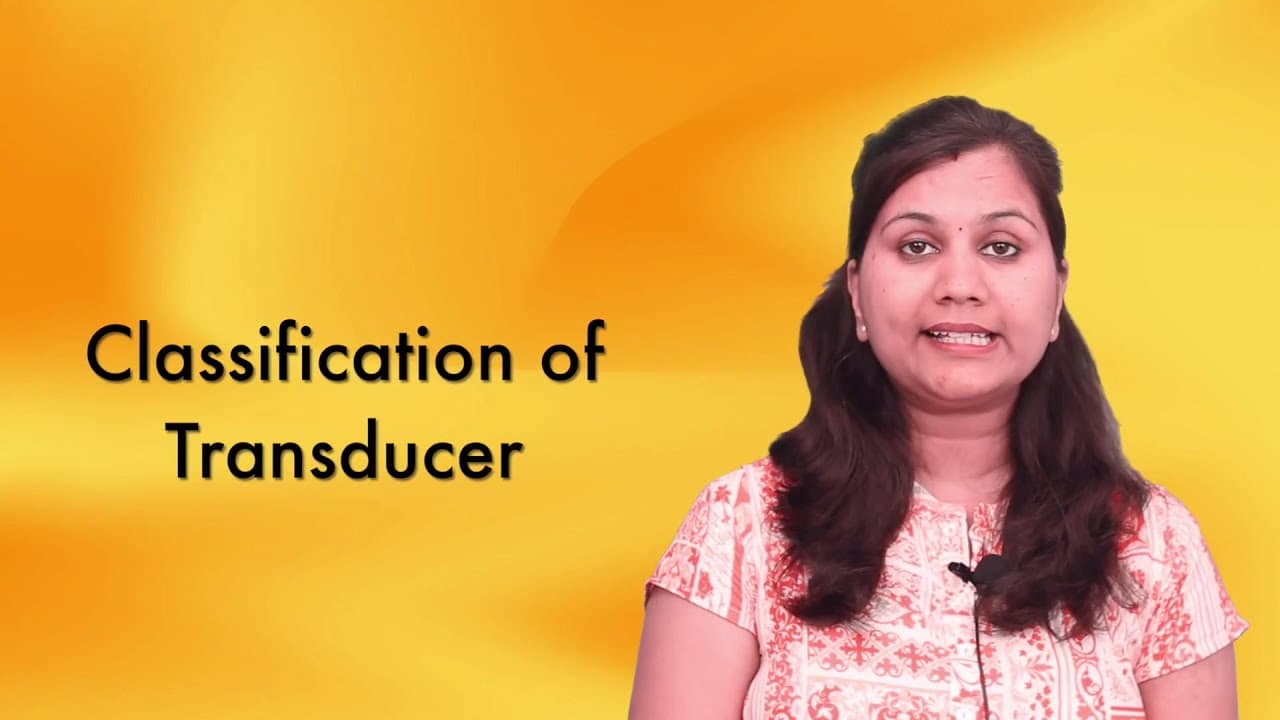
This video discusses the various criteria for classifying transducers and provides examples of different types of transducers.
Transcript
hello friends in this video we are going to study the classification of transducers we will study that in how many categories and in how many ways the transducers can be classified with their examples so let us start with our topic the classification of transducers can be done in many ways there are various categories or there are various criteria ... Read More
Key Insights
- ⚾ Transducers can be classified based on various criteria such as energy conversion method, output signal nature, electrical principles, electrical parameters, principle of operation, and applications.
- 💁 They can be divided into resistive, capacitive, and inductive transducers based on the form of transduction used.
- ☢️ Transducers can also be classified as primary and secondary, active and passive, and analog and digital.
- 🚱 Inverse transducers convert electrical quantity to non-electrical quantity, while transducers convert non-electrical quantity to electrical quantity.
- ❓ Examples of transducers include potentiometer, LVDT, strain gauge, thermocouple, and thermistor.
- 🏑 Examples of inverse transducers include a current carrying coil in a magnetic field, piezoelectric crystal, and ammeters/voltmeters.
Install to Summarize YouTube Videos and Get Transcripts
Explore YouTube Video Summarizer or Get YouTube Transcript Extractor
Questions & Answers
Q: What are the different criteria used to classify transducers?
Transducers can be classified based on the method of energy conversion, nature of the output signal, electrical principles involved, electrical parameters used, principle of operation, and applications.
Q: How are transducers classified as resistive, capacitive, and inductive?
Transducers are classified as resistive, capacitive, or inductive based on the form of transduction used. For example, a resistive transducer converts a non-electrical quantity into resistance, while a capacitive transducer converts it into capacitance.
Q: What is the difference between primary and secondary transducers?
Primary transducers are mechanical devices that convert a non-electrical quantity into an intermediate signal, which is then converted into an electrical signal by secondary transducers. They work in two stages of transduction.
Q: What is the difference between active and passive transducers?
Passive transducers derive power for transduction from an auxiliary power source, while active transducers generate their own power from the physical quantity being measured.
Q: How do analog and digital transducers differ?
Analog transducers convert the input quantity into a continuous analog output signal, while digital transducers provide a digital output in the form of pulses representing zeros and ones.
Q: Can you provide an example of an inverse transducer?
A current carrying coil in a magnetic field is an example of an inverse transducer as it converts electrical current into a non-electrical force.
Q: What is the role of a piezoelectric crystal in transduction?
A piezoelectric crystal can act as both a transducer and an inverse transducer. It converts acceleration into an output voltage and vice versa.
Q: How are ammeters and voltmeters classified as inverse transducers?
Ammeters and voltmeters convert electrical quantities (current and voltage) into non-electrical displacements of the pointer over the calibrated scale, making them examples of inverse transducers.
Summary & Key Takeaways
-
Transducers can be classified based on the method of energy conversion, nature of the output signal, electrical principles involved, electrical parameters used, principle of operation, and applications.
-
They can be divided into resistive, capacitive, and inductive transducers based on the form of transduction used.
-
Transducers can also be classified as primary and secondary, active and passive, and analog and digital.
-
Inverse transducers convert electrical quantity to non-electrical quantity, while transducers convert non-electrical quantity to electrical quantity.
Read in Other Languages (beta)
Share This Summary 📚
Summarize YouTube Videos and Get Video Transcripts with 1-Click
Try YouTube Summary with ChatGPT & Claude or YouTube Transcript Generator
Explore More Summaries from Ekeeda 📚




Summarize YouTube Videos and Get Video Transcripts with 1-Click
Try YouTube Summary with ChatGPT & Claude or YouTube Transcript Generator