Higher Order Differential Equation when R.H.S = 0 - Problem 1
TL;DR
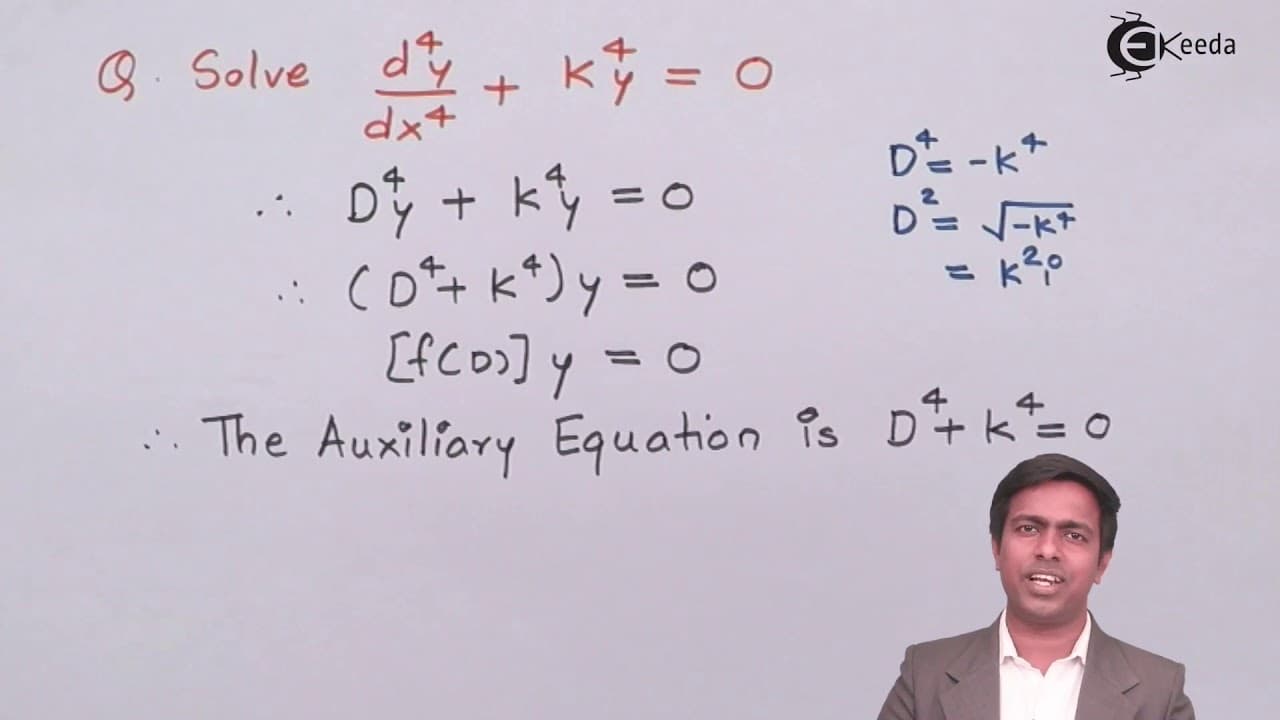
Learn how to solve a higher order differential equation with a zero right hand side using the steps provided in the video.
Transcript
friends so after understanding the concept of finding the solution of a higher order differential equation whenever the right hand side is 0 now let us start with the numericals based on the same concept so here i am going to take one higher differential equation and i'm gonna show you how to apply those previous video steps over here to get this s... Read More
Key Insights
- ✋ The process of finding the solution to a higher order differential equation with a zero right hand side involves converting the equation, finding roots, and using the complementary function.
- 🥺 The common mistake of assuming the roots based on the term with a constant coefficient can lead to incorrect solutions.
- 💯 By adding and subtracting a middle term, the equation can be simplified into the form of a perfect square, making it easier to find the roots.
- ✋ The solution to a higher order differential equation with a zero right hand side consists of the complementary function and particular integral, with the particular integral being zero in this case.
- 🫚 Four complex and distinct roots can be obtained from the simplified equation.
- ✋ The complementary function and particular integral combine to form the complete solution to the given higher order differential equation.
- 🎮 It is important to subscribe to the eKila channel for more informative videos on mathematics.
Install to Summarize YouTube Videos and Get Transcripts
Explore YouTube Video Summarizer or Get YouTube Transcript Extractor
Questions & Answers
Q: How do you convert a higher order differential equation into operator form?
To convert the equation into operator form, take the equation and replace the differential term with the operator. In this case, the operator is denoted as "d raised to 4 y".
Q: What is the solution to a higher order differential equation with a zero right hand side?
The solution consists of the complementary function (yc) and particular integral (yp). However, since the right hand side is zero, the particular integral will be zero, resulting in yc being the complete solution.
Q: How can the roots of a higher order differential equation be found?
To find the roots, add and subtract a middle term derived from the given equation. This allows the first three terms to become a perfect square, simplifying the equation and making it easier to find the roots.
Q: What is the formula for finding the roots of a quadratic equation?
The formula for finding the roots of a quadratic equation is d = (-b ± √(b^2 - 4ac)) / (2a), where a, b, and c are coefficients of the quadratic equation.
Summary & Key Takeaways
-
The video covers the process of finding the solution to a higher order differential equation with a zero right hand side.
-
The equation is converted into an operator form and the solution is found using the complementary function and particular integral.
-
The roots of the equation are determined by adding and subtracting a middle term to create a perfect square, leading to four complex and distinct roots.
Read in Other Languages (beta)
Share This Summary 📚
Summarize YouTube Videos and Get Video Transcripts with 1-Click
Try YouTube Summary with ChatGPT & Claude or YouTube Transcript Generator
Explore More Summaries from Ekeeda 📚




Summarize YouTube Videos and Get Video Transcripts with 1-Click
Try YouTube Summary with ChatGPT & Claude or YouTube Transcript Generator