George Hotz | Programming | thursday tiny corp evening: OpenCL microbenchmarks | from $1499 comma 3
TL;DR
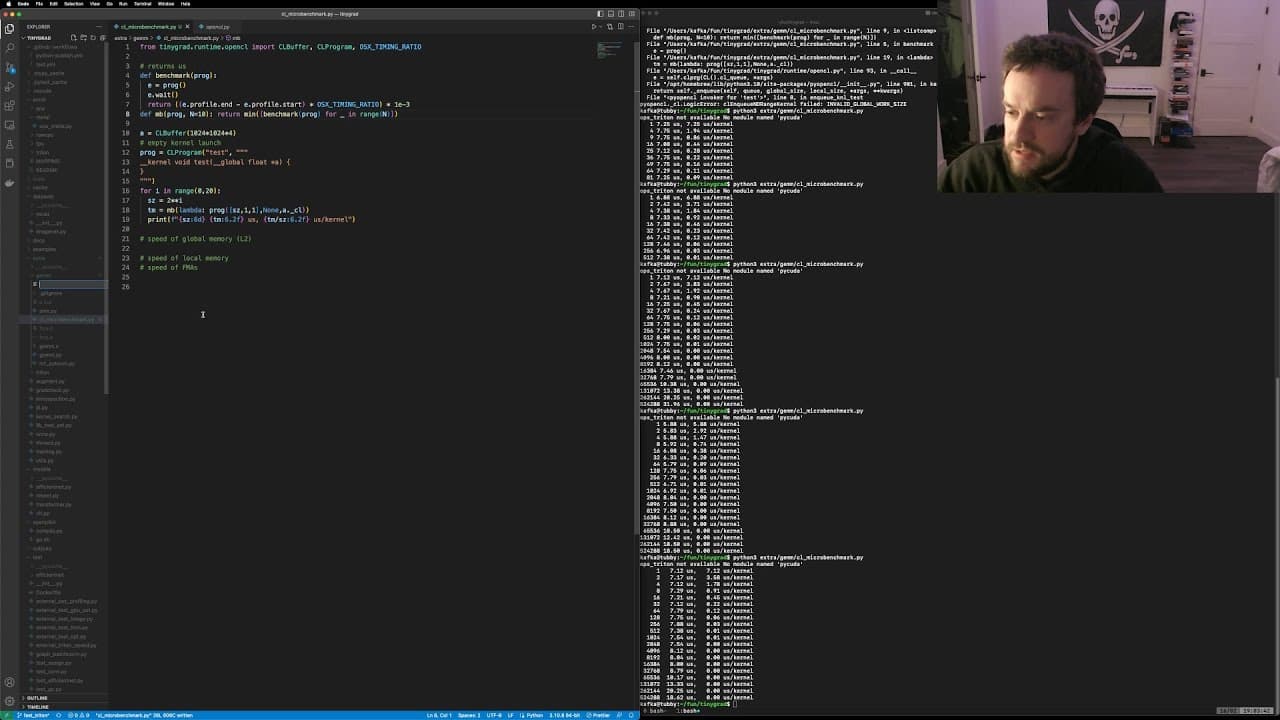
Testing GPU speeds using micro benchmarks for memory and flops.
Transcript
welcome welcome it's a Thursday tiny Corp evening I think it's Thursday we got some ice cream boys we got ice cream and banana got a spin drift um we got a keto Rolls Royce we got a phone we got everything we need um um Bo Burnham the world works oh yeah you know you guys know this song Hey everybody look who stopped by to say hello it's Saco with ... Read More
Key Insights
- 📈 Micro benchmarks provide valuable insights into GPU performance metrics like memory bandwidth and FMA operations.
- ❓ Discrepancies in local memory bandwidth can impact overall GPU efficiency and performance.
- 🍵 Comparing different GPUs reveals design-specific strengths and weaknesses in handling memory and computation tasks.
- 🆘 Understanding FMA performance across GPUs helps evaluate computational efficiency and throughput.
- 🖐️ Micro benchmarks play a crucial role in evaluating and comparing the performance of GPUs from various manufacturers.
- 🙂 Testing local memory access sheds light on how GPUs manage data sharing and memory operations during complex computations.
- 🎨 The results reflect design choices and optimization strategies that influence GPU performance outcomes.
Install to Summarize YouTube Videos and Get Transcripts
Explore YouTube Video Summarizer or Get YouTube Transcript Extractor
Questions & Answers
Q: What was the purpose of running micro benchmarks on GPUs?
The goal was to measure memory bandwidth, FMA performance, and observe the discrepancies in local memory bandwidth between different GPUs.
Q: Why was there a focus on testing local memory bandwidth?
Testing local memory bandwidth helps understand how efficiently GPUs handle memory access and sharing data among threads during computation.
Q: What did the results reveal about FMA performance across different GPUs?
Results showed that FMA performance was consistent with expectations, with GPUs like NVIDIA's 3080 TI performing close to theoretical values, while Qualcomm's chipset showed a slight deviation.
Q: How did the benchmarks highlight the challenges faced by different GPUs?
The benchmarks demonstrated the impact of design choices on GPU performance, showcasing the strengths and weaknesses of each GPU in handling memory and computation tasks.
Summary & Key Takeaways
-
Ran micro benchmarks on GPUs to test memory bandwidth and FMA performance.
-
GPUs from Qualcomm, NVIDIA, and Apple were compared.
-
Identified discrepancies in local memory bandwidth and FMA performance.
Read in Other Languages (beta)
Share This Summary 📚
Summarize YouTube Videos and Get Video Transcripts with 1-Click
Try YouTube Summary with ChatGPT & Claude or YouTube Transcript Generator
Explore More Summaries from george hotz archive 📚




Summarize YouTube Videos and Get Video Transcripts with 1-Click
Try YouTube Summary with ChatGPT & Claude or YouTube Transcript Generator