What Happens in Weak Acid-Strong Base Reactions?
TL;DR
Weak acid-strong base reactions result in the formation of a salt and water, impacting the solution's pH based on the reactant ratios. When equal moles are used, the solution is slightly basic; excess weak acid leads to lower pH, while excess strong base results in higher pH.
Transcript
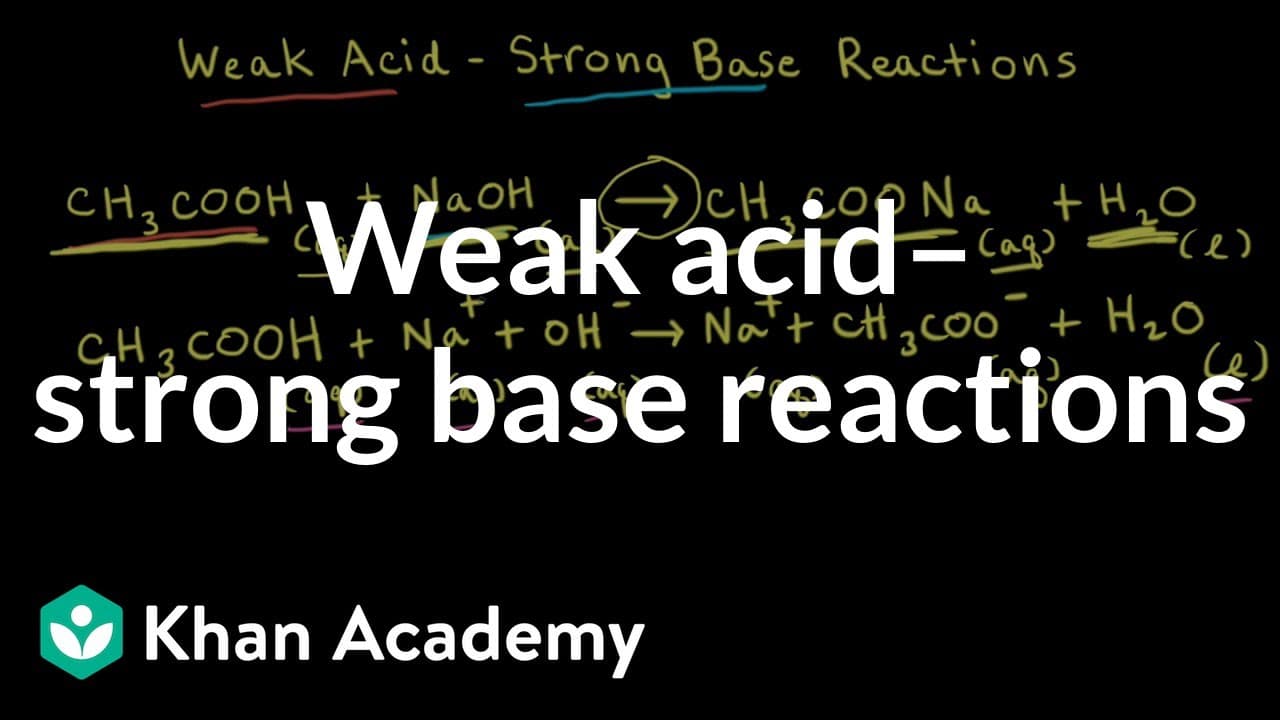
- [Instructor] Acetic acid is an example of a weak acid and sodium hydroxide is an example of a strong base. When acetic acid reacts with sodium hydroxide, an aqueous solution of sodium acetate is formed along with water. Since this reaction is an acid-base neutralization reaction, and these reactions go to completion, instead of using an equilibri... Read More
Key Insights
- 💦 Neutralization reactions involve the reaction between an acid and a base to form a salt and water.
- 💪 Complete ionic equations show the dissociation of weak acids and strong bases in solution.
- 💪 The resulting solution's pH depends on the relative amounts of weak acid and strong base.
- 🙂 Excess weak acid leads to acidity, excess strong base makes the solution basic, and equal moles result in a slightly basic solution.
Install to Summarize YouTube Videos and Get Transcripts
Explore YouTube Video Summarizer or Get YouTube Transcript Extractor
Questions & Answers
Q: What is the difference between a weak acid and a strong base?
A weak acid only partially ionizes in a solution, while a strong base dissociates 100%. This means that a weak acid exists mostly in its original form, while a strong base exists as separate cations and anions.
Q: How does the concentration of hydroxide ions affect the pH of the resulting solution?
If the concentration of hydroxide ions increases, the resulting solution will be basic and have a pH greater than 7. This occurs when there is an excess of strong base or from anion hydrolysis.
Q: What happens when the weak acid is in excess?
When the weak acid is in excess, it reacts with water to form hydronium ions and acetate anions. This increase in hydronium ions makes the solution more acidic, resulting in a pH less than 7.
Q: How does the presence of the acetate anion affect the ionization of acetic acid?
The presence of the acetate anion, a common ion, decreases the ionization of acetic acid in water. However, the concentration of hydronium ions still increases, leading to a lower pH.
Summary & Key Takeaways
-
The video discusses the reaction between acetic acid (a weak acid) and sodium hydroxide (a strong base) to form sodium acetate and water.
-
It explains the concept of complete ionic equations, where the weak acid only partially ionizes while the strong base dissociates completely.
-
The video explores three different scenarios: equal moles of weak acid and strong base, weak acid in excess, and strong base in excess, and how they affect the resulting solution's pH.
Read in Other Languages (beta)
Share This Summary 📚
Summarize YouTube Videos and Get Video Transcripts with 1-Click
Try YouTube Summary with ChatGPT & Claude or YouTube Transcript Generator
Explore More Summaries from Khan Academy 📚



Summarize YouTube Videos and Get Video Transcripts with 1-Click
Try YouTube Summary with ChatGPT & Claude or YouTube Transcript Generator