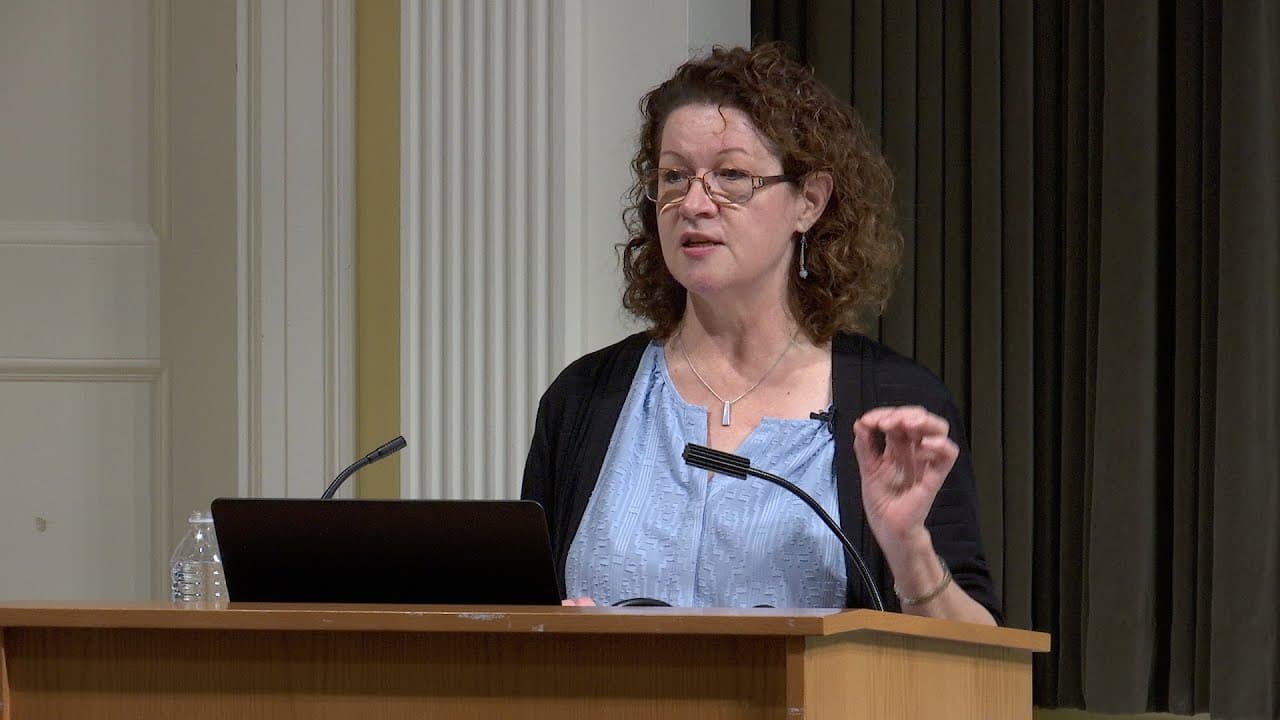
Maryanne Kowaleski | Living by the Sea || Radcliffe Institute
TL;DR
Women in medieval maritime communities had limited options for work, primarily in tasks associated with household work. However, they played crucial roles in supporting the fishing industry and had some agency and influence within their communities.
Transcript
[MUSIC PLAYING] -Thank you, Judy, for that very generous introduction. And thanks to all of you for coming. Like everybody, I'm especially appreciative of the opportunities that being at the Radcliffe Institute offers for those of us who just need an extended time away from administrative duties, in particular in teaching, to work on a monograph pr... Read More
Key Insights
- 👩⚕️ Women in medieval maritime communities primarily participated in tasks associated with household work, such as brewing ale, selling fish, and working with materials like hemp and flax.
- 🎣 In smaller fishing communities, women played crucial roles in mending nets, baiting hooks, and curing and selling fish, which contributed to the household economy and the success of the fishing industry.
- 🤵 The marine environment influenced the timing of marriages and births in maritime communities, with marriages often peaking in the winter when fishers returned from expeditions.
- 😘 Demographic characteristics such as high male mortality, low sex ratios, and endogamous marriages were observed in maritime communities, indicating similarities with later periods.
Install to Summarize YouTube Videos and Get Transcripts
Explore YouTube Video Summarizer or Get YouTube Transcript Extractor
Questions & Answers
Q: Were there any instances of women working at sea as fishers or mariners in medieval England?
There is no evidence that women worked at sea as fishers or mariners in medieval England. The roles of fishers and mariners were predominantly filled by men. Women's work in maritime communities was primarily focused on supporting the fishing industry through tasks such as mending nets and baiting hooks.
Q: Did women in maritime communities have any legal and inheritance rights that supported their autonomy?
While there are no written laws explicitly outlining the legal and inheritance rights of women in medieval maritime communities in England, customary practices and evidence from wills suggest that women had some degree of autonomy and influence. Widows, in particular, often inherited fishing equipment and could continue the family enterprise.
Q: How did the marine environment shape the lives of those living in maritime communities?
The marine environment influenced the work regime and lifestyle of those living in maritime communities. Fishers and mariners frequently spent extended periods at sea, and high male mortality rates were observed due to the risks associated with their occupations. The seasonal demands of fishing and seafaring also impacted the timing of marriages and births in these communities. The marine environment also shaped the identification of shoreside residents with the maritime subculture and influenced their participation in collaborative enterprises and traditions associated with the sea.
Q: Did women in maritime communities have any economic or social value for their work?
The economic value of women's work in maritime communities is difficult to ascertain due to a lack of specific evidence. However, the study suggests that women's work in supporting the fishing industry was crucial to the household economy. Women's roles in mending nets, baiting hooks, and curing and selling fish contributed to the success of the family enterprise. Socially, women in maritime communities may have gained some agency and influence through their involvement in these tasks and their participation in collaborative endeavors.
Summary & Key Takeaways
-
The study focuses on the role of women in maritime communities in medieval England, particularly from the 12th to the 15th centuries.
-
Women's work in maritime communities was primarily centered around traditional household tasks such as brewing ale, selling fish, and working with materials like hemp and flax.
-
In smaller fishing communities, women played crucial roles in mending nets, baiting hooks, and curing and selling fish, which contributed to the household economy.
-
The marine environment influenced the timing of marriages and births in these communities, with marriages often peaking in the winter when fishers returned from fishing expeditions.
-
Demographic characteristics such as high male mortality, low sex ratios, and endogamous marriages were also observed in maritime communities, indicating similarities with later periods.
Read in Other Languages (beta)
Share This Summary 📚
Summarize YouTube Videos and Get Video Transcripts with 1-Click
Try YouTube Summary with ChatGPT & Claude or YouTube Transcript Generator
Explore More Summaries from Harvard University 📚






Summarize YouTube Videos and Get Video Transcripts with 1-Click
Try YouTube Summary with ChatGPT & Claude or YouTube Transcript Generator