Earth formation | Life on earth and in the universe | Cosmology & Astronomy | Khan Academy
TL;DR
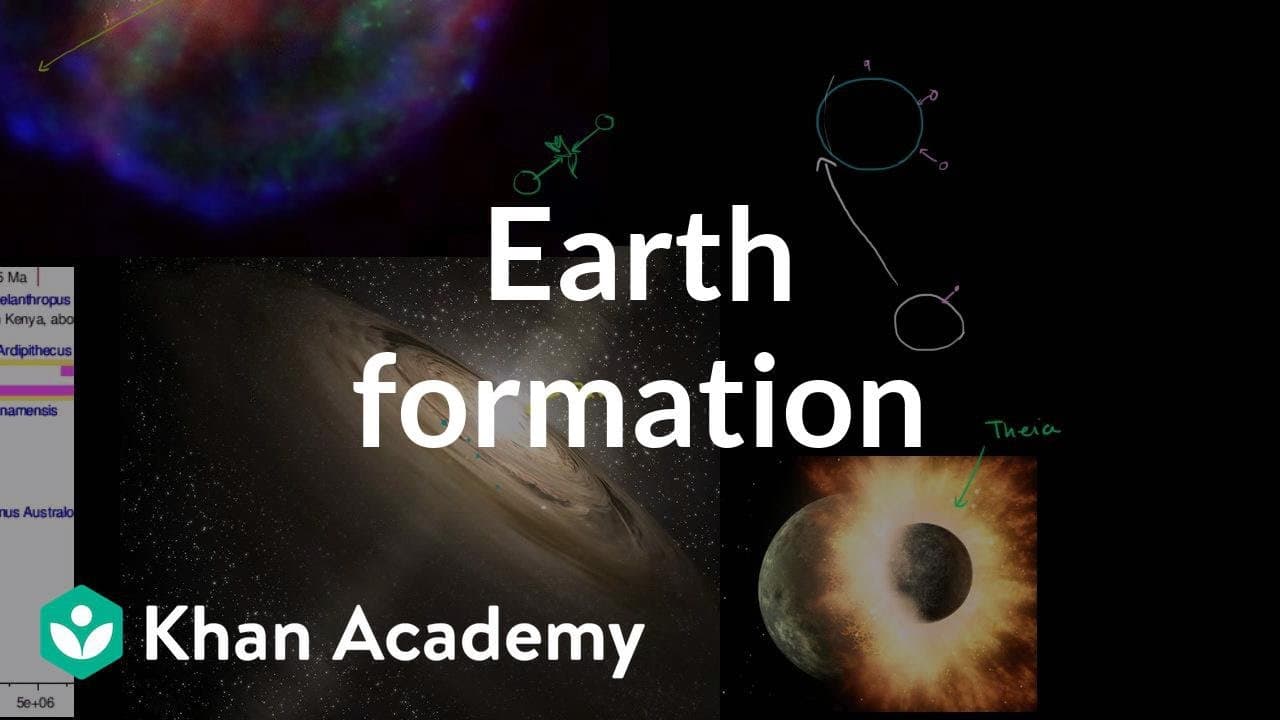
Earth's formation involved a supernova creating a shockwave that compressed gas to form a solar system. The Moon was likely formed through a glancing collision with another planet-sized object.
Transcript
What I'm going to attempt to do in the next two videos is really just give an overview of everything that's happened to Earth since it came into existence. We're going start really at the formation of Earth or the formation of our Solar system or the formation of the Sun, and our best sense of what actually happened is that there was a supernova in... Read More
Key Insights
- 🫢 The shockwave from a supernova compressed gas and molecules, leading to the formation of our solar system.
- 💥 Accretion and collisions between particles formed early planets and planetesimals.
- 💥 The Moon was likely formed through a glancing collision with another planet-sized object.
- 🥵 The Hadean eon was characterized by a volatile Earth, with no rocks and a continuous cycle of heat and churning.
- 🛟 Life likely did not exist during the Hadean eon due to its inhospitable conditions.
- 💁 The formation of Earth and the Moon involved violent and chaotic processes.
- 👨🎤 Geological evidence for the Hadean eon is scarce due to the constant recycling of rocks.
Install to Summarize YouTube Videos and Get Transcripts
Explore YouTube Video Summarizer or Get YouTube Transcript Extractor
Questions & Answers
Q: How did the shockwave from a supernova lead to the formation of our solar system?
The shockwave compressed gas and molecules, increasing their density to a critical point where gravity could cause accretion, leading to the formation of a solar system.
Q: Why do we believe a supernova is responsible for the formation of our solar system?
The heavy elements found in our solar system, like uranium, are thought to have been formed in the heat of a supernova. The timing of their formation aligns with the formation of our solar system.
Q: How did the Moon form?
Another planet-sized object, called Theia, had a glancing collision with Earth. This collision splashed molten material into orbit, which eventually formed the Moon.
Q: What was the Earth like during the Hadean eon?
The Earth was a molten ball of magma and lava, constantly being churned and recycled. There were no macroscopic-scale rocks, and the surface was a vast magma pool.
Summary & Key Takeaways
-
A supernova near Earth's vicinity caused a shockwave that compressed gas and molecules, leading to the formation of our solar system.
-
Over millions of years, gas and particles accreted into rocks, asteroids, and planetesimals, eventually forming early planets.
-
The Moon formed through a glancing collision between Earth and a Mars-sized object, splashing molten material into orbit.
Read in Other Languages (beta)
Share This Summary 📚
Summarize YouTube Videos and Get Video Transcripts with 1-Click
Try YouTube Summary with ChatGPT & Claude or YouTube Transcript Generator
Explore More Summaries from Khan Academy 📚



Summarize YouTube Videos and Get Video Transcripts with 1-Click
Try YouTube Summary with ChatGPT & Claude or YouTube Transcript Generator