Order doesn't matter when purely multiplying | 3rd grade | Khan Academy
TL;DR
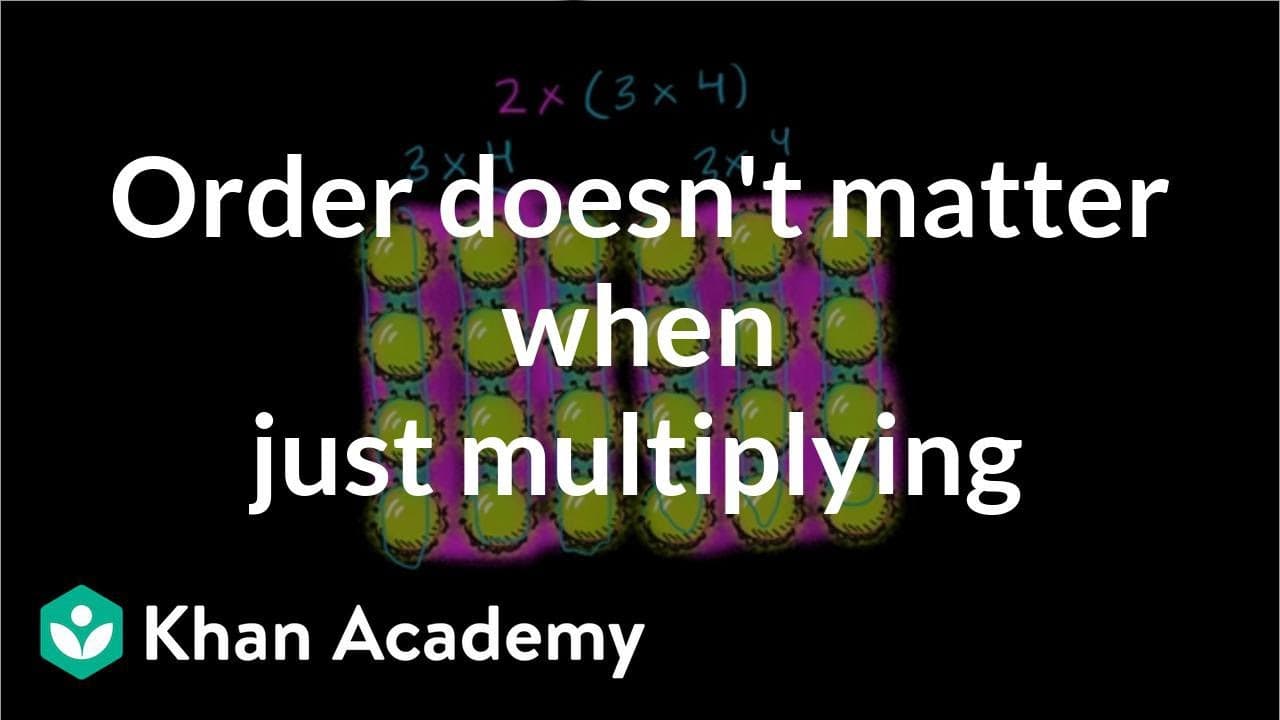
The video explains how the order of multiplication does not matter and introduces the concepts of the associative and commutative properties.
Transcript
So if you look at each of these 4 by 6 grids, it's pretty clear that there's 24 of these green circle things in each of them. But what I want to show you is that you can get 24 as the product of three numbers in multiple different ways. And it actually doesn't matter which products you take first or what order you actually do them in. So let's thin... Read More
Key Insights
- 👥 Multiplication can be used to find the total number of objects in groups or arrays.
- 🪈 The product of numbers can be obtained in different orders without changing the result.
- ✖️ The associative property of multiplication allows for flexibility in how numbers are grouped during multiplication.
- ✖️ The commutative property of multiplication states that changing the order of the numbers being multiplied does not affect the final result.
- 💄 Both the associative and commutative properties apply to multiplication, making it a flexible and commutative operation.
- 🆘 Understanding these properties can help simplify calculations and make problem-solving more efficient.
- 🎮 The video provides visual representations to demonstrate the concepts of associative and commutative properties.
Install to Summarize YouTube Videos and Get Transcripts
Explore YouTube Video Summarizer or Get YouTube Transcript Extractor
Questions & Answers
Q: How does the video demonstrate that the order of multiplication does not matter?
The video shows that the product of 24 can be achieved by multiplying 2, 3, and 4 in various orders, such as 2 times 3 times 4 or 3 times 2 times 4. The result remains the same, proving that the order is irrelevant.
Q: What are the examples used to explain the associative property of multiplication?
The examples of 4 times 5 times 6 and 5 times 4 times 6 demonstrate the associative property. Regardless of whether you perform the multiplication in the order of 4 times 5 first or 5 times 6 first, the result will be the same.
Q: What does the term "associative property" mean in relation to multiplication?
The associative property refers to the fact that the grouping or order in which numbers are multiplied does not affect the outcome. It allows for flexibility in how numbers are grouped during multiplication.
Q: How does the video define the commutative property of multiplication?
The video defines the commutative property as the idea that the order of numbers being multiplied does not matter. Whether you multiply 4 times 5 or 5 times 4, the result will be the same.
Summary & Key Takeaways
-
The video demonstrates that the product of 24 can be obtained in multiple ways by multiplying three numbers (2, 3, and 4) together.
-
It emphasizes that the order in which multiplication is performed does not affect the final result.
-
The examples of 4 times 5 times 6 and 5 times 4 times 6 further illustrate the associative and commutative properties of multiplication.
Read in Other Languages (beta)
Share This Summary 📚
Summarize YouTube Videos and Get Video Transcripts with 1-Click
Try YouTube Summary with ChatGPT & Claude or YouTube Transcript Generator
Explore More Summaries from Khan Academy 📚



Summarize YouTube Videos and Get Video Transcripts with 1-Click
Try YouTube Summary with ChatGPT & Claude or YouTube Transcript Generator