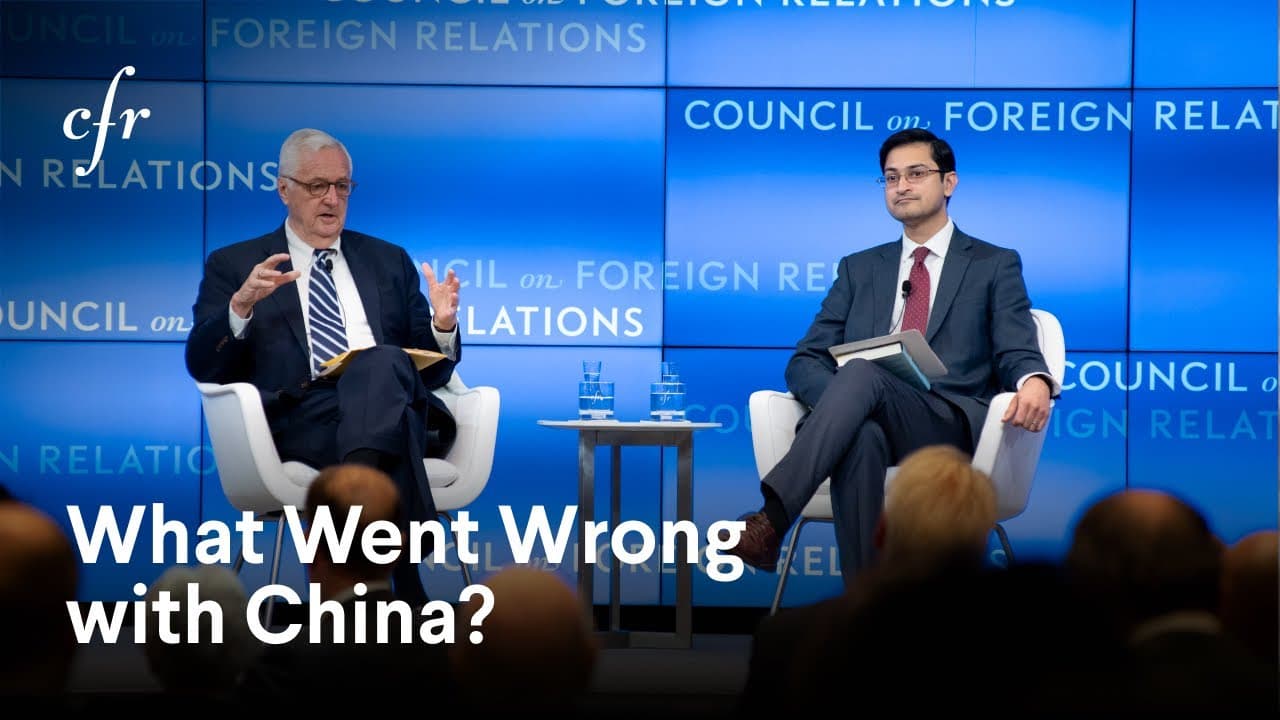
Reassessing U.S.-China Relations with David Shambaugh
TL;DR
David Shambaugh discusses the evolution of U.S.-China relations.
Transcript
DOSHI: Can you hear me OK? There we go. I hope you all enjoyed lunch. There’s still food in the back, of course. Welcome to the Council on Foreign Relations. My name is Rush Doshi. And I’m the C.V. Starr senior fellow for Asia studies and director of the China Strategy Initiative here at the Council. I’m excited to welcome you all to our an... Read More
Key Insights
- David Shambaugh's new book, 'Breaking the Engagement,' explores the evolution of U.S.-China relations over the past several decades, focusing on the shift from engagement to competition.
- The lecture highlights the historical context of U.S.-China relations, tracing back to the Qing Dynasty and the recurring cycles of amity and enmity between the two nations.
- Shambaugh argues that the U.S. engagement strategy towards China was based on four pillars: modernization, liberalization, international socialization, and exchange.
- The relationship between the U.S. and China has shifted from engagement to comprehensive competition, with increasing frictions and systemic disengagement over the past decade.
- Shambaugh attributes the deterioration of U.S.-China relations to Xi Jinping's policies, which have undermined the premises of American engagement and alienated various American actors.
- The discussion also touches on the triangular relationship between China, the U.S., and Russia, emphasizing the historical and contemporary dynamics at play.
- Shambaugh categorizes the current American schools of thought on China policy into five distinct groups, each with different approaches to managing the relationship.
- The lecture includes a personal anecdote from Shambaugh's time as a student in China, highlighting the complexities and challenges of U.S.-China interactions.
Install to Summarize YouTube Videos and Get Transcripts
Explore YouTube Video Summarizer or Get YouTube Transcript Extractor
Questions & Answers
Q: What was the primary motivation for the U.S. opening to China in the 1970s?
The primary motivation for the U.S. opening to China in the 1970s was geopolitical, particularly in relation to the Soviet Union. Both the U.S. and China saw the Soviet Union as a significant threat, and the rapprochement between the U.S. and China was partly aimed at countering Soviet influence. The Vietnam War also played a role, as the U.S. sought to undermine relations between Vietnam and its perceived ally, China.
Q: How has the balance of power between the U.S. and China affected their relationship?
The balance of power between the U.S. and China has shifted, with China gaining more leverage and confidence in its interactions with the U.S. Historically, the relationship was asymmetrical, with the U.S. as the dominant power. However, China's economic and technological advancements have led to a more symmetrical relationship, emboldening China and leading to increased competition and friction.
Q: What are the main challenges facing American universities in their relationships with China?
American universities face several challenges in their relationships with China, including issues related to academic freedom, research collaboration, and influence operations. The securitization of scholarship in China has made it difficult for American scholars to conduct research, and there are concerns about Chinese influence on American campuses through donations, student monitoring, and executive education programs. These challenges require careful navigation to maintain academic integrity and independence.
Q: What are the key elements of the U.S. engagement strategy towards China?
The U.S. engagement strategy towards China was based on four key elements: modernization, liberalization, international socialization, and exchange. The goal was to help China modernize economically and technologically, liberalize politically and socially, integrate into the international order, and encourage exchanges at various levels. While the U.S. succeeded in aiding China's modernization, efforts to liberalize and socialize China have faced significant challenges.
Q: How does Shambaugh categorize the current American schools of thought on China policy?
Shambaugh categorizes the current American schools of thought on China policy into five groups: stealthy rival, reengagement, managed competition, comprehensive competition, and strategic empathy. Each group offers a different approach to managing U.S.-China relations, ranging from viewing China as a long-term strategic rival to advocating for reengagement and understanding China's perspective to better manage tensions.
Q: What impact has Xi Jinping's leadership had on U.S.-China relations?
Xi Jinping's leadership has had a significant impact on U.S.-China relations, contributing to the shift from engagement to comprehensive competition. Under Xi, China's domestic policies and international behavior have increasingly diverged from American expectations, leading to heightened tensions and frictions. Xi's securitization of various sectors has also impeded American actors in China, further straining the relationship.
Q: What role did the Soviet Union play in the U.S.-China rapprochement in the 1970s?
The Soviet Union played a crucial role in the U.S.-China rapprochement in the 1970s. Both the U.S. and China viewed the Soviet Union as a significant threat, and the rapprochement was partly aimed at countering Soviet influence. The presence of Soviet divisions on China's border and the Brezhnev Doctrine heightened China's security concerns, prompting it to seek closer ties with the U.S. as a strategic counterbalance.
Q: How do Chinese scholars perceive the decline of the United States?
Chinese scholars have long predicted the decline of the United States, and recent developments have reinforced this perception. They view the U.S. as increasingly dysfunctional and divided, which they believe provides China with greater leverage in the bilateral relationship. This perception of American decline has emboldened Chinese scholars and leaders, leading to a more assertive and confident approach in their interactions with the U.S.
Summary & Key Takeaways
-
David Shambaugh's lecture at the Council on Foreign Relations delves into the history and evolution of U.S.-China relations, highlighting the transition from engagement to competition. He presents insights from his book, 'Breaking the Engagement,' which examines the underlying drivers and fluctuations in the bilateral relationship over the past five decades.
-
The lecture outlines the four pillars of the U.S. engagement strategy towards China: modernization, liberalization, international socialization, and exchange. Shambaugh argues that while the U.S. succeeded in helping China modernize, efforts to liberalize China politically and socially have largely failed.
-
Shambaugh discusses the current state of U.S.-China relations, emphasizing the shift towards comprehensive competition and the role of Xi Jinping's policies in this transition. He also explores the American debate on China policy, categorizing different schools of thought and their approaches to managing the bilateral relationship.
Read in Other Languages (beta)
Share This Summary 📚
Summarize YouTube Videos and Get Video Transcripts with 1-Click
Try YouTube Summary with ChatGPT & Claude or YouTube Transcript Generator
Explore More Summaries from Council on Foreign Relations 📚


Summarize YouTube Videos and Get Video Transcripts with 1-Click
Try YouTube Summary with ChatGPT & Claude or YouTube Transcript Generator