Algebra Math Trick - Division
TL;DR
Learn a trick to directly divide polynomials without the need for long division.
Transcript
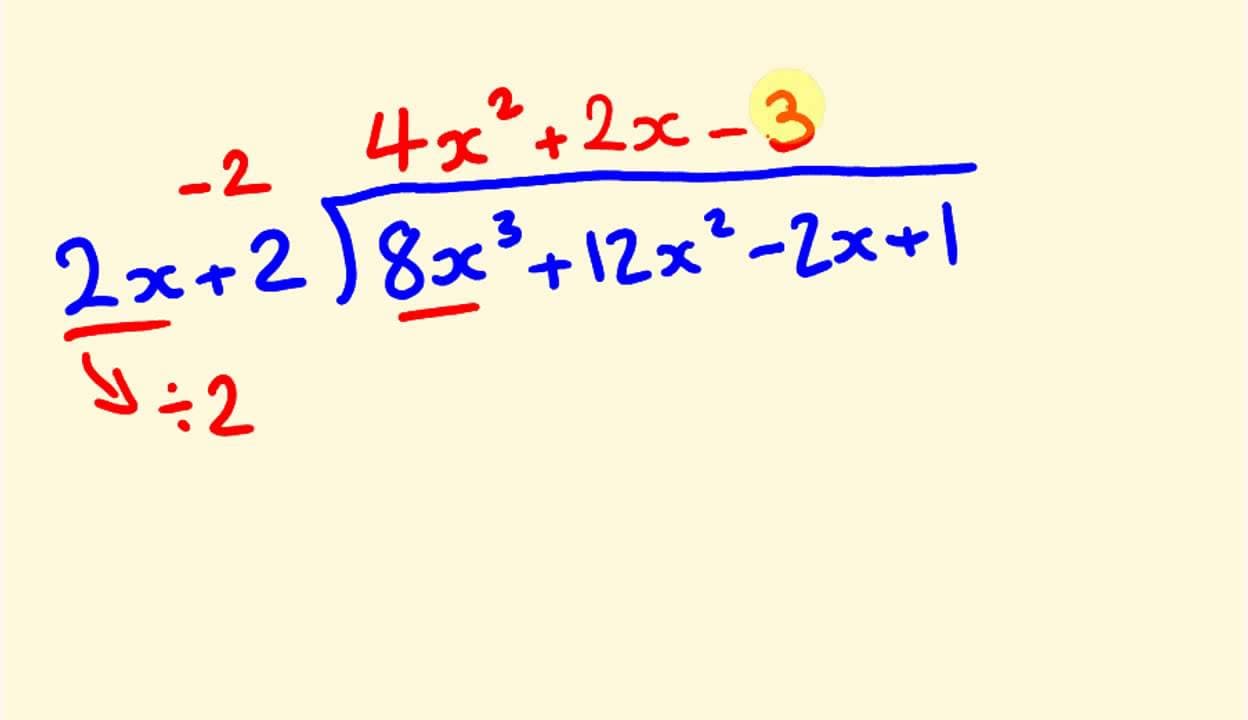
good day and welcome to techmath channel what we're going to be having a look at in this video is this is the second video looking at the direct division of Pol nomials and this is a great little direct division trick rather than having to worry about a long division that typically occurs with pols okay so if you haven't seen the first video lookin... Read More
Key Insights
- ➗ The direct division method is a useful trick for dividing polynomials without the need for lengthy long division.
- 🍉 The method involves finding the number of times the first term of the divisor goes into the first term of the dividend and using the inverse of the second term of the divisor to find the second term of the quotient.
- 🥡 The coefficient of the divisor needs to be taken into account by dividing the quotient by the coefficient.
- 🍉 Remainders can be determined by subtracting the product of the inverse of the second term of the divisor and the quotient from the dividend.
Install to Summarize YouTube Videos and Get Transcripts
Explore YouTube Video Summarizer or Get YouTube Transcript Extractor
Questions & Answers
Q: How does the direct division method for polynomials work?
The direct division method involves finding the number of times the first term of the divisor goes into the first term of the dividend and using the inverse of the second term of the divisor to find the second term of the quotient. The coefficient of the divisor also needs to be considered by dividing the quotient by the coefficient.
Q: What is the purpose of dividing the answer by the coefficient?
Dividing the answer by the coefficient ensures that the quotient is normalized and accounts for the difference in coefficient values between the divisor and dividend.
Q: How does the direct division method handle remainders?
If there is a remainder, it is determined by multiplying the inverse of the second term of the divisor by the quotient and subtracting the result from the dividend. The remaining terms form the remainder.
Q: Why does the power of the variable decrease in the quotient?
The power of the variable decreases in the quotient because the direct division method uses the next power down in each step of the division process. This ensures that the quotient is in the correct form.
Summary & Key Takeaways
-
The video discusses a trick for dividing polynomials using a direct division method.
-
The trick involves finding the number of times the first term of the divisor goes into the first term of the dividend, and then using the inverse of the second term of the divisor to find the second term of the quotient.
-
The coefficient of the divisor also needs to be taken into account by dividing the quotient by the coefficient.
Read in Other Languages (beta)
Share This Summary 📚
Summarize YouTube Videos and Get Video Transcripts with 1-Click
Try YouTube Summary with ChatGPT & Claude or YouTube Transcript Generator
Explore More Summaries from tecmath 📚

Summarize YouTube Videos and Get Video Transcripts with 1-Click
Try YouTube Summary with ChatGPT & Claude or YouTube Transcript Generator