Scarcity of resources
TL;DR
Scarcity in economics refers to the limited availability of resources such as land, labor, capital, and entrepreneurship, which affects how they are combined to produce goods and services.
Transcript
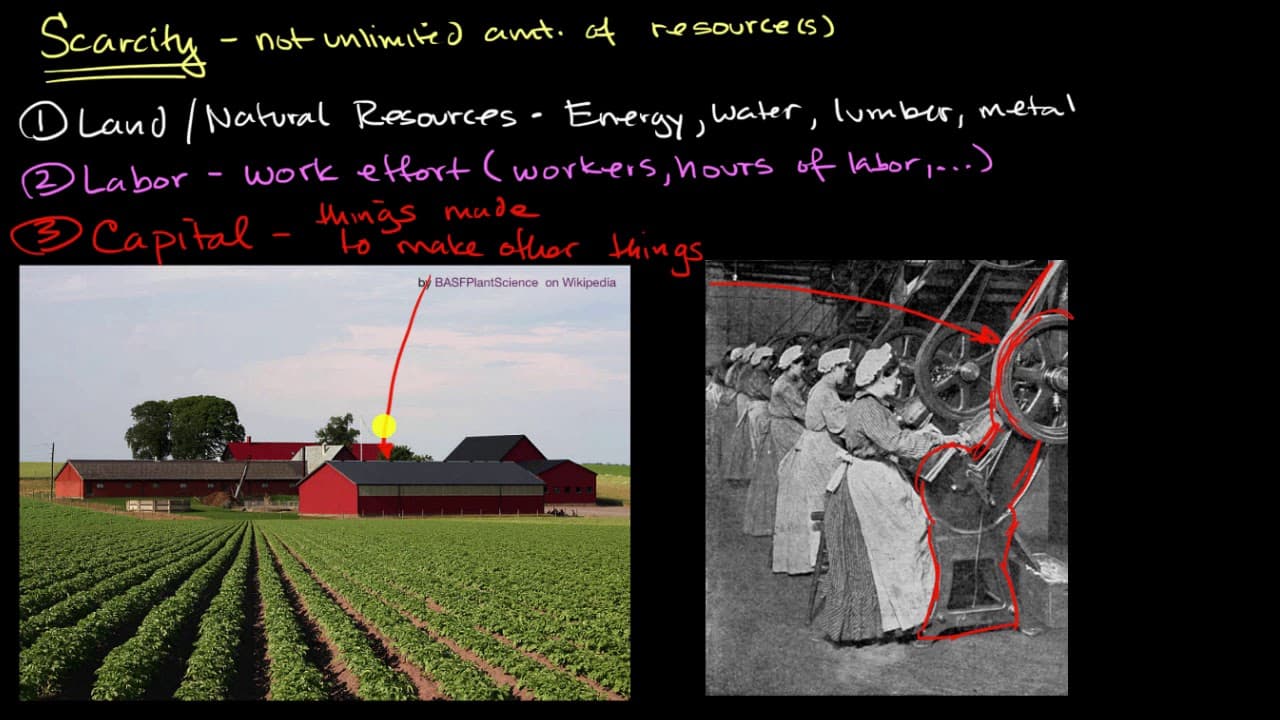
- [Instructor] All of economics is based on this notion of scarcity of resources. What does scarcity mean? Well, in an everyday context, it means that there's not as much of something, say, a resource, as people may need or there's not an unlimited amount of something. So not unlimited unlimited amount of a resource or resources. Resource, and I'll... Read More
Key Insights
- 😌 Scarcity lies at the core of economics, as it influences how resources are allocated, produced, and consumed.
- 🏝️ The four main resources affected by scarcity in economics are land, labor, capital, and entrepreneurship.
- 🧑💼 The limited availability of resources necessitates making choices and trade-offs.
- ❓ The combination of these scarce resources is crucial for economic production and development.
- ⛔ Scarcity is not limited to a specific country or region but applies universally.
- ❓ The concept of scarcity highlights the importance of efficient resource management.
- 🆘 Understanding scarcity helps economists analyze supply and demand dynamics.
Install to Summarize YouTube Videos and Get Transcripts
Explore YouTube Video Summarizer or Get YouTube Transcript Extractor
Questions & Answers
Q: What does scarcity mean in economics?
Scarcity in economics refers to the limited availability of resources compared to the needs and desires of individuals and society. It implies that resources are not infinite and choices must be made regarding their allocation.
Q: What are some examples of natural resources affected by scarcity?
Natural resources impacted by scarcity include energy sources such as oil and gas, water, timber, minerals like gold and iron ore, and land itself. These resources have finite quantities, and their availability may vary geographically.
Q: How is labor considered a scarce resource?
Labor is considered a scarce resource because there is a finite number of people available to work. The number of hours that individuals can dedicate to work is limited, and different skills and abilities add further complexity to labor scarcity.
Q: What is the role of entrepreneurship in scarcity?
Entrepreneurship refers to the ability to combine land, labor, and capital effectively to produce goods and services. It involves making decisions about resource allocation and risk-taking. In the context of scarcity, entrepreneurship plays a vital role in optimizing resource utilization and finding innovative solutions.
Summary & Key Takeaways
-
Economics is based on the concept of scarcity, which means there is a limited amount of resources compared to the needs and wants of people.
-
Scarcity affects various resources, including land (natural resources), labor (work effort), capital (tools, buildings, infrastructure), and entrepreneurship (the ability to combine resources).
-
The scarcity of these resources influences how they are utilized and combined to create goods and services.
Read in Other Languages (beta)
Share This Summary 📚
Summarize YouTube Videos and Get Video Transcripts with 1-Click
Try YouTube Summary with ChatGPT & Claude or YouTube Transcript Generator
Explore More Summaries from Khan Academy 📚



Summarize YouTube Videos and Get Video Transcripts with 1-Click
Try YouTube Summary with ChatGPT & Claude or YouTube Transcript Generator