Economic profit for firms in perfectly competitive markets
TL;DR
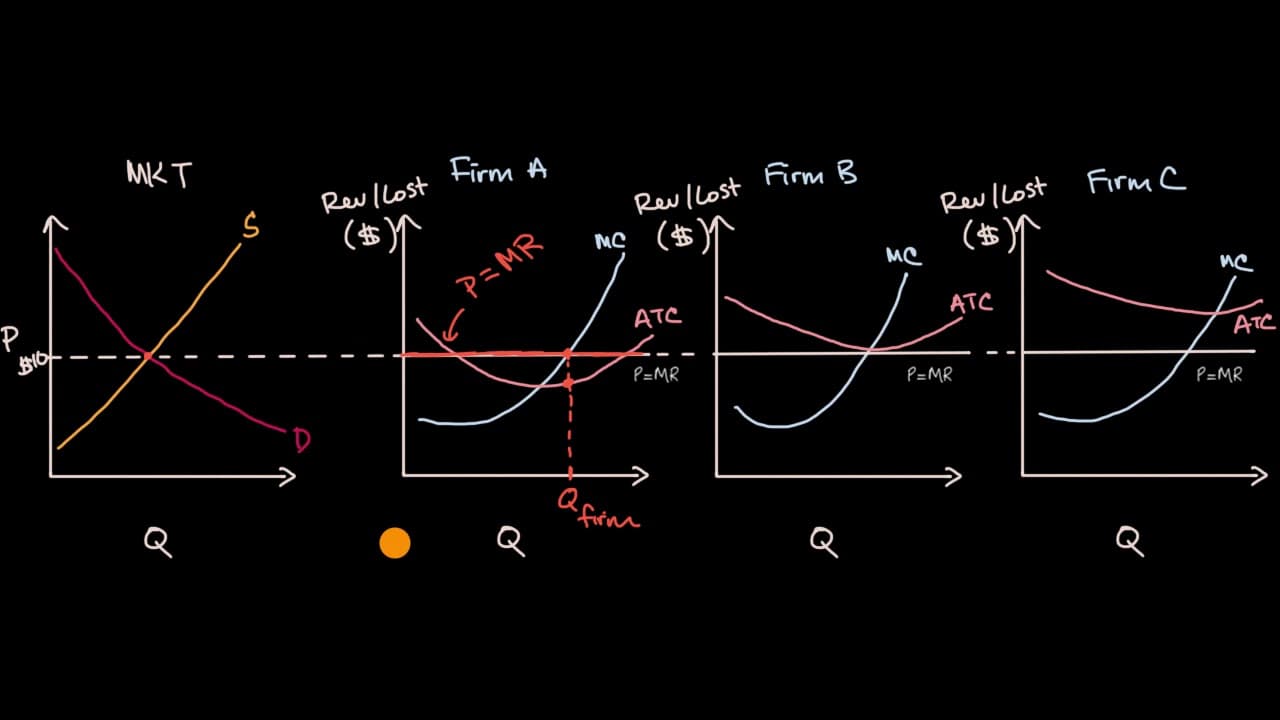
Perfectly competitive markets are characterized by firms being price-takers and producing at a quantity where marginal cost equals marginal revenue. Economic profit or loss depends on the average total cost at that quantity.
Transcript
- [Instructor] In this video, we're going to dig a little bit deeper into the notion of perfectly competitive markets. So we're gonna think about under what scenarios a firm would make an economic profit or an economic loss in them. Now as a reminder, these perfectly competitive markets are something of a theoretical ideal. There's few markets in t... Read More
Key Insights
- 🌍 Perfectly competitive markets are an idealized concept with few real-world examples.
- 🟰 Firms in perfectly competitive markets are price-takers and produce at a quantity where marginal cost equals marginal revenue, which is equal to the market price.
- 🌸 Economic profit or loss in perfectly competitive markets is determined by the difference between price (marginal revenue) and average total cost at the rational quantity.
Install to Summarize YouTube Videos and Get Transcripts
Explore YouTube Video Summarizer or Get YouTube Transcript Extractor
Questions & Answers
Q: What are the characteristics of perfectly competitive markets?
Perfectly competitive markets have undifferentiated products, no barriers to entry or exit, and firms that are price-takers, meaning they take the market price for their products.
Q: How do firms determine the rational quantity to produce in perfectly competitive markets?
Firms produce at a quantity where marginal cost equals marginal revenue, which is equal to the market price. They choose this quantity to maximize their profit.
Q: What determines whether a firm in a perfectly competitive market makes an economic profit or loss?
The average total cost at the rational quantity determines economic profit or loss. If the price (marginal revenue) is higher than the average total cost, the firm makes an economic profit. If it is lower, the firm incurs an economic loss.
Q: What happens to firms in the long run in perfectly competitive markets?
In the long run, firms in perfectly competitive markets have the flexibility to enter or exit the market. If a firm is unable to cover its fixed costs and achieve economic profit, it would likely exit the market.
Summary & Key Takeaways
-
Perfectly competitive markets are theoretical in nature, with no product differentiation or barriers to entry or exit. Price is determined by market supply and demand, and firms are price-takers.
-
Firms in perfectly competitive markets produce at a quantity where marginal cost equals marginal revenue, which is equal to the market price. This is the rational quantity for them to produce.
-
Economic profit or loss for a firm in a perfectly competitive market is determined by the difference between price (marginal revenue) and average total cost at the rational quantity.
Read in Other Languages (beta)
Share This Summary 📚
Summarize YouTube Videos and Get Video Transcripts with 1-Click
Try YouTube Summary with ChatGPT & Claude or YouTube Transcript Generator
Explore More Summaries from Khan Academy 📚



Summarize YouTube Videos and Get Video Transcripts with 1-Click
Try YouTube Summary with ChatGPT & Claude or YouTube Transcript Generator