Nazi aggression and appeasement | The 20th century | World history | Khan Academy
TL;DR
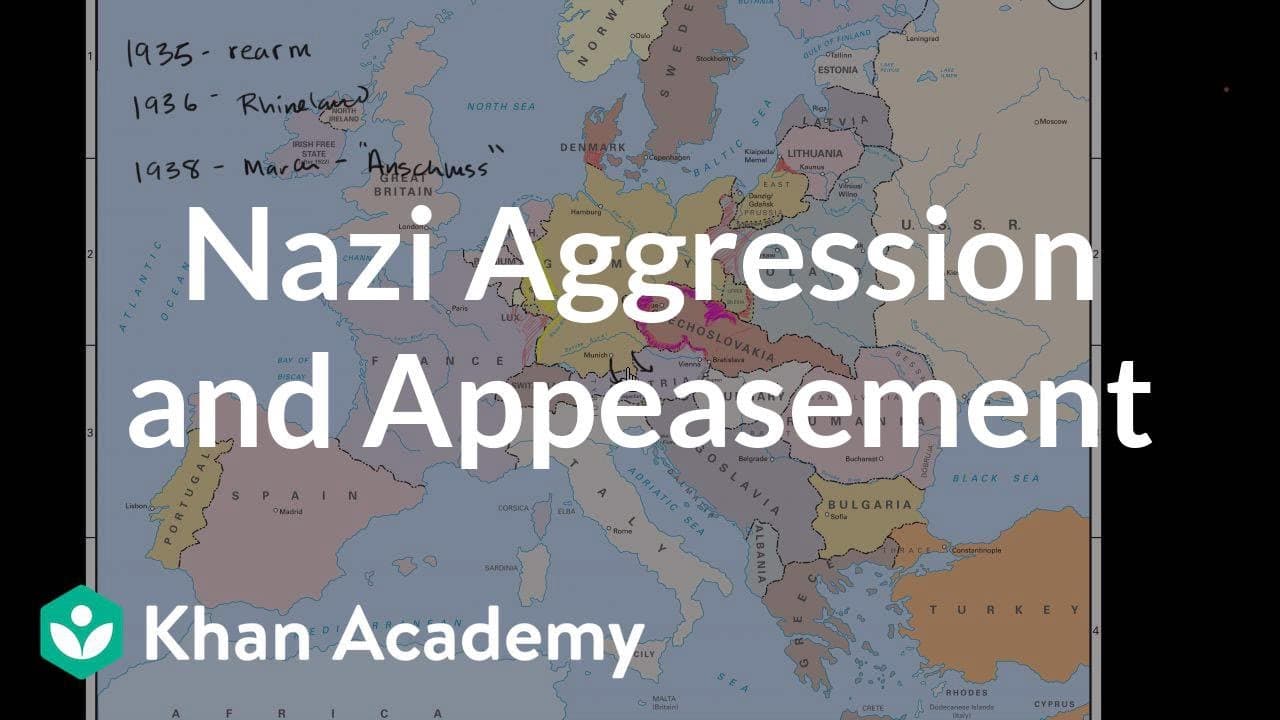
In the 1930s, Germany aggressively violated the Treaty of Versailles and expanded its territory, while other European powers followed a policy of appeasement to avoid another war.
Transcript
As we get into the second half of the 1930s, we see an increasingly aggressive Nazi Germany. In 1935, they publicly announce their intent to rearm their military. The reason why this is significant is not that they were all of a sudden building their military. They, in fact, were doing this as soon as they had taken power, in 1933. But now, they fe... Read More
Key Insights
- ✊ Germany began rearming its military shortly after coming to power, but in the 1930s, they openly defied the Treaty of Versailles.
- 🇦🇹 The occupation of the Rhineland in 1936 and the unification with Austria in 1938 were both violations of the treaties.
- 👻 The Munich Agreement in 1938 allowed Germany to annex the Sudetenland region of Czechoslovakia, further expanding their control.
Install to Summarize YouTube Videos and Get Transcripts
Explore YouTube Video Summarizer or Get YouTube Transcript Extractor
Questions & Answers
Q: How did Germany violate the Treaty of Versailles in the 1930s?
Germany began rearming its military as soon as they came to power in 1933, and in 1935, they publicly announced their intention to do so, disregarding the treaty's limitations on their military capabilities.
Q: What did Germany do in 1936 that violated the Treaty of Versailles?
In 1936, Hitler's Germany ignored the treaty's prohibition on occupying the Rhineland and proceeded to take control of the region, going against agreements made in the Treaties of Locarno.
Q: What was the Munich Agreement, and what did it lead to?
The Munich Agreement, signed in 1938, allowed Germany to annex the Sudetenland region of Czechoslovakia without consulting the Czechoslovakian government. This gave Germany more territory and industrial capacity.
Q: How did German aggression and the policy of appeasement contribute to the start of World War II?
The aggression displayed by Germany, coupled with the appeasement policy of other European powers like Great Britain, allowed Germany to become more confident and ultimately led to the invasion of Poland in 1939, triggering the start of World War II.
Summary & Key Takeaways
-
In the mid-1930s, Nazi Germany publicly announced its intent to rearm its military and violated the Treaty of Versailles by occupying the Rhineland.
-
In 1938, Germany forcefully unified with Austria, and later that year, it was allowed to annex the Sudetenland region of Czechoslovakia through the Munich Agreement.
-
The pattern of German aggression and the policy of appeasement from other European powers culminated in the invasion of Poland in 1939, marking the start of World War II.
Read in Other Languages (beta)
Share This Summary 📚
Summarize YouTube Videos and Get Video Transcripts with 1-Click
Try YouTube Summary with ChatGPT & Claude or YouTube Transcript Generator
Explore More Summaries from Khan Academy 📚



Summarize YouTube Videos and Get Video Transcripts with 1-Click
Try YouTube Summary with ChatGPT & Claude or YouTube Transcript Generator