Put payoff diagram | Finance & Capital Markets | Khan Academy
TL;DR
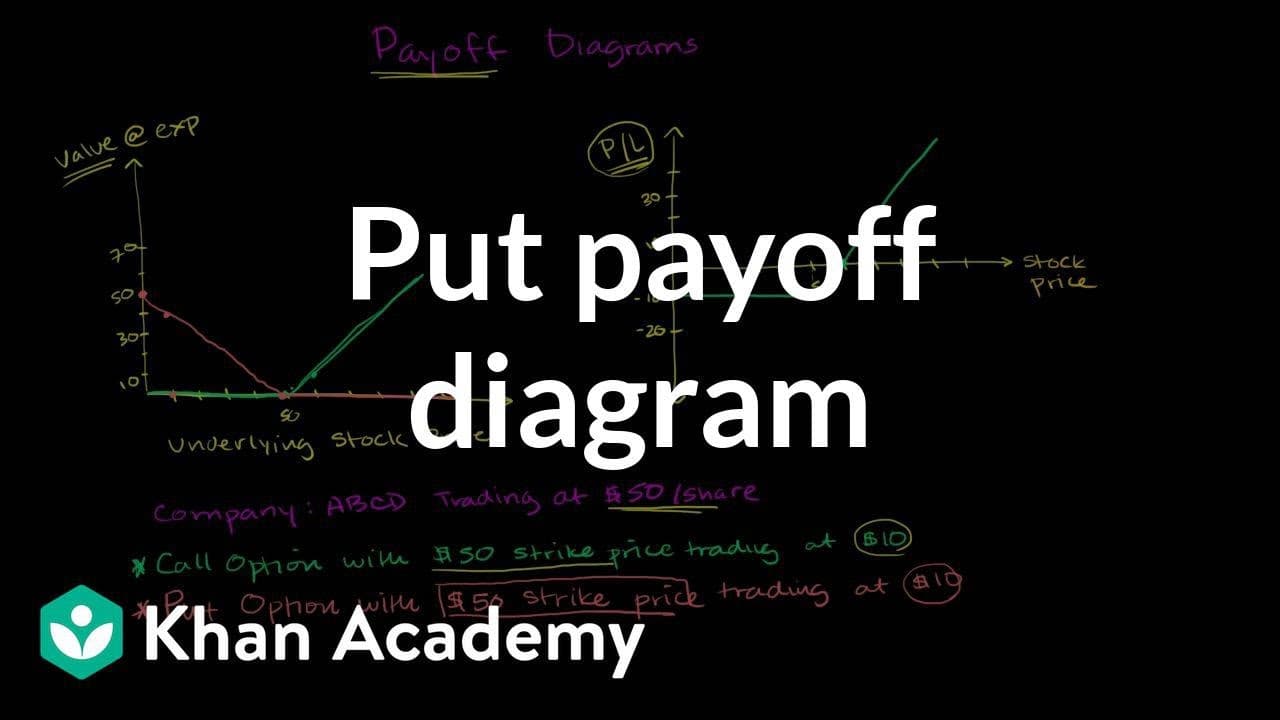
This content explains how to draw a payoff diagram for a put option with a $50 strike price and analyzes the value of the option at different stock prices.
Transcript
We have company ABCD trading at $50 a share Let's draw a payoff diagram for a put option with a $50 strike price trading at $10 So once again we get to draw two types of payoff diagrams One type that only cares about the value of the option at expiration. This is what you tend to see in academic settings like business schools or textbooks. And the ... Read More
Key Insights
- 🙃 Payoff diagrams illustrate the potential profit or loss from owning a put option at different stock prices.
- ❓ The value of a put option increases as the stock price decreases, offering protection against a declining stock price.
- 🟰 If the stock price is equal to the strike price, the put option may not be exercised as it would result in a loss equal to the option price.
- 😚 Put options lose value as the stock price rises above the strike price, becoming worthless when the stock price exceeds the strike price.
Install to Summarize YouTube Videos and Get Transcripts
Explore YouTube Video Summarizer or Get YouTube Transcript Extractor
Questions & Answers
Q: How is the value of a put option calculated at expiration when the stock price is $0?
When the stock price is $0, the put option is valuable as it allows buying the stock for $0 and selling it for the strike price of $50. Therefore, the put option is worth $50.
Q: What happens to the value of a put option as the stock price increases?
The value of the put option decreases as the stock price increases. The option becomes less attractive as it allows selling the stock at a lower price than the current market value.
Q: Why would someone exercise a put option when the stock price equals the strike price?
When the stock price equals the strike price, the put option becomes worthless. However, if the option was purchased for a price (e.g., $10), not exercising it would result in a loss, so it is better to exercise the option and limit the loss to the price paid.
Q: What happens to the put option value if the stock price goes above $50?
If the stock price exceeds $50, the put option becomes worthless. It is not logical to exercise the option and sell the stock at $50 when it can be sold at a higher market price.
Summary & Key Takeaways
-
The content discusses two types of payoff diagrams for put options: one that only considers the option value at expiration and one that incorporates the price paid for the option.
-
A put option gives the right to sell the stock at $50. If the stock price is $0 at expiration, the put option is worth $50 as it allows buying the stock for $0 and selling it for $50.
-
As the stock price increases, the value of the put option decreases. If the stock price exceeds $50, the put option becomes worthless.
Read in Other Languages (beta)
Share This Summary 📚
Summarize YouTube Videos and Get Video Transcripts with 1-Click
Try YouTube Summary with ChatGPT & Claude or YouTube Transcript Generator
Explore More Summaries from Khan Academy 📚



Summarize YouTube Videos and Get Video Transcripts with 1-Click
Try YouTube Summary with ChatGPT & Claude or YouTube Transcript Generator