Developing an American identity, 1800-1848 | US history | Khan Academy
TL;DR
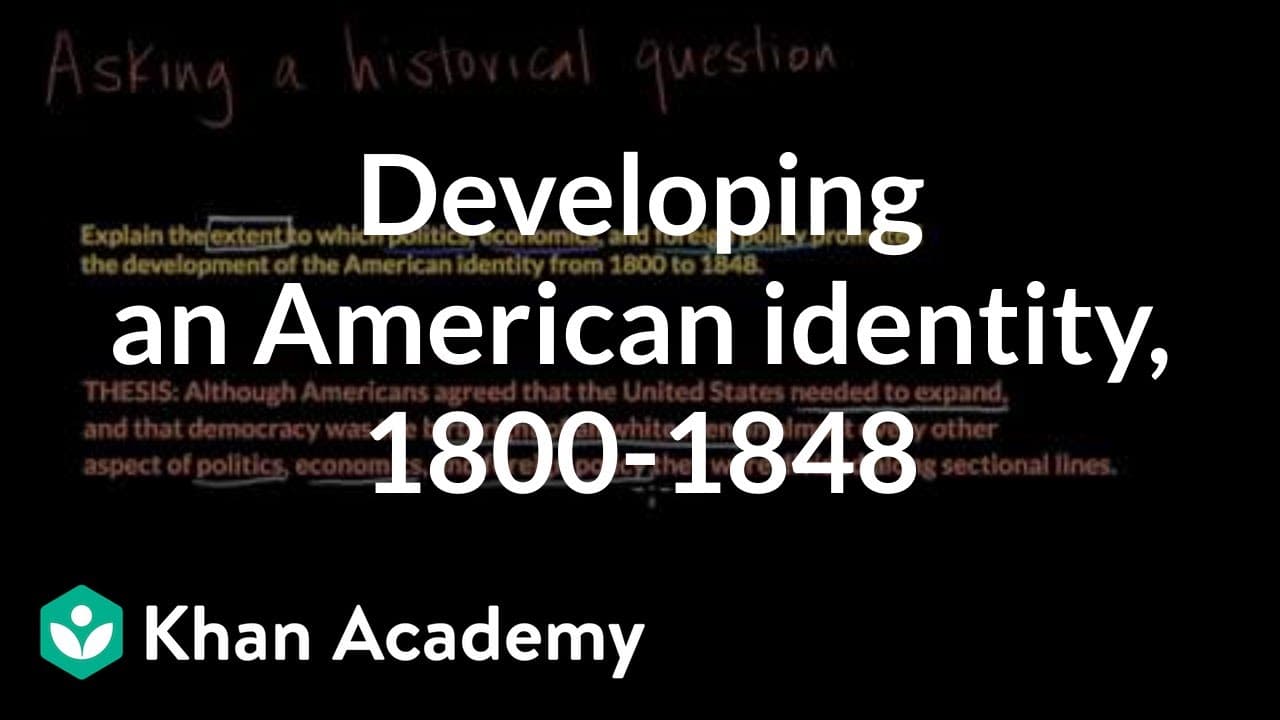
Despite some points of unity such as the expansion of democracy and the desire for territorial expansion, the period from 1800 to 1848 saw a divided regional identity in the United States due to political, economic, and foreign policy differences.
Transcript
- [Instructor] In this video I want to take a look back at the period from 1800 to 1848, kinda from a bird's eye view. This is a huge time in American history. In 1800, the United States was just a fledgling nation, less than 20 years out from winning its independence. Political parties were in their infancy, infrastructure was practically non-exis... Read More
Key Insights
- 🇺🇸 The United States experienced significant growth and development from 1800 to 1848.
- 🥳 Political parties, the expansion of the right to vote, and political controversies highlighted regional divisions.
- 🗂️ Separate economic systems, disputes over tariffs, and the Market Revolution further contributed to a divided regional identity.
Install to Summarize YouTube Videos and Get Transcripts
Explore YouTube Video Summarizer or Get YouTube Transcript Extractor
Questions & Answers
Q: How did political parties contribute to the development of American identity during this period?
Political parties both promoted unity and division. While they weren't exclusively defined by region, they often focused on the balance of power between the Federal Government and states, leading to regional conflicts.
Q: Did economic differences play a role in the development of a divided regional identity?
Yes, separate economic systems in the North and South, controversies over tariffs favoring the North, and the Market Revolution, which primarily connected the North and West, all contributed to a divided regional identity.
Q: How did foreign policy events impact American identity during this time?
The War of 1812 increased a shared sense of patriotism, while westward expansion and conflicts with Native Americans and Mexico led to division, as it threatened the balance of power between free and slave states in Congress.
Q: Overall, did the evidence suggest a unified American identity or a divided regional identity?
The evidence points towards a divided regional identity, with some points of unity. Americans generally agreed on territorial expansion and democracy for white men, but most other aspects of politics, economics, and foreign policy were divided along sectional lines.
Summary & Key Takeaways
-
In the period from 1800 to 1848, the United States experienced significant growth and development as a nation.
-
Political parties emerged, the right to vote was expanded, and political controversies such as the Missouri Compromise and Nullification Crisis took place.
-
Economically, there was a Market Revolution, disputes over tariffs, and a growing divide between the North and South. In terms of foreign policy, there was the War of 1812 and westward expansion, leading to conflicts with Native Americans and Mexico.
Read in Other Languages (beta)
Share This Summary 📚
Summarize YouTube Videos and Get Video Transcripts with 1-Click
Try YouTube Summary with ChatGPT & Claude or YouTube Transcript Generator
Explore More Summaries from Khan Academy 📚



Summarize YouTube Videos and Get Video Transcripts with 1-Click
Try YouTube Summary with ChatGPT & Claude or YouTube Transcript Generator