Adding protected routes in Next (Next-Auth and getServerSideProps)
TL;DR
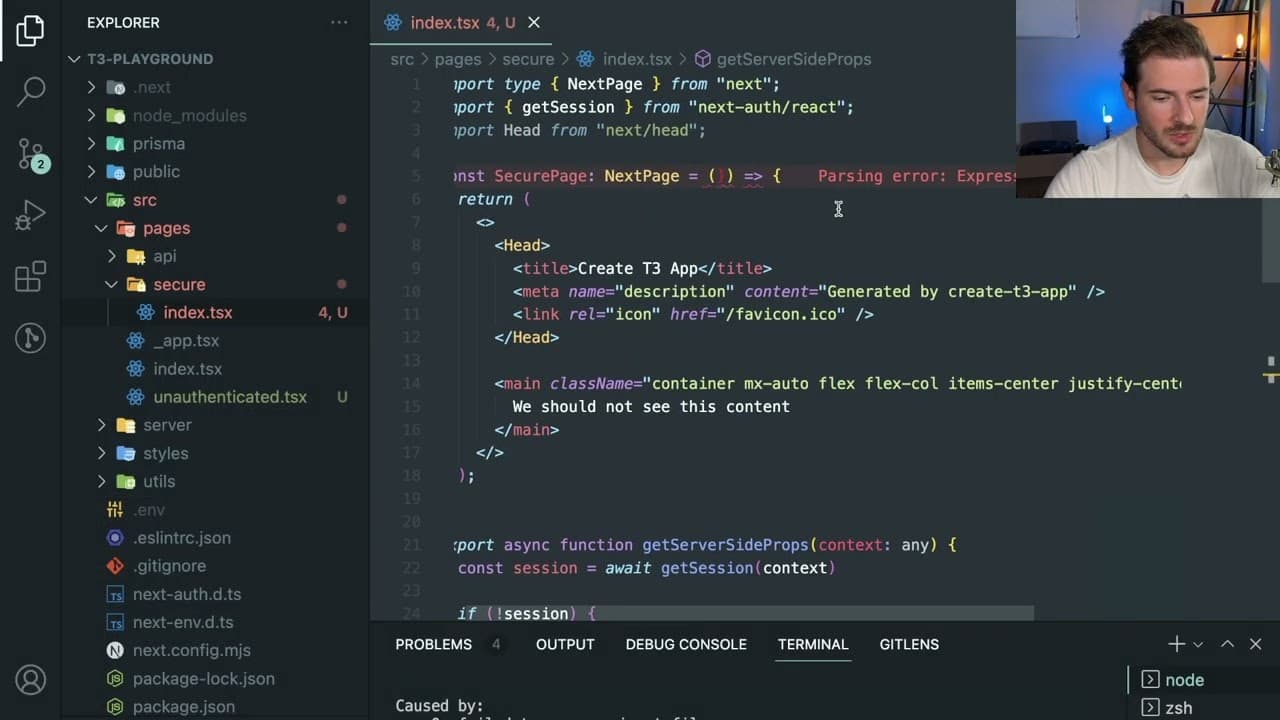
Protect a Next.js route with NextAuth database sessions by calling getSession inside getServerSideProps and redirecting visitors whose session is not set. The redirect should use permanent: false so the browser does not cache the location and the check runs again. You can also extract this logic into a reusable requireAuthentication helper; read on for the implementation details and the JWT-session alternative.
Transcript
all right so someone in my discord youtube comments was asking how can i set up a guard to kind of protect a certain route in next js he's also using next auth and i do want to say that if you're using jwt sessions you might be able to use this middleware function which is kind of newer in react 12. but there is a caveat if you scroll down to the b... Read More
Key Insights
- 👤 Next.js with NextAuth provides robust methods for user authentication, crucial for securing routes and managing access efficiently.
- 👋 Understanding the differences between JWT and database sessions is essential for leveraging the best practices in user authentication.
- 🎮 The
getServerSidePropsmethod plays a critical role in evaluating user sessions during the request process, allowing for real-time access control. - 👨💻 Reusable authentication functions can streamline code and reduce redundancy in managing route security across a web application.
- 👤 Redirecting users based on authentication status helps ensure that pages remain secure, providing a seamless user experience.
- 🦔 Edge computing creates unique challenges for session management, particularly with database sessions, indicating a need for ongoing technological advancements.
- 👥 Engaging with programming communities, such as Discord groups, fosters collaboration and provides valuable support for developers at all levels.
Install to Summarize YouTube Videos and Get Transcripts
Explore YouTube Video Summarizer or Get YouTube Transcript Extractor
Questions & Answers
Q: How do you protect a Next.js route with NextAuth and getServerSideProps?
Export getServerSideProps, call NextAuth’s getSession with its context, and check whether a session is set. If it is not set, return an object containing a redirect; otherwise, return the result needed to render the protected page.
Q: How does getSession help protect a Next.js page?
getSession retrieves the user’s current session. Passing the getServerSideProps context to it lets the server decide during the request whether to show the page or redirect the visitor.
Q: What should happen when a visitor has no NextAuth session?
Return a redirect object from getServerSideProps when the session is not set. In the demonstrated setup, attempts to open the secure page redirect the visitor back to the authenticated page.
Q: Why should permanent be false in the redirect object?
Set permanent to false because the browser should not cache the redirected URL location. This allows the application to recompute the session check rather than continuing to use a cached redirect.
Q: Can the session be returned from getServerSideProps?
Yes, the session can be returned if the page needs to use it. The demonstrated protected page does not need the session data after the authentication check, so it is not used there.
Q: How can the authentication check be reused across protected pages?
Move the repeated logic into a utility such as requireAuthentication. The helper can accept the request context and a callback, return the redirect when no session exists, and call the callback when the session is set.
Q: Can NextAuth middleware protect routes that use JWT sessions?
The transcript says a newer middleware approach can be used with JWT sessions. It can use a matcher to redirect people who are not logged in and can support a custom authorization check for conditions such as a user role.
Q: Why is the middleware approach not used with database sessions here?
The demonstrated application uses normal database sessions, while the described middleware approach only works for JWT sessions. The transcript explains that the edge technology involved is not yet sufficiently compatible with the database-session approach, so getServerSideProps is used instead.
Summary & Key Takeaways
-
This content demonstrates how to securely manage access to specific routes in a Next.js application utilizing NextAuth for handling user authentication.
-
It explains the differences between using JWT sessions and database sessions, detailing why certain methods may not be compatible with all setups, particularly related to edge computing.
-
The video walks through practical coding examples, showing how to implement server-side session checks and create reusable authentication functions to streamline secure access across pages.
Read in Other Languages (beta)
Share This Summary 📚
Summarize YouTube Videos and Get Video Transcripts with 1-Click
Try YouTube Summary with ChatGPT & Claude or YouTube Transcript Generator
Explore More Summaries from Web Dev Cody 📚

Summarize YouTube Videos and Get Video Transcripts with 1-Click
Try YouTube Summary with ChatGPT & Claude or YouTube Transcript Generator