Exocytosis | Membranes and transport | Biology | Khan Academy
TL;DR
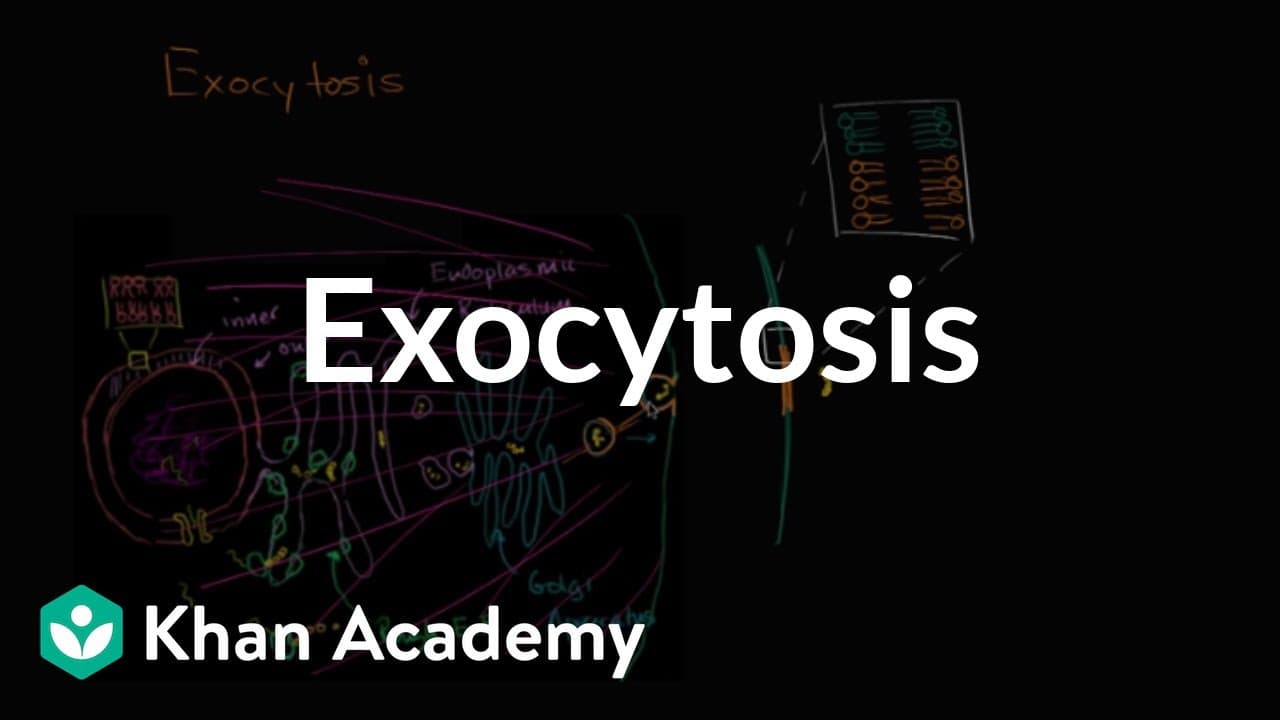
Exocytosis is the process by which cells release molecules, and it involves the merging of vesicles with the cell's outer membrane.
Transcript
- Let's talk a little bit about exocytosis, which is how the cell is able to release larger molecules that might be used by the rest of the body. Other cells, or maybe it's going to be part of the extracellular matrix. And to understand how this works, it's really the reverse of endocytosis, we're going to go and produce some proteins in the endopl... Read More
Key Insights
- ◀️ Exocytosis is the process by which cells release molecules or components, and it is the reverse of endocytosis.
- ❓ Proteins are produced in the endoplasmic reticulum and processed in the Golgi apparatus before being released through exocytosis.
- 👻 The merging of vesicles with the cell's plasma membrane allows for the release of their contents.
- 🧑🦼 Exocytosis is not a chaotic process; vesicles can be transported along the cell's cytoskeleton using motor proteins.
Install to Summarize YouTube Videos and Get Transcripts
Explore YouTube Video Summarizer or Get YouTube Transcript Extractor
Questions & Answers
Q: What is exocytosis and how does it differ from endocytosis?
Exocytosis is the cellular process of releasing molecules or components, while endocytosis is the process of internalizing substances into the cell. Exocytosis involves merging vesicles with the cell's outer membrane, while endocytosis involves the formation of vesicles from the cell membrane.
Q: How are proteins processed during exocytosis?
Proteins are initially produced in the endoplasmic reticulum and transported in vesicles to the Golgi apparatus. In the Golgi apparatus, they undergo further processing before being packaged into new vesicles for exocytosis.
Q: What is the significance of exocytosis in the body?
Exocytosis plays a crucial role in various cellular functions, such as releasing proteins and lipids to be used by the body or extracellular matrix. It is also important in neuronal communication, as neurotransmitters are released through exocytosis to trigger signals in neighboring neurons.
Q: How are vesicles transported during exocytosis?
Vesicles can be transported along microtubules and other components of the cell's cytoskeleton. Motor proteins, fueled by ATP, actively push the vesicles towards the cell's outer membrane for fusion and release.
Summary & Key Takeaways
-
Exocytosis is the reverse of endocytosis and enables cells to release larger molecules or components to be used by the body or extracellular matrix.
-
Proteins are produced in the endoplasmic reticulum, and then transported in vesicles to the Golgi apparatus where further processing occurs.
-
Vesicles bud off from the Golgi apparatus and merge with the cell's plasma membrane, releasing their contents.
Read in Other Languages (beta)
Share This Summary 📚
Summarize YouTube Videos and Get Video Transcripts with 1-Click
Try YouTube Summary with ChatGPT & Claude or YouTube Transcript Generator
Explore More Summaries from Khan Academy 📚



Summarize YouTube Videos and Get Video Transcripts with 1-Click
Try YouTube Summary with ChatGPT & Claude or YouTube Transcript Generator