What Caused the Cuban Missile Crisis in 1962?
TL;DR
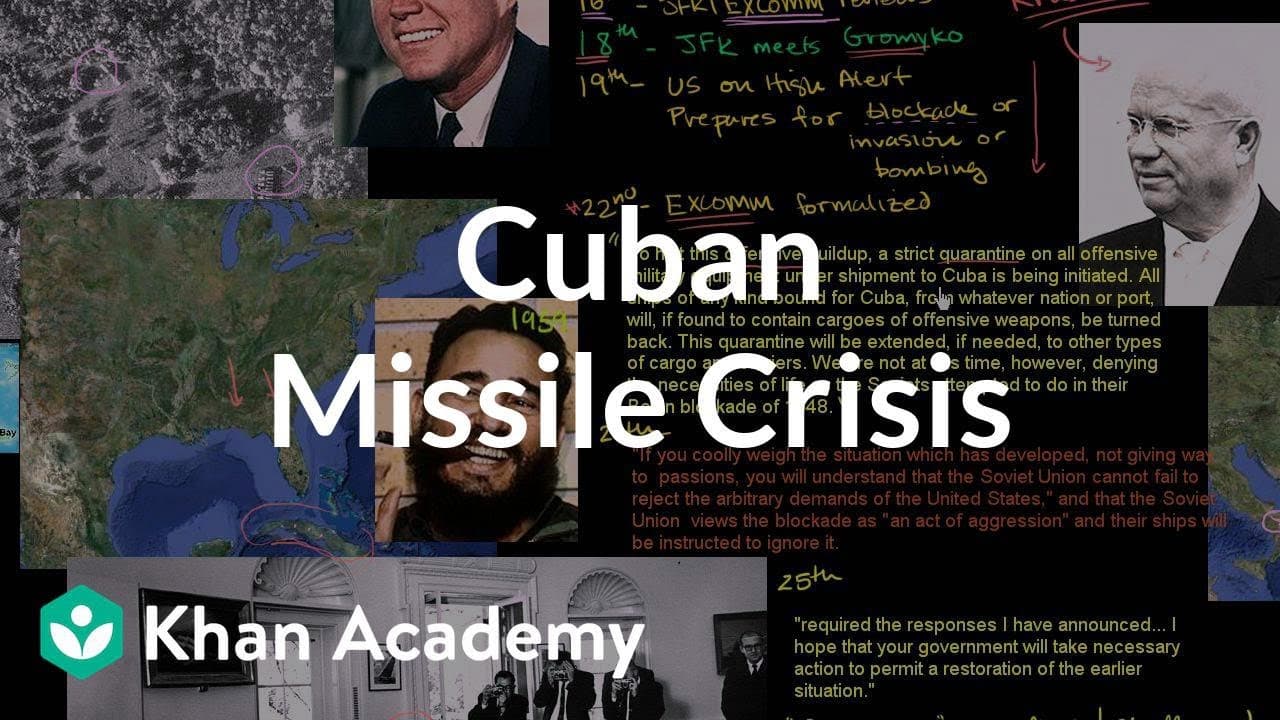
The Cuban Missile Crisis arose in 1962 when the U.S. discovered Soviet missiles in Cuba, triggered by the failed Bay of Pigs invasion and U.S. missiles in Turkey. This led to intense negotiations between the U.S. and the Soviet Union, culminating in a strategy combining military preparedness and diplomatic resolution to prevent a nuclear conflict.
Transcript
Before we go into the details of the Cuban Missile Crisis, it's important to understand the world's environment entering into October of 1962. In 1959, you have a revolution in Cuba led by Fidel Castro. And he is heading the Communist party there. Cuba is now a Communist nation right off of the coast of the United States. This is the middle of the ... Read More
Key Insights
- 🤨 The failed Bay of Pigs invasion weakened the US position and raised tensions during the Cold War.
- 🇨🇺 The placement of missiles in Cuba was a strategic move by the USSR to counterbalance US missiles in Turkey and Italy.
- 👊 The Kennedy administration considered various options, including a blockade, air attacks, and invasion, but opted for negotiations to resolve the crisis.
Install to Summarize YouTube Videos and Get Transcripts
Explore YouTube Video Summarizer or Get YouTube Transcript Extractor
Questions & Answers
Q: How did the failure of the Bay of Pigs invasion impact the United States' perception?
The failed invasion made the US look weak and raised doubts about their competence in dealing with the Cuban situation, especially during the ongoing Cold War.
Q: Why did the USSR place missiles in Cuba?
The USSR placed missiles in Cuba to deter any potential invasion or attack on Cuba, as well as create a strategic balance with US missiles in Turkey and Italy.
Q: What were the main options considered by the Kennedy administration to address the missile crisis?
The options considered were a blockade of Cuba, air attacks on the missile sites, and a full-scale invasion of Cuba to remove the missiles and overthrow Fidel Castro's regime.
Q: How did both sides eventually reach an agreement?
The US publicly agreed not to invade Cuba, while privately agreeing to remove their missiles from Turkey and Italy. The USSR agreed to remove their missiles from Cuba. Both sides wanted to appear strong, but compromise was necessary to prevent further escalation.
Summary & Key Takeaways
-
The United States attempted to invade Cuba in 1961 but failed, making them appear weak and inept.
-
The USSR placed missiles in Cuba to counterbalance US missiles in Turkey and Italy, causing tensions to rise.
-
President Kennedy and his advisors considered options such as a blockade, air attacks, and invasion of Cuba, weighing the potential consequences.
Read in Other Languages (beta)
Share This Summary 📚
Summarize YouTube Videos and Get Video Transcripts with 1-Click
Try YouTube Summary with ChatGPT & Claude or YouTube Transcript Generator
Explore More Summaries from Khan Academy 📚



Summarize YouTube Videos and Get Video Transcripts with 1-Click
Try YouTube Summary with ChatGPT & Claude or YouTube Transcript Generator