Letter from a Birmingham Jail | US government and civics | Khan Academy
TL;DR
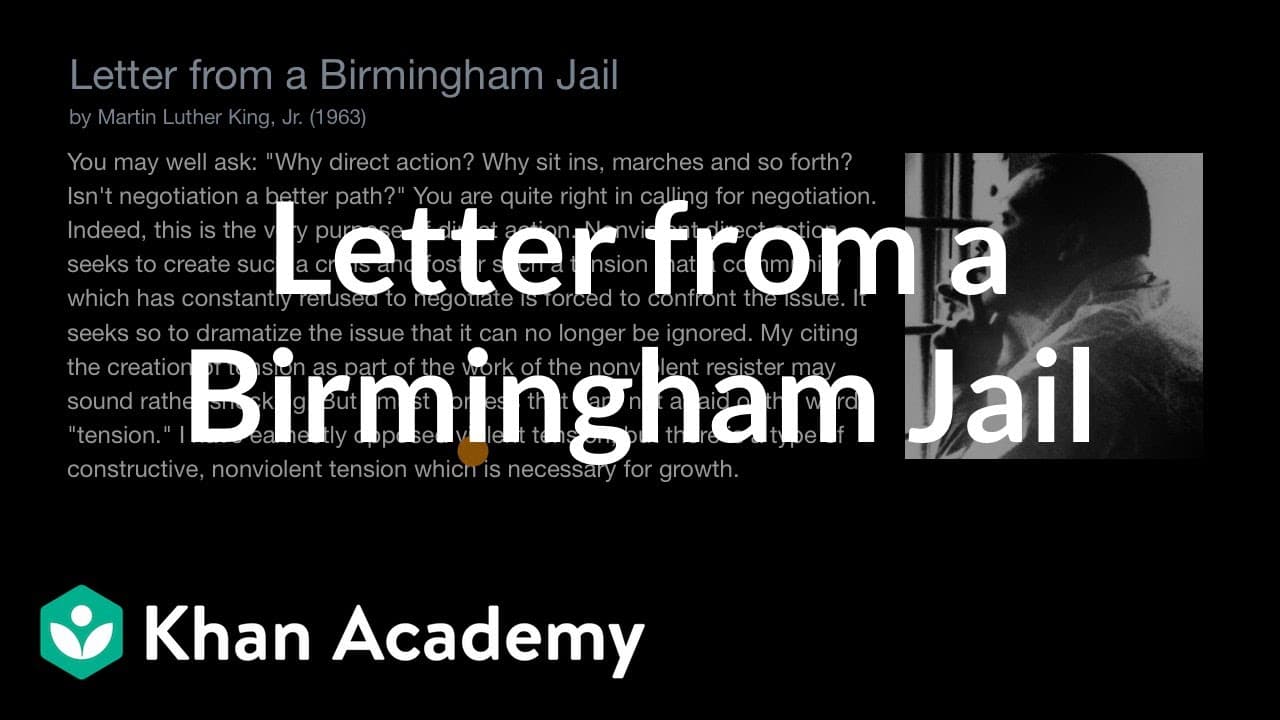
Martin Luther King's letter from a Birmingham jail highlights the importance of nonviolent direct action and creating tension to bring about change.
Transcript
- [Narrator] What we're going to read together in this video is what has become known as Martin Luther King's Letter from a Birmingham Jail, which he wrote from a jail cell in 1963 after he and several of his associates were arrested in Birmingham, Alabama as they nonviolently protested segregation there. And, I'm going to read an excerpt of it. I ... Read More
Key Insights
- 📜 Martin Luther King's Letter from a Birmingham Jail is a powerful document that highlights the philosophical underpinnings of the Civil Rights Movement.
- 📁 Nonviolent direct action and creating tension were central to King's strategies for effecting change.
- 💌 The letter played a significant role in influencing the Civil Rights Act of 1964 passed by Congress.
- 👨⚖️ King's personal experiences and observations of systemic racism and discrimination motivated his advocacy for immediate action and justice.
- 💌 The letter challenged the notion of waiting for change through legal channels and emphasized the urgency for addressing racial injustices.
- 🖐️ King's exceptional writing skills and ability to articulate his arguments played a crucial role in inspiring and mobilizing supporters.
- 💌 The letter serves as a reminder of the enduring importance of activism, nonviolent resistance, and the power of words in the pursuit of justice.
Install to Summarize YouTube Videos and Get Transcripts
Explore YouTube Video Summarizer or Get YouTube Transcript Extractor
Questions & Answers
Q: Why did Martin Luther King write the Letter from a Birmingham Jail?
King wrote the letter in response to eight Alabama clergymen who encouraged protesters to wait for resolution through the courts rather than engaging in protests and tension. He wanted to explain the importance of direct action and highlight the urgency of addressing the issue of segregation.
Q: How did Martin Luther King define nonviolent direct action?
King believed that nonviolent direct action involved creating a crisis and fostering tension in society. This strategy aimed to push communities that had consistently refused to negotiate into confronting and resolving the issue at hand. It sought to make the issue impossible to ignore.
Q: What role did tension play in King's approach?
King saw tension as necessary for growth and progress. He distinguished between violent tension, which he opposed, and constructive, nonviolent tension. This tension aimed to challenge societal norms and bring about change, just as Socrates believed it was necessary to create tension in the mind for individuals to rise above myths and prejudices.
Q: How did personal experiences shape King's views on waiting?
King shared personal experiences of witnessing violence, discrimination, and injustice towards Black individuals, including lynching, police brutality, and poverty. He described the daily humiliations and restrictions faced by African Americans, emphasizing that the urgency for change made waiting for justice and equality impossible.
Summary & Key Takeaways
-
Martin Luther King wrote the letter from a Birmingham jail after being arrested during a nonviolent protest against segregation.
-
The letter responds to Alabama clergymen who advised patience and legal action instead of protests.
-
King argues that nonviolent direct action and tension are necessary to force communities to confront and address issues of injustice.
Read in Other Languages (beta)
Share This Summary 📚
Summarize YouTube Videos and Get Video Transcripts with 1-Click
Try YouTube Summary with ChatGPT & Claude or YouTube Transcript Generator
Explore More Summaries from Khan Academy 📚



Summarize YouTube Videos and Get Video Transcripts with 1-Click
Try YouTube Summary with ChatGPT & Claude or YouTube Transcript Generator