Characteristics Of Complex Ions - Co-Ordination Compounds - Chemistry Class 12
TL;DR
Complex ions are formed by transition metals, which exhibit multiple oxidation states and have suitable orbitals for ligands to donate electrons. They lose their individual properties and acquire new ones when forming a complex.
Transcript
click the bell icon to get latest videos from akira hello friends in the previous topic we have discussed about the types of ligands and types of complexes so now in this topic let me talk about the characteristic of the complex ions so what are those let us start with this one friends in this topic let me talk about the most important points relat... Read More
Key Insights
- 😑 Transition metals, which have variable oxidation states, are commonly found as the central metal ion in complex ions.
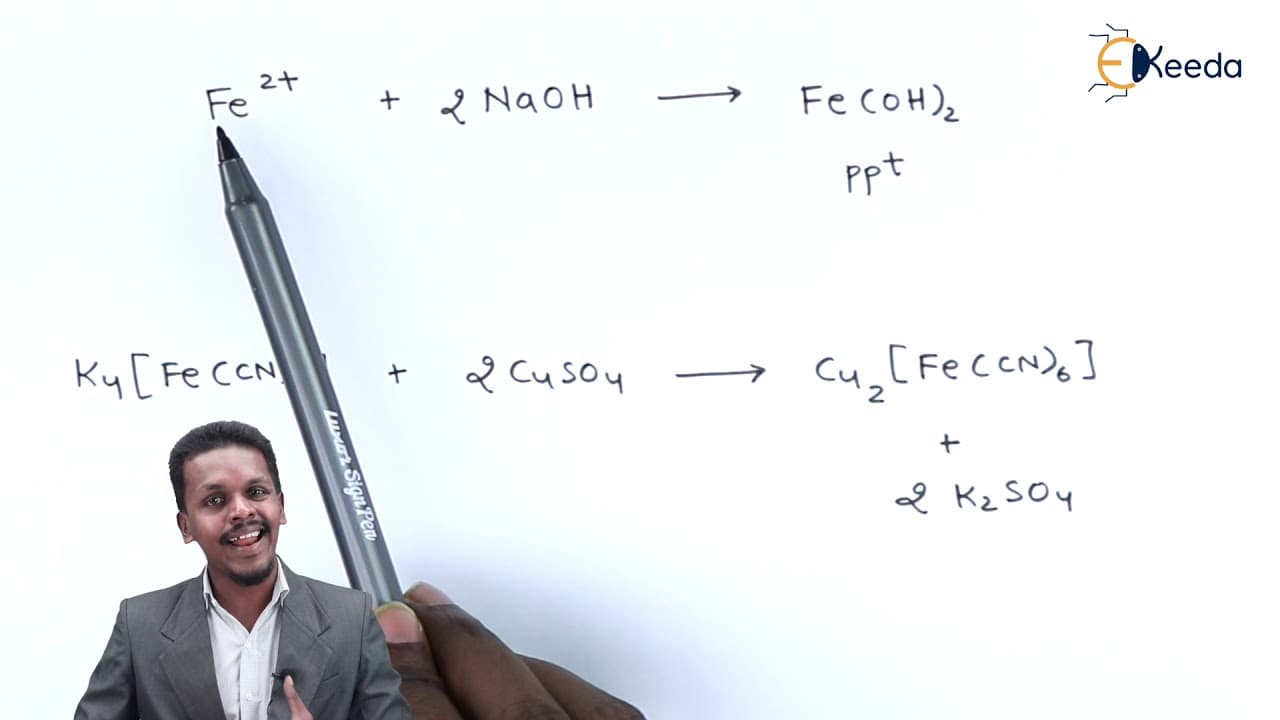
- 💥 Complex ions lose their individual properties and acquire new ones that are characteristic of the complex.
- 😑 The stability of complex ions is influenced by factors such as the oxidation state of the metal ion, the coordination number, and the nature of the ligands.
- 🫀 Chelate complexes, which involve ligands with multiple donor atoms, are more stable than non-chelate complexes.
- 🙂 Complex ions can retain their identity even after slight dissociation in a solution.
- 🍹 The net charge of a complex ion is the sum of the charges of its constituent ions.
- 😑 Transition metals have suitable orbitals available for ligands to donate electrons, contributing to the stability of complex ions.
Install to Summarize YouTube Videos and Get Transcripts
Explore YouTube Video Summarizer or Get YouTube Transcript Extractor
Questions & Answers
Q: Why are transition metals commonly found as the central metal ion in complex ions?
Transition metals have variable oxidation states, which allows them to form stable complexes. They also have suitable orbitals for ligands to donate electrons and have small ionic sizes with high charges.
Q: How does the identity of a metal ion change when it forms a complex ion?
When a metal ion forms a complex, it loses its individual properties and acquires new ones that are characteristic of the complex. The metal ion's reactivity and behavior may be different when it is part of a complex.
Q: What factors contribute to the stability of complex ions?
The stability of complex ions is influenced by factors such as the oxidation state of the metal ion, the coordination number, the nature of the ligands, and the strength of the bonds between the metal ion and the ligands.
Q: What is the difference between a chelate complex and a non-chelate complex?
A chelate complex is more stable than a non-chelate complex. Chelate ligands have multiple donor atoms that form a ring structure with the central metal ion, resulting in stronger bonding and greater stability.
Summary & Key Takeaways
-
Complex ions are usually formed by transition metals, which have variable oxidation states and a tendency to form stable complexes.
-
Transition metals have small ionic sizes and high charges, making them suitable for forming complexes with ligands.
-
Transition metals have suitable orbitals of appropriate energy to accommodate electrons donated by ligands.
Read in Other Languages (beta)
Share This Summary 📚
Summarize YouTube Videos and Get Video Transcripts with 1-Click
Try YouTube Summary with ChatGPT & Claude or YouTube Transcript Generator
Explore More Summaries from Ekeeda 📚






Summarize YouTube Videos and Get Video Transcripts with 1-Click
Try YouTube Summary with ChatGPT & Claude or YouTube Transcript Generator