Estimating division that results in non whole numbers
TL;DR
Learn how to estimate division problems with non-whole number results using inequalities and consecutive whole numbers.
Transcript
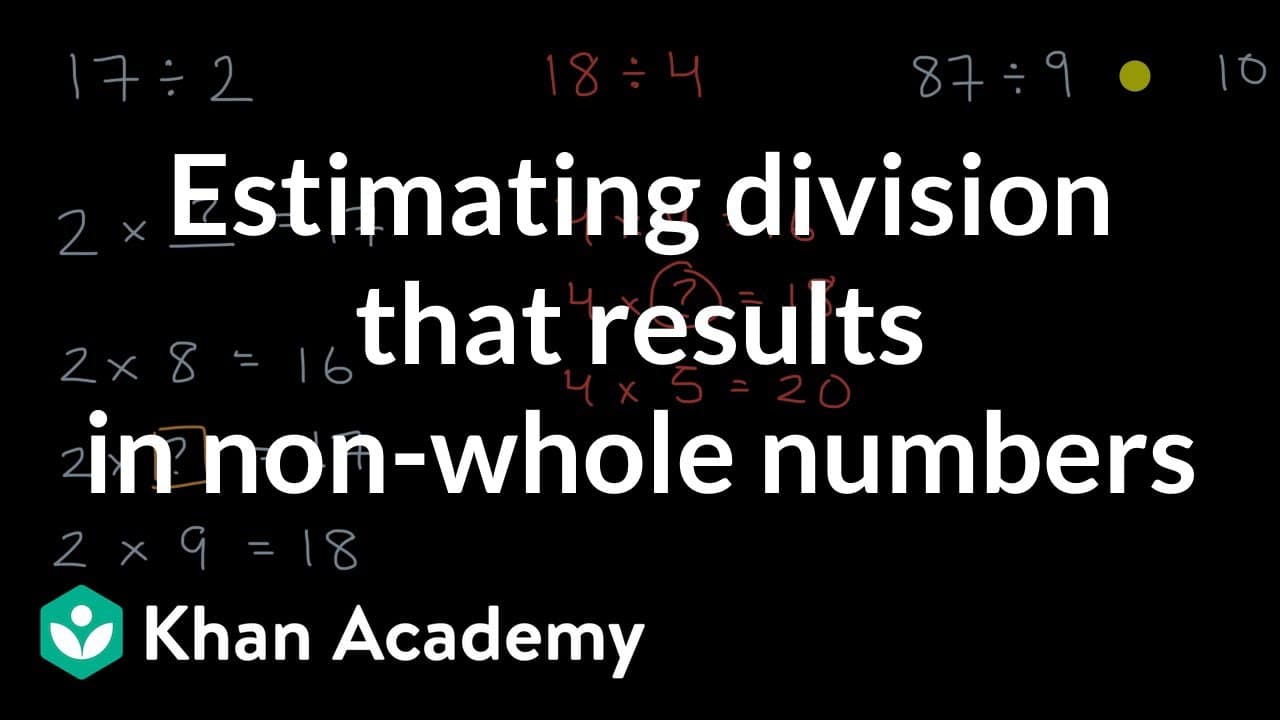
- [Instructor] So let's think about something a little bit. What do you think 17 divided by two is going to be? Well, you might immediately realize that it's not obvious what you need to multiply two by in order to get to 17. There's no whole number that I could put here that gets us to 17. We know that two times, let's see, two times eight is a li... Read More
Key Insights
- #️⃣ Estimating division with non-whole number results involves determining the range of possible answers using consecutive whole numbers or inequalities.
- 🧡 Consecutive whole numbers help identify a narrower range for the estimated answer.
- 👻 Inequalities allow for a comparison between the given division problem and nearby multiples of the divisor.
- 🏛️ Estimating division helps build comfort and familiarity with non-whole number results before learning to compute them accurately.
Install to Summarize YouTube Videos and Get Transcripts
Explore YouTube Video Summarizer or Get YouTube Transcript Extractor
Questions & Answers
Q: How can division problems with non-whole number results be estimated?
Division problems with non-whole number results can be estimated by using consecutive whole numbers or inequalities to determine the range of possible answers.
Q: What is the estimated value of 17 divided by 2?
The estimated value of 17 divided by 2 is between 8 and 9. This can be determined by finding the consecutive whole numbers that are less than and greater than the given dividend.
Q: How can inequalities be used to estimate division results?
Inequalities can be used by comparing the given division problem to nearby multiples of the divisor. For example, when dividing 87 by 9, which is less than 90 divided by 9 (equal to 10) and greater than 81 divided by 9 (equal to 9), we can estimate that the answer is less than 10.
Q: What is the purpose of estimating division with non-whole number results?
Estimating division with non-whole number results helps develop a sense of approximation and prepares learners for calculating more precise values in the future.
Summary & Key Takeaways
-
Division problems with non-whole number results can be estimated using consecutive whole numbers. For example, when dividing 17 by 2, the answer is between 8 and 9.
-
Another approach is to use inequalities. For instance, when dividing 87 by 9, the answer is between 9 and 10, indicating it is less than 10.
-
This video teaches the concept of estimating division and getting comfortable with the idea of non-whole number results.
Read in Other Languages (beta)
Share This Summary 📚
Summarize YouTube Videos and Get Video Transcripts with 1-Click
Try YouTube Summary with ChatGPT & Claude or YouTube Transcript Generator
Explore More Summaries from Khan Academy 📚



Summarize YouTube Videos and Get Video Transcripts with 1-Click
Try YouTube Summary with ChatGPT & Claude or YouTube Transcript Generator