Overview of the Bolshevik Revolution
TL;DR
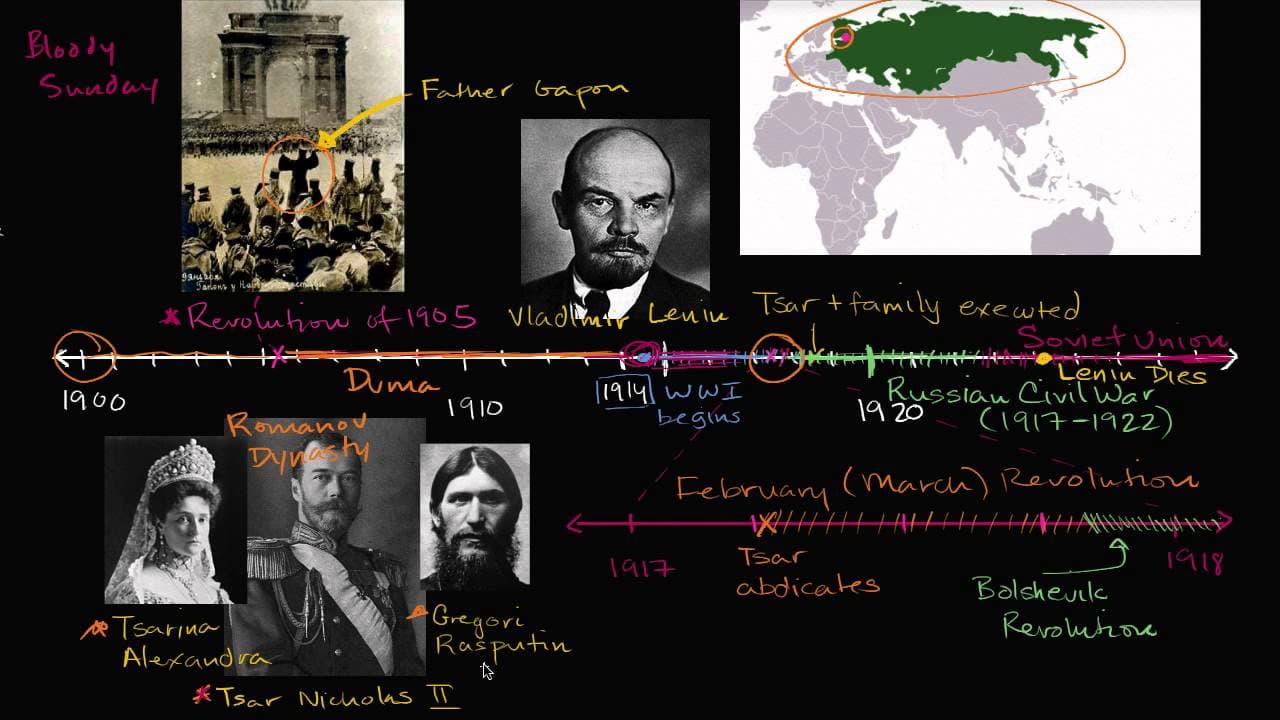
The Russian Revolution of 1917 saw increasing tensions between the ruling class and the labor class, leading to the abdication of Tsar Nicholas II and the rise of the Bolsheviks.
Transcript
As we enter into the 1900s imperial Russia is under the absolute control of the czar and [a] [czar] an analogous term would be emperor he has absolute control over Russia, and he's part of the Romanov dynasty Romanov Dynasty That has had control that has ruled over imperial Russia since the early 1600s, so for Roughly 300 years, but as we see from ... Read More
Key Insights
- 📏 Imperial Russia was ruled by the Romanov dynasty for over 300 years until the Russian Revolution of 1917.
- 🏛️ The tensions between the ruling class and the labor class grew increasingly worse under Tsar Nicholas II's rule.
- 💖 The revolution was sparked by the peaceful protest known as Bloody Sunday in 1905 and further fueled by the economic and social impact of World War I.
- 🥺 The Bolsheviks, led by Vladimir Lenin, eventually took power and established the Soviet Union, while the civil war resulted in millions of casualties.
Install to Summarize YouTube Videos and Get Transcripts
Explore YouTube Video Summarizer or Get YouTube Transcript Extractor
Questions & Answers
Q: What were the major causes of the Russian Revolution of 1917?
The major causes were the increasing tensions between the ruling and labor classes, the harsh working conditions in factories and fields, and the impact of World War I on the economy and the average person.
Q: What role did Bloody Sunday play in the revolution?
Bloody Sunday was a turning point as the peaceful protest highlighted the brutality of the ruling class towards the laborers, sparking sympathy and further fueling the revolution.
Q: How did Tsar Nicholas II's abdication come about?
The abdication was forced by the masses in 1917, as they had reached their breaking point with the tsar's perceived indifference to their suffering and the influence of his German-born wife and mystic advisor, Gregory Rasputin.
Q: Why did the provisional government fail to satisfy the people?
The provisional government was unable to address the worsening conditions and effectively lead the country during World War I, leading to further discontent and the rise of the workers' councils, or soviets.
Summary & Key Takeaways
-
Imperial Russia under Tsar Nicholas II experienced growing tensions between the ruling class and the labor class, culminating in the 1917 revolution.
-
The revolution began with the peaceful protest known as Bloody Sunday in 1905, where unarmed protesters were met with open fire.
-
World War I worsened conditions in Russia, leading to further discontent and eventually the abdication of the tsar in 1917.
Read in Other Languages (beta)
Share This Summary 📚
Summarize YouTube Videos and Get Video Transcripts with 1-Click
Try YouTube Summary with ChatGPT & Claude or YouTube Transcript Generator
Explore More Summaries from Khan Academy 📚



Summarize YouTube Videos and Get Video Transcripts with 1-Click
Try YouTube Summary with ChatGPT & Claude or YouTube Transcript Generator