Two Input NAND Gate
TL;DR
This video explains the realization process and mask layout for NMOS and CMOS NAND gates in digital electronics.
Transcript
hi today's class is to input nmos and cmos nand gates so here in this video we are going to discuss about the realization part of nand gates using internal metal oxide semiconductor field effect transistor as well as complementary metal oxide semiconductor field effect transistors right and also we would like to draw the stick diagram for the nand ... Read More
Key Insights
- 🔬 A NAND gate is a logic gate that produces a false output only if all its inputs are true.
- 🔬 NMOS and CMOS can be used to realize NAND gates, with NMOS using a series combination of transistors and CMOS using a series combination for NMOS and a parallel combination for PMOS.
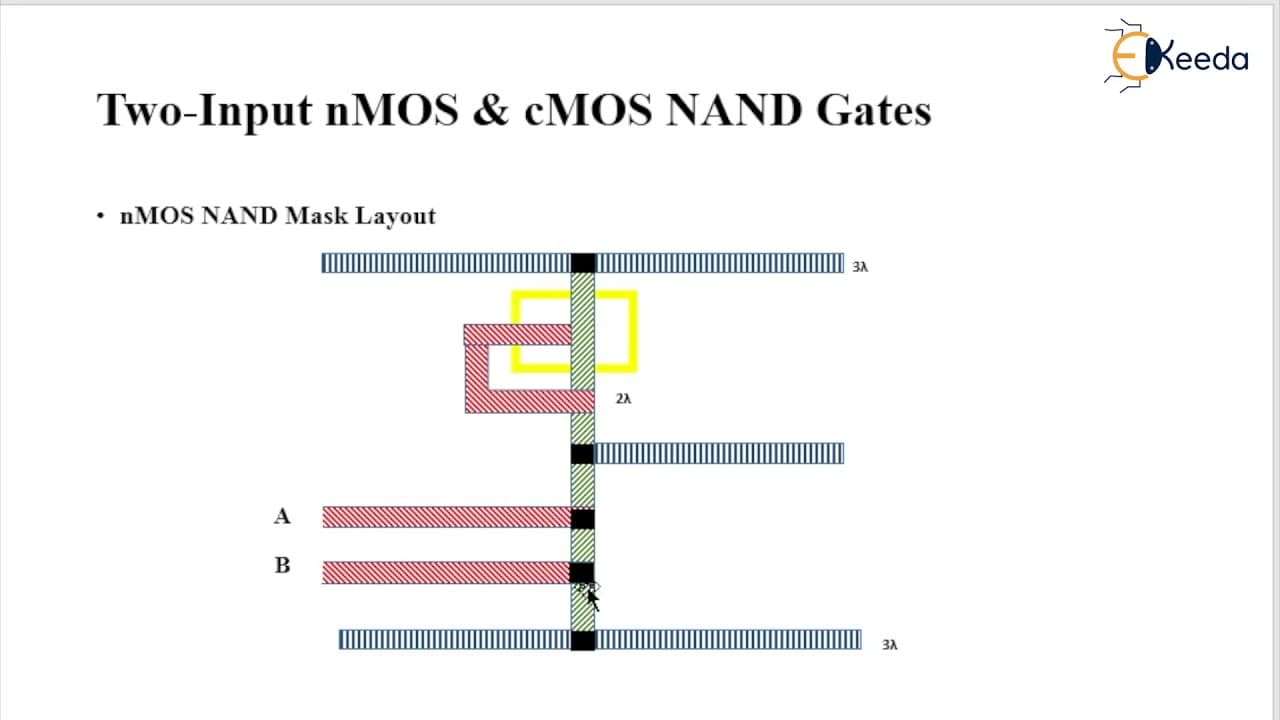
- 😷 The mask layout is a visual representation of the physical layout of components in the NAND gate circuit, including metal wires, diffusion regions, poly silicon, and contacts.
- 😷 The mask layout for NMOS and CMOS NAND gates involves the representation of metal wires, diffusion regions, and poly silicon in the appropriate arrangements.
- 😷 The mask layout helps to ensure that the physical components are properly connected and arranged to create the desired logic function.
- 😷 The minimum width for metals in the mask layout is 3 lambda, while for polysilicon and diffusion, it is 2 lambda.
- 😒 The mask layout for NMOS and CMOS NAND gates involves the use of patterns to represent the different components, such as metals, polysilicon, and diffusion.
Install to Summarize YouTube Videos and Get Transcripts
Explore YouTube Video Summarizer or Get YouTube Transcript Extractor
Questions & Answers
Q: What is a NAND gate and how does it differ from an AND gate?
A NAND gate is a logic gate that produces an output which is false only if all its inputs are true. In contrast, an AND gate produces a true output only if all its inputs are true.
Q: How are NMOS and CMOS used to realize NAND gates?
In NMOS, a series combination of transistors is used to create the logic of an AND gate, with a depletion MOSFET used for complementing. In CMOS, a series combination of transistors is used for the NMOS part, and a parallel combination is used for the PMOS part.
Q: What is the purpose of the mask layout in the realization of NAND gates?
The mask layout is used to represent the physical layout of the components in the NAND gate circuit, including metal wires, diffusion regions, poly silicon, and contacts. It provides a visual representation of how the components are connected and arranged.
Q: Why is the poly silicon crossed with the diffusion in the mask layout?
The crossing of the poly silicon and diffusion regions in the mask layout represents the formation of a transistor. When the poly silicon crosses the diffusion region, it creates a conducting path, allowing current to flow between the source and drain regions.
Summary & Key Takeaways
-
The video discusses the concept of a NAND gate in digital electronics, which produces a false output only if all its inputs are true.
-
The realization of NAND gates using internal MOSFETs and CMOS is explained, including the stick diagram and mask layout.
-
The video shows the mask layout for the NMOS NAND gate, including the representation of metal wires, diffusion, and poly silicon.
-
The CMOS NAND gate mask layout is also shown, with the representation of metal wires, diffusion, and poly silicon in both NMOS and PMOS.
Read in Other Languages (beta)
Share This Summary 📚
Summarize YouTube Videos and Get Video Transcripts with 1-Click
Try YouTube Summary with ChatGPT & Claude or YouTube Transcript Generator
Explore More Summaries from Ekeeda 📚




Summarize YouTube Videos and Get Video Transcripts with 1-Click
Try YouTube Summary with ChatGPT & Claude or YouTube Transcript Generator