What Is the Program Evaluation and Review Technique (PERT)?
TL;DR
The Program Evaluation and Review Technique (PERT) is a project management tool that helps in scheduling complex projects by analyzing interrelated tasks. It provides optimistic, most likely, and pessimistic time estimates, allowing for the calculation of expected completion time and the probability of meeting deadlines. PERT enhances planning and adapts to changes in the project's timeline.
Transcript
hello friends in this video we are talking about what that is program evaluation and review technique part is a tool using network drawing and analysis of your project duration part is basically known as program evaluation and review technique part is used for your works which are added out for research work or which are one time in a lifetime proj... Read More
Key Insights
- 📽️ PERT is a network analysis tool used for scheduling complex projects with many interrelated tasks.
- 👻 It allows planners to define project activities, estimate their duration, and analyze the effects of changes to the overall plan.
- ⌛ PERT provides expected completion time and standard deviation to calculate the probability of meeting a specific deadline.
- ⌛ PERT uses three types of time estimates: optimistic, most likely, and pessimistic time.
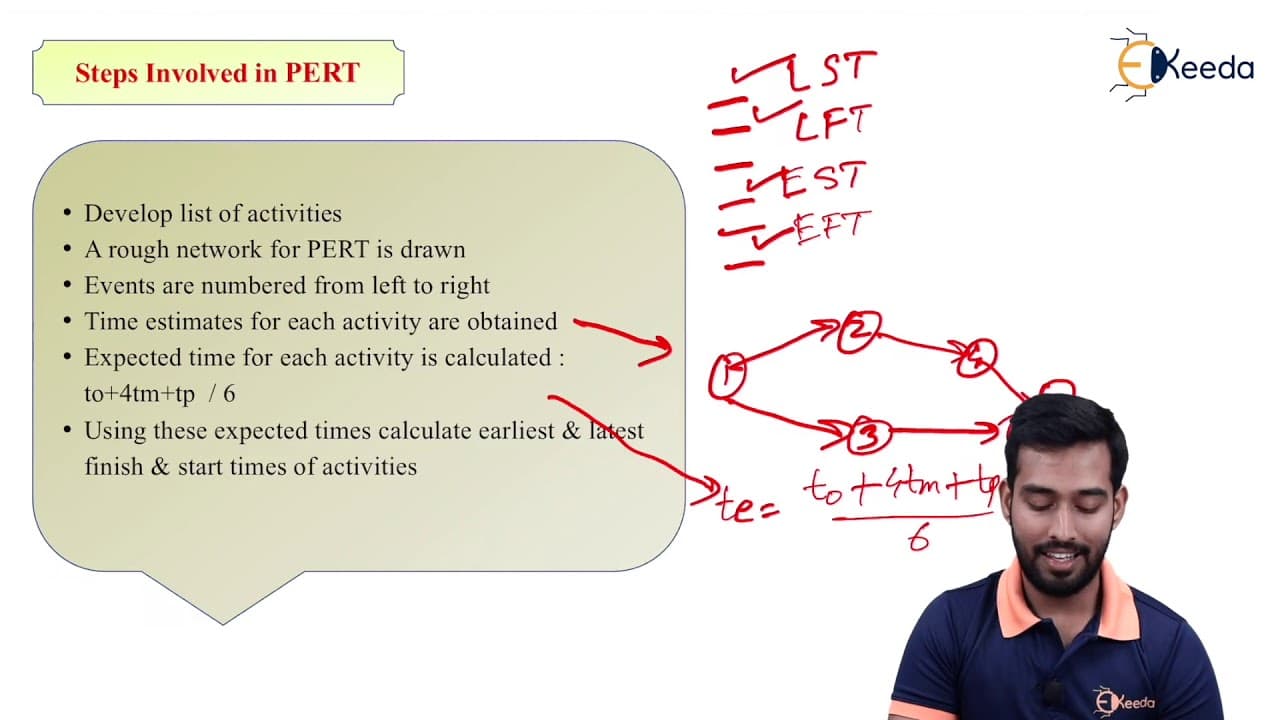
- ⌛ The expected time of completion is calculated using a formula that combines the three time estimates.
- ⌛ Standard deviation is used to measure the variability in the time required to complete the project.
- ⌛ PERT involves developing a list of activities, creating a network diagram, obtaining time estimates for each activity, and calculating earliest and latest start and finish times.
Install to Summarize YouTube Videos and Get Transcripts
Explore YouTube Video Summarizer or Get YouTube Transcript Extractor
Questions & Answers
Q: What is PERT?
PERT (Program Evaluation and Review Technique) is a tool used for scheduling complex projects by defining activities, estimating their duration, and analyzing the effects of changes to the project plan.
Q: How does PERT improve the planning process?
PERT improves planning by allowing planners to define project activities and estimate their duration, providing a basis for time estimates and allowing for measures of optimism and pessimism in completion dates.
Q: What are the three types of time estimates used in PERT?
The three types of time estimates used in PERT are optimistic time (minimum possible time under ideal conditions), most likely time (time that the activity will take most frequently), and pessimistic time (longest time the activity can take accounting for possible delays and events).
Q: How is the expected time of completion calculated in PERT?
The expected time of completion is calculated using the formula: expected time (t) = optimistic time + 4 * most likely time + pessimistic time / 6.
Summary & Key Takeaways
-
PERT is a network analysis tool used for scheduling complex projects with many interrelated tasks.
-
It allows planners to define project activities, estimate their duration, and analyze the effects of changes to the overall plan.
-
PERT provides expected completion time and standard deviation to calculate the probability of meeting a specific deadline.
Read in Other Languages (beta)
Share This Summary 📚
Summarize YouTube Videos and Get Video Transcripts with 1-Click
Try YouTube Summary with ChatGPT & Claude or YouTube Transcript Generator
Explore More Summaries from Ekeeda 📚






Summarize YouTube Videos and Get Video Transcripts with 1-Click
Try YouTube Summary with ChatGPT & Claude or YouTube Transcript Generator