The Born Rule
TL;DR
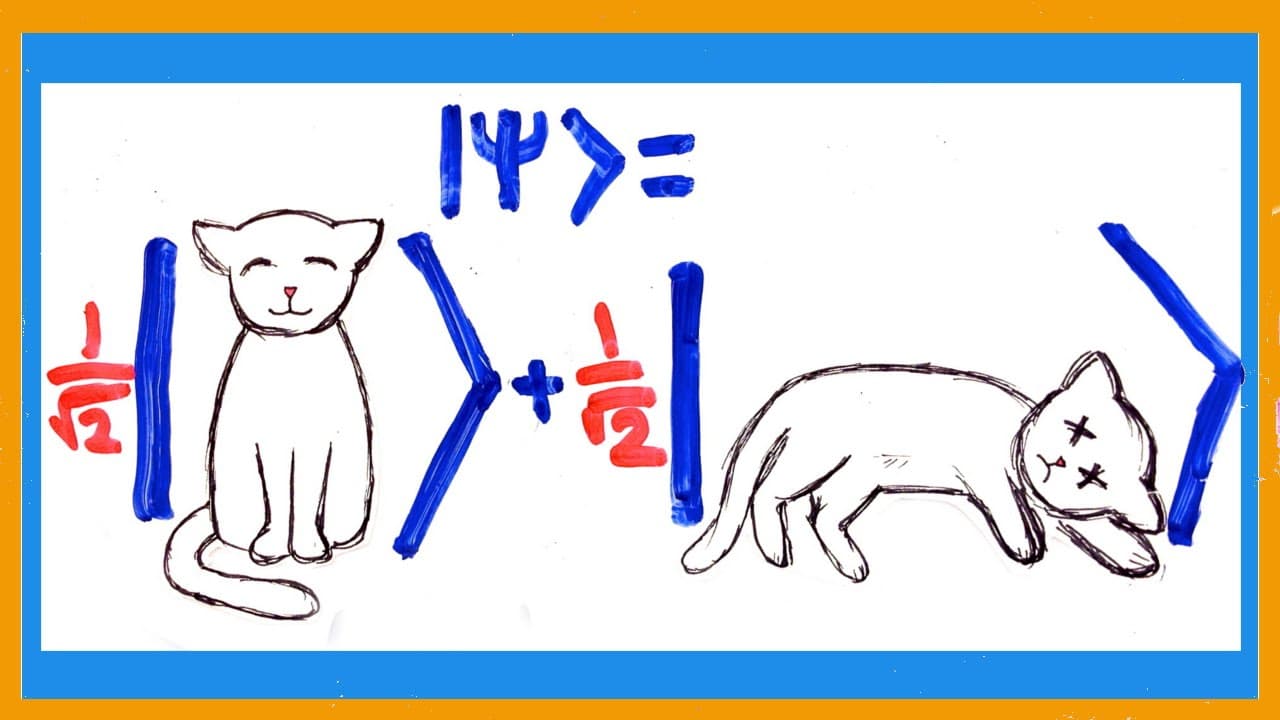
The Born Rule determines the probability of outcomes in quantum measurements by squaring the coefficients in the wavefunction, which can be complex numbers. The use of complex numbers does not affect the Born Rule but has implications for interpretations of the wavefunction as a physical object.
Transcript
Last time we said that we can’t predict exactly what will happen when we measure a quantum system. But the Born rules tells us how likely the possible out comes are. In this video I’ll first teach you the easy version of this rule that works for most simple cases and will work for the all the stuff we’ll do in the main quantum videos. Then if you f... Read More
Key Insights
- 🦾 The Born Rule provides a simple method of determining the probabilities of measurement outcomes in most cases in quantum mechanics.
- 👻 Complex numbers are allowed in the wavefunction and represent arrows of different lengths and directions.
- 😒 The use of complex numbers does not affect the application of the Born Rule but has implications for interpreting the wavefunction as a physical object.
- 🥺 Interpreting the wavefunction as a physical reality may be influenced by the presence of complex numbers, leading to debates and different perspectives.
- 💨 The standard notation for complex numbers provides a more compact way of representing wavefunctions.
- 📏 Understanding the length of a complex number can be determined using Pythagoras' rule.
- 🎮 Homework questions are provided to reinforce the concepts discussed in the video.
Install to Summarize YouTube Videos and Get Transcripts
Explore YouTube Video Summarizer or Get YouTube Transcript Extractor
Questions & Answers
Q: What is the Born Rule and how does it determine the probability of measurement outcomes in quantum systems?
The Born Rule states that the probability of a measurement outcome is determined by squaring the coefficients in the wavefunction, which represents the superposition of all possible states. This simple rule applies to most cases in quantum mechanics.
Q: How do complex numbers relate to the wavefunction in quantum mechanics?
Complex numbers can be used in the wavefunction and represent arrows of different lengths and directions. They generalize real numbers, which are also represented by arrows but are limited to pointing left or right. However, the Born Rule remains the same for both real and complex coefficients.
Q: What are the implications of using complex numbers in the wavefunction?
The use of complex numbers does not affect the application of the Born Rule, but it has implications for interpreting the wavefunction as a physical object. Some interpretations argue that the wavefunction cannot be a real physical object due to the presence of complex numbers. However, others may argue that taking the term "imaginary" too literally may lead to misunderstandings.
Q: How do interpretations of the wavefunction relate to the use of complex numbers?
The presence of complex numbers in the wavefunction allows for different interpretations of its physical reality. Some interpretations may be ruled out due to the use of complex numbers, suggesting that the wavefunction is not a direct representation of physical reality. However, debates continue regarding the literal interpretation of the term "imaginary" and its implications on the nature of the wavefunction.
Summary & Key Takeaways
-
The Born Rule provides a simple version of determining the probability of measurement outcomes in quantum systems by squaring the coefficients in the wavefunction.
-
Complex numbers can be used in the wavefunction, representing arrows of different lengths and directions, without affecting the application of the Born Rule.
-
Complex numbers in the wavefunction have implications for interpreting the wavefunction as a physical object and may rule out certain interpretations.
Read in Other Languages (beta)
Share This Summary 📚
Summarize YouTube Videos and Get Video Transcripts with 1-Click
Try YouTube Summary with ChatGPT & Claude or YouTube Transcript Generator
Explore More Summaries from Looking Glass Universe 📚




Summarize YouTube Videos and Get Video Transcripts with 1-Click
Try YouTube Summary with ChatGPT & Claude or YouTube Transcript Generator