RLC Circuits (19 of 19) Parallel RLC; An Example Problem; Current, Impedance and Admittance
TL;DR
Learn about RLC parallel circuits, calculating reactances, currents, phasor diagrams, total impedance, admittance, and more.
Transcript
okay so here we go for our problem our example problem for our LC parallel circuits with an alternating current I've already made videos for RL and our CV link to those in the upper right-hand corner we're gonna put all together RLC circuits for this video now before we get started please don't forget to subscribe to my channel get all my excellent... Read More
Key Insights
- ❓ RLC parallel circuits involve a resistor, inductor, and capacitor, each contributing to the overall circuit behavior.
- ❓ Calculating capacitive and inductive reactances is crucial in determining current distribution in different branches.
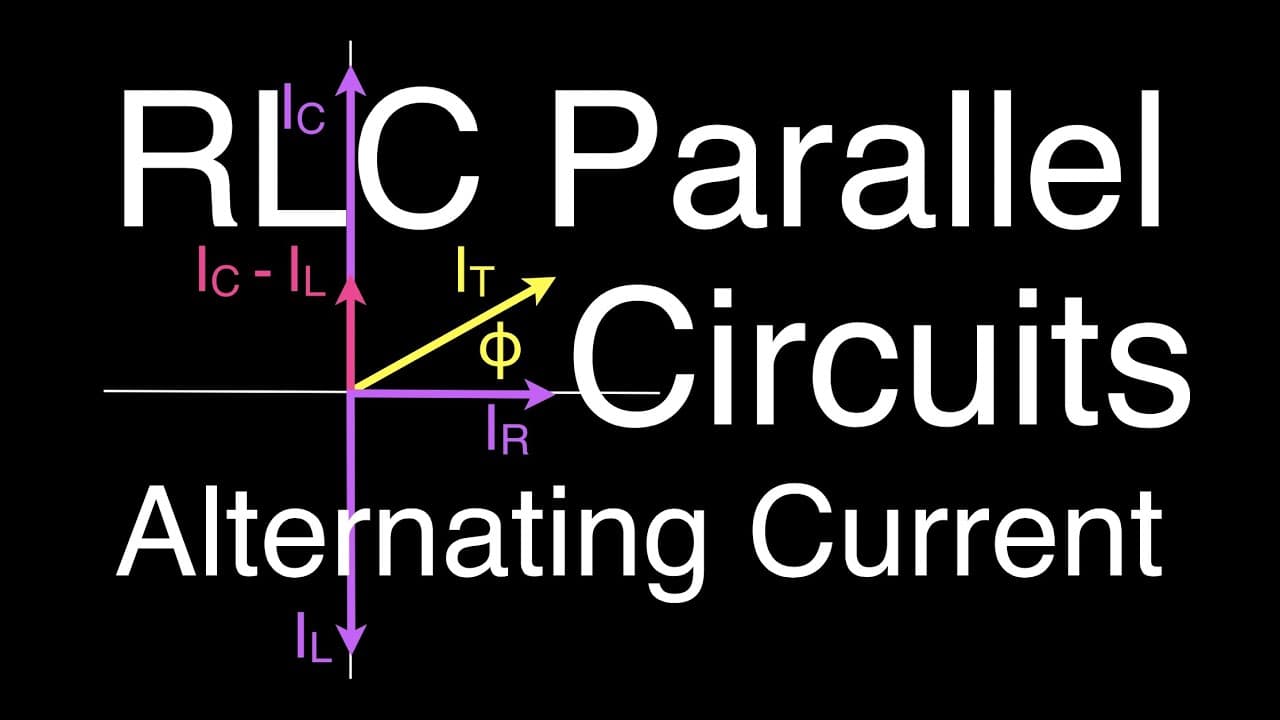
- 🦻 Phasor diagrams aid in visualizing the relationship between current and voltage in RLC circuits.
- 💐 Total impedance quantifies the opposition to current flow due to resistances and reactances in the circuit.
- 💐 Admittance measures how readily current flows through the circuit based on conductance and susceptance values.
- 👮 Utilizing Ohm's law and admittance equations helps in solving for total current and validating circuit calculations.
- ❓ Understanding the interplay of reactances, resistances, and admittance is essential for analyzing RLC parallel circuits effectively.
Install to Summarize YouTube Videos and Get Transcripts
Explore YouTube Video Summarizer or Get YouTube Transcript Extractor
Questions & Answers
Q: What elements are present in an RLC parallel circuit?
An RLC parallel circuit consists of a resistor, inductor, and capacitor, each with specific values for resistance, inductance, and capacitance.
Q: How are capacitive and inductive reactances calculated in RLC circuits?
Capacitive reactance is calculated as 1/(2πfC), while inductive reactance is 2πfL, where f is frequency, C is capacitance, and L is inductance.
Q: How is current determined in RLC parallel circuits?
Current through each branch is calculated using Ohm's law: V/R for resistance, V/XL for inductive reactance, and V/XC for capacitive reactance.
Q: How is the total impedance and admittance calculated in RLC parallel circuits?
Total impedance is found using the square root of the sum of resistances and reactances, while admittance is the reciprocal of impedance calculated as 1/Z.
Summary & Key Takeaways
-
Video covers RLC circuits with alternating current, calculating reactances, currents, phasor diagrams, and total impedance.
-
Details equations for capacitive and inductive reactances, calculating currents through each branch, and constructing phasor diagrams.
-
Demonstrates finding total impedance, admittance, and solving for total current using admittance in RLC parallel circuits.
Read in Other Languages (beta)
Share This Summary 📚
Summarize YouTube Videos and Get Video Transcripts with 1-Click
Try YouTube Summary with ChatGPT & Claude or YouTube Transcript Generator
Explore More Summaries from Step by Step Science 📚





Summarize YouTube Videos and Get Video Transcripts with 1-Click
Try YouTube Summary with ChatGPT & Claude or YouTube Transcript Generator