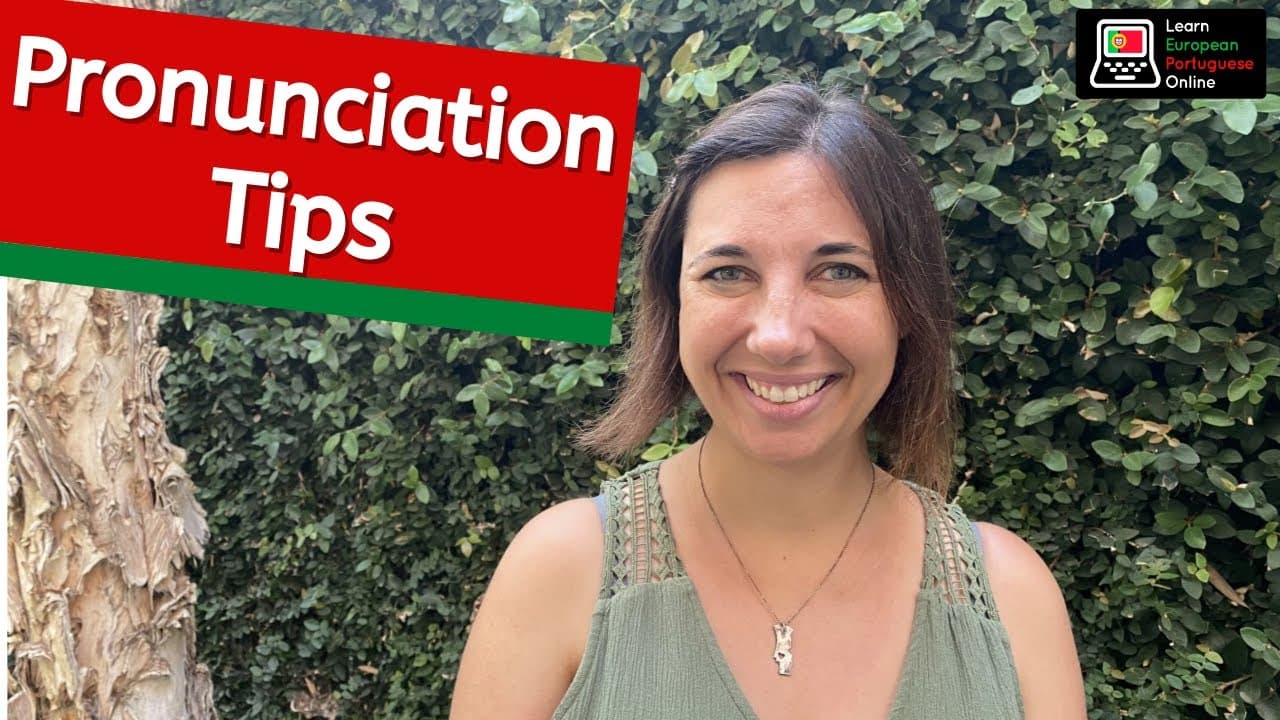
European Portuguese PRONUNCIATION TIPS to help you SOUND LIKE A NATIVE.
TL;DR
Learn key pronunciation tips for European Portuguese verbs.
Transcript
today i want to help you with pronunciation i can't stress enough how practicing pronunciation is important in learning a language that is something i love to practice with my students and by far one of the benefits of working one-on-one with a native tutor pronunciation is key to build confidence and to make you comfortable knowing that you are be... Read More
Key Insights
- Pronunciation is crucial in language learning, boosting confidence and understanding. Practicing with a native tutor can greatly enhance pronunciation skills.
- Infinitive verbs in Portuguese stress the last syllable, but this changes when conjugated, often stressing the penultimate syllable.
- Vowel sounds can change when verbs are conjugated, with 'o' and 'a' often becoming open vowels, altering pronunciation patterns.
- The 'u' sound in Portuguese is challenging, resembling a mix of 'l' and 'y' sounds, requiring practice for accurate pronunciation.
- The double 'l' sound in Spanish differs from the Portuguese 'u' sound, emphasizing the need for language-specific pronunciation practice.
- Plural words ending in 'isis' or 'isis' often challenge learners, with the 's' sounding more like a 'z' than a 'j'.
- The 'e' in certain Portuguese verbs is muted, contrasting with Spanish pronunciation, requiring careful listening and practice.
- Engagement with interactive content, such as videos and social media, can support learners in mastering Portuguese pronunciation.
Install to Summarize YouTube Videos and Get Transcripts
Explore YouTube Video Summarizer or Get YouTube Transcript Extractor
Questions & Answers
Q: Why is pronunciation important in learning a language?
Pronunciation is vital in language learning as it enhances communication by ensuring clarity and understanding. It builds confidence in learners, allowing them to express themselves accurately and be understood by native speakers. Practicing pronunciation also helps in overcoming language barriers and improving overall language proficiency.
Q: How does verb conjugation affect pronunciation in Portuguese?
In Portuguese, verb conjugation often shifts the stress from the last syllable in infinitive forms to the penultimate syllable, altering vowel sounds. For example, the vowel 'o' in 'gustar' changes in conjugation to sound like 'go' in 'gosto'. This shift requires learners to adjust their pronunciation patterns accordingly.
Q: What challenges do learners face with the Portuguese 'u' sound?
The Portuguese 'u' sound is challenging as it resembles a blend of 'l' and 'y' sounds, articulated quickly. This unique sound requires learners to position their tongue near their front teeth and transition swiftly to a 'y' sound, differing from similar sounds in other languages like Spanish.
Q: How can learners overcome difficulties with plural word endings in Portuguese?
Learners often struggle with plural endings like 'isis', where the 's' sounds more like a 'z'. To overcome this, practicing with native speakers and listening to authentic Portuguese content can help. Repeating and mimicking correct pronunciations aids in mastering these challenging sounds.
Q: What is the difference between the Spanish double 'l' and the Portuguese 'u' sound?
The Spanish double 'l' is pronounced as a 'y' sound, while the Portuguese 'u' is a unique sound, combining 'l' and 'y'. This distinction emphasizes the need for language-specific pronunciation practice, as the sounds are not interchangeable and require different tongue positioning and articulation.
Q: Why is it beneficial to practice with native speakers?
Practicing with native speakers is beneficial as it provides authentic language exposure, helping learners to grasp correct pronunciation, intonation, and rhythm. Native speakers can offer immediate feedback and corrections, enabling learners to refine their speaking skills and gain confidence in their language abilities.
Q: How does engaging with online resources aid in learning Portuguese pronunciation?
Engaging with online resources, such as videos, social media, and interactive platforms, provides diverse learning materials that cater to different learning styles. These resources offer practical examples, pronunciation guides, and opportunities for practice, making language learning more accessible and effective.
Q: What role does Patreon play in enhancing pronunciation skills?
Patreon offers exclusive content, such as detailed pronunciation videos and audios, that can enhance learning. By becoming a patron, learners gain access to tailored materials and support from language experts, enabling them to focus on specific pronunciation challenges and improve their spoken Portuguese skills.
Summary & Key Takeaways
-
This video provides essential tips for mastering European Portuguese pronunciation, focusing on verb conjugations and vowel sound changes. It highlights the importance of stressing different syllables when verbs are conjugated, which affects vowel sounds, and offers practical examples.
-
The content explains specific pronunciation challenges, such as the 'u' sound and plural word endings, and provides strategies to overcome these difficulties. The video emphasizes the benefit of practicing with native speakers and using online resources to improve language skills.
-
Learners are encouraged to engage with additional materials, including social media and Patreon content, to deepen their understanding of Portuguese pronunciation. The video serves as a comprehensive guide for both beginners and advanced learners seeking to improve their spoken Portuguese.
Read in Other Languages (beta)
Share This Summary 📚
Summarize YouTube Videos and Get Video Transcripts with 1-Click
Try YouTube Summary with ChatGPT & Claude or YouTube Transcript Generator
Explore More Summaries from Learn European Portuguese Online 📚



Summarize YouTube Videos and Get Video Transcripts with 1-Click
Try YouTube Summary with ChatGPT & Claude or YouTube Transcript Generator