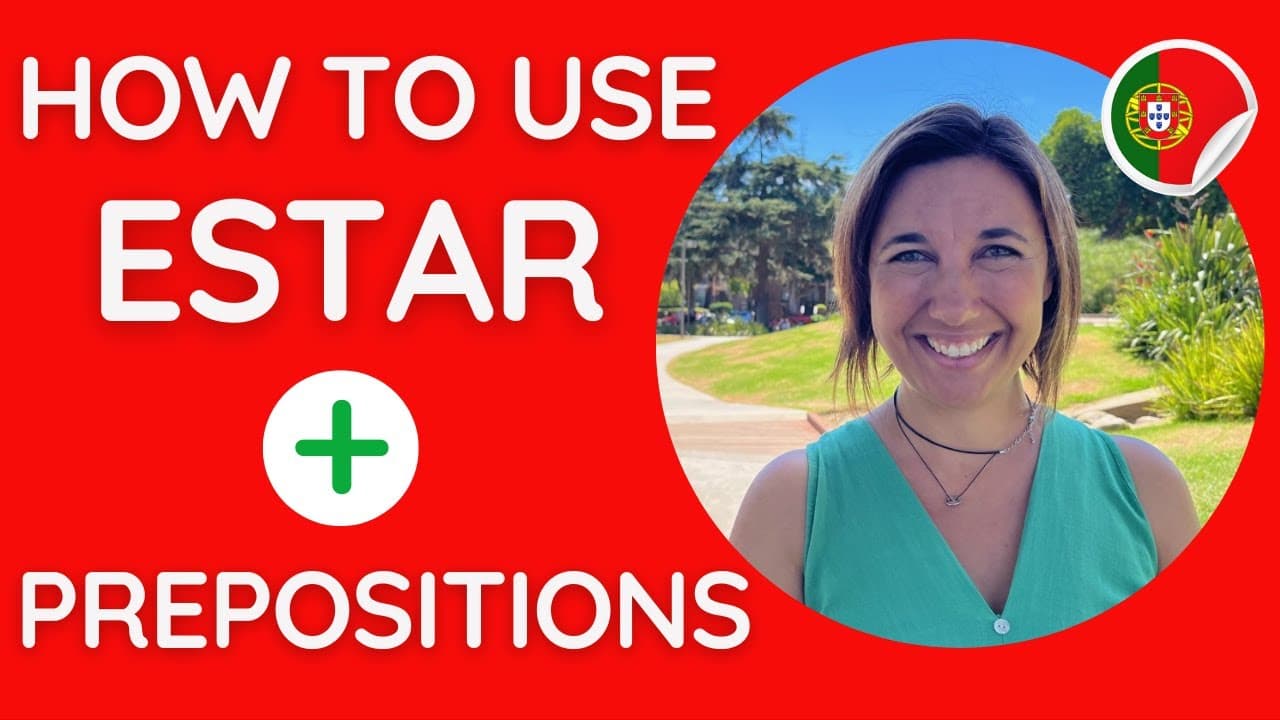
Master the Verb Estar + Em/Para/Por/De/Com/A in European Portuguese!
TL;DR
Learn fixed expressions with 'estar' and prepositions in Portuguese.
Transcript
Hi everyone! Olá, sejam bem-vindos! In this video, I will be taking you a step further in learning how to use the verb Estar. I’m sure you know the verb Estar by now and you are probably confident about how to use it when choosing between SER and ESTAR. But that’s not what this video is about. Today, I will show you how the verb ESTAR combined ... Read More
Key Insights
- The verb 'estar' is crucial in Portuguese, often used with prepositions to form fixed expressions that are integral to daily communication.
- Combining 'estar' with 'em' indicates a specific location, like 'Estou na escola' (I'm at school), crucial for expressing presence.
- 'Estar + para' is used to express imminent actions or intentions, as well as reluctance when preceded by negation.
- 'Estar + por' signifies incomplete actions, often used to describe tasks that are yet to be finished.
- Using 'estar + de' helps indicate a temporary state or mode, such as being on vacation or maternity leave.
- 'Estar + com' is versatile, expressing companionship or feelings, interchangeable with 'ter' for sensations like hunger or cold.
- 'Estar + a' is common in European Portuguese to indicate ongoing actions, replacing the gerund form found in other languages.
- Understanding these combinations enhances natural expression and comprehension in Portuguese, making learners sound more native-like.
Install to Summarize YouTube Videos and Get Transcripts
Explore YouTube Video Summarizer or Get YouTube Transcript Extractor
Questions & Answers
Q: How is 'estar' used with the preposition 'em'?
The combination 'estar + em' is used to indicate presence at a specific location. For example, 'Estou na escola' means 'I am at school'. This is one of the simplest and most common uses of 'estar', making it essential for expressing where someone or something is located.
Q: What does 'estar + para' signify in Portuguese?
'Estar + para' signifies an action that is about to happen or an intention to do something. It can also indicate reluctance when preceded by a negation. For example, 'Estou para sair' means 'I am about to leave', whereas 'Não estou para ir à praia' means 'I don’t feel like going to the beach'.
Q: How does 'estar + por' function in expressions?
'Estar + por' is used to indicate actions that are not yet completed. It often describes tasks that remain unfinished. For instance, 'Estou por me arranjar' translates to 'I still have to get ready', highlighting the uncompleted nature of the action.
Q: In what context is 'estar + de' used?
The combination 'estar + de' is used to express a temporary state or mode. It can describe being on vacation, maternity leave, or any temporary condition. For example, 'Estou de férias' means 'I am on vacation', and 'Estou de licença de maternidade' means 'I am on maternity leave'.
Q: What does 'estar + com' express?
'Estar + com' is used to express companionship or a sensation, often interchangeable with 'ter' for feelings. For example, 'Estou com fome' means 'I am hungry', and 'Estou com frio' means 'I am cold'. It can also mean being with someone, like 'Estou com amigos' (I am with friends).
Q: How is 'estar + a' used in European Portuguese?
'Estar + a' is used to indicate ongoing actions, replacing the gerund form. It expresses actions that extend over time. For example, 'Estou a estudar' means 'I am studying'. This construction is prevalent in European Portuguese and helps convey continuous actions.
Q: What is the importance of learning these 'estar' combinations?
Learning these 'estar' combinations is crucial for sounding natural and fluent in Portuguese. They allow speakers to express a wide range of ideas, from location and intention to emotions and ongoing actions. Mastering these expressions enhances both comprehension and conversational skills.
Q: How can learners benefit from practicing these expressions?
Practicing these expressions helps learners internalize the nuances of Portuguese, making their speech more fluid and native-like. It improves their ability to communicate effectively in various contexts, whether discussing plans, expressing feelings, or describing ongoing activities. Regular practice builds confidence and proficiency.
Summary & Key Takeaways
-
This video lesson explores the verb 'estar' in European Portuguese, focusing on its use with prepositions to form fixed expressions. These combinations are essential for expressing location, intention, incomplete actions, temporary states, companionship, and ongoing activities.
-
The instructor provides examples of how 'estar' combines with prepositions like 'em', 'para', 'por', 'de', 'com', and 'a'. Each combination serves a unique purpose, from indicating location to expressing feelings or ongoing actions.
-
Viewers are encouraged to practice these expressions to improve their fluency and sound more native-like. The video also suggests reviewing basic verb usage for better understanding.
Read in Other Languages (beta)
Share This Summary 📚
Summarize YouTube Videos and Get Video Transcripts with 1-Click
Try YouTube Summary with ChatGPT & Claude or YouTube Transcript Generator
Explore More Summaries from Learn European Portuguese Online 📚


Summarize YouTube Videos and Get Video Transcripts with 1-Click
Try YouTube Summary with ChatGPT & Claude or YouTube Transcript Generator