Boosting Confidence With Student-Driven Math
TL;DR
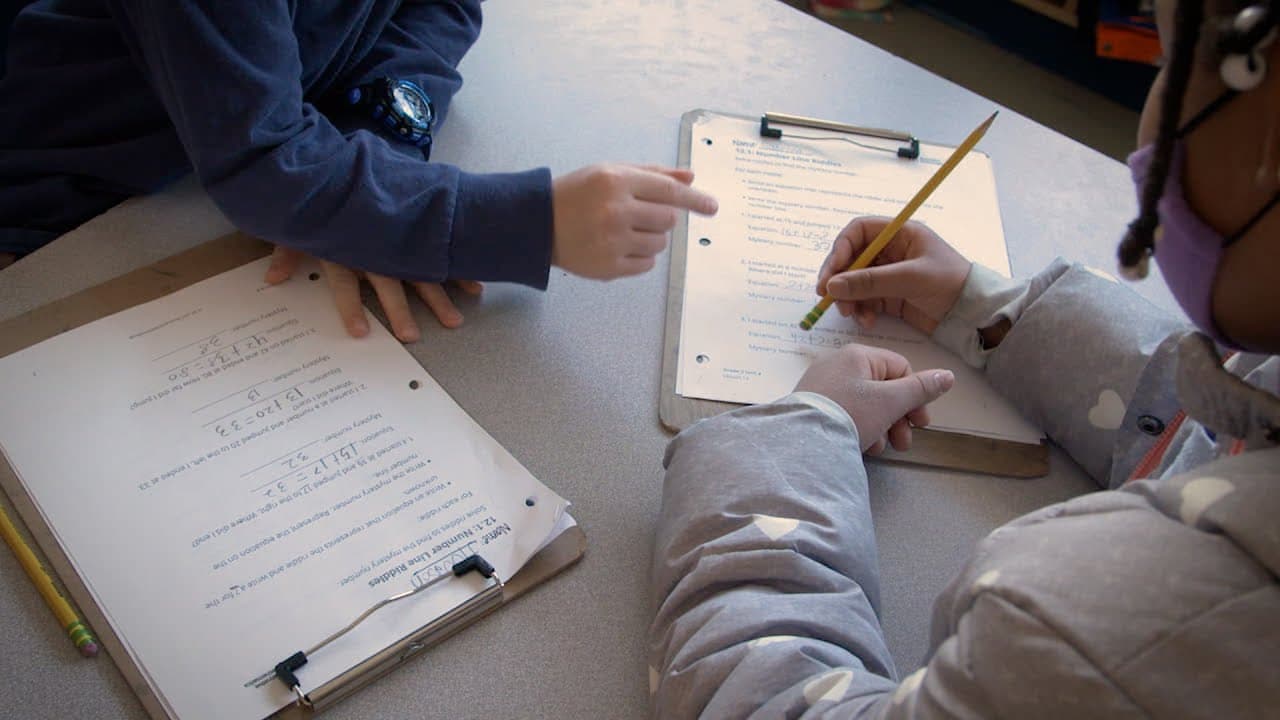
A school in Washington, D.C. has shifted towards an Illustrative Math curriculum, allowing students to have ownership and choice in their learning, leading to increased math confidence and problem-solving skills.
Transcript
Katherine McQuain: In today's lesson, you're going to be solving a few mysteries. >>Class: Ooo, mysteries! >>McQuain: You have some number lines. >>McQuain: Because we've made the switch to this curriculum where students have the ownership for their math learning, we have seen such an increase in students' math confidence. Their ownership for the... Read More
Key Insights
- 🧑🎓 The transition to a student-centered math curriculum increases students' math confidence and ownership of their learning.
- 🤔 The traditional approach to teaching math can make learners dependent and limit their thinking.
- 🤔 Collaborative learning and sharing of strategies promote critical thinking and deeper understanding of math concepts.
Install to Summarize YouTube Videos and Get Transcripts
Explore YouTube Video Summarizer or Get YouTube Transcript Extractor
Questions & Answers
Q: How has the transition to the Illustrative Math curriculum impacted students' math confidence?
The shift towards a student-centered approach has resulted in increased math confidence as students have ownership of their learning and a toolbox of strategies to choose from. They now have more confidence in their problem-solving abilities.
Q: What are some of the drawbacks of the traditional "I do, we do, you do" approach to teaching math?
The traditional approach can make learners dependent on the teacher and limit their thinking. It does not encourage autonomy, choice, or critical thinking skills, which can hinder students' overall math development.
Q: How do students collaborate and share their strategies in the classroom?
Students work with partners with different strategies, allowing them to think from different perspectives. They share their strategies and ideas, respectfully disagreeing when necessary. This collaboration helps them develop a deeper understanding of math concepts.
Q: How does the Illustrative Math curriculum change the discourse in the classroom?
The curriculum promotes discourse by encouraging students to talk, teach, and explain their strategies to one another. This leads to better internalization of information and a deeper understanding of math concepts.
Summary & Key Takeaways
-
Van Ness School in Washington, D.C. has transitioned to an Illustrative Math curriculum, giving students autonomy and choice in their math learning.
-
The traditional "I do, we do, you do" approach to teaching math has been replaced with a student-centered approach, where students have a toolbox of strategies to choose from.
-
Students work on word problems independently, with a partner, and in whole-group discussions, fostering collaboration, critical thinking, and communication skills.
Read in Other Languages (beta)
Share This Summary 📚
Summarize YouTube Videos and Get Video Transcripts with 1-Click
Try YouTube Summary with ChatGPT & Claude or YouTube Transcript Generator
Explore More Summaries from Edutopia 📚




Summarize YouTube Videos and Get Video Transcripts with 1-Click
Try YouTube Summary with ChatGPT & Claude or YouTube Transcript Generator