Compound interest and e (part 4) | Exponential and logarithmic functions | Algebra II | Khan Academy
TL;DR
Learn how to calculate compound interest using the formula Pe^(rt), and understand the power of continuous compounding.
Transcript
In the last video, I hopefully showed you that if I borrowed P dollars, and I borrow it for a year, and you were to charge me an interest rate of r, or you could say 10r%, then at the end-- and we were to compound continuously. So we compound every zillionth of a second, but we compound it a trillion times, however many of those intervals are in a ... Read More
Key Insights
- 🥺 Continuous compounding leads to significant growth in the amount owed due to the continuous accumulation of interest.
- 🤑 The compound interest formula, Pe^(rt), is commonly used to calculate the total repayment amount after borrowing money for a certain period.
- 🎴 The interest rate and time play crucial roles in determining the final amount owed.
- 🤑 Calculating compound interest using the formula can help individuals make informed decisions regarding borrowing and lending money.
- 🤑 Continuous compounding is a powerful concept that showcases the exponential growth of money over time.
- ❓ The compound interest formula can be complex in theory but becomes clearer with practical examples and calculations.
- 🤩 Compound interest is a key concept in finance and plays a significant role in investment strategies and loan repayment plans.
Install to Summarize YouTube Videos and Get Transcripts
Explore YouTube Video Summarizer or Get YouTube Transcript Extractor
Questions & Answers
Q: What is the compound interest formula and how is it used?
The compound interest formula, Pe^(rt), calculates the amount owed after borrowing a certain sum, where P is the principal, r is the interest rate, and t is the number of years. It is used by multiplying the principal by the constant e raised to the power of the product of the interest rate and time.
Q: What is continuous compounding and how does it affect interest?
Continuous compounding involves compounding interest every infinitesimally small interval, resulting in larger amounts owed compared to simple interest. The interest is consistently added and earns more interest as time goes on, leading to exponential growth of the amount owed.
Q: Why is continuous compounding more effective in generating larger amounts owed?
Continuous compounding is more effective in generating larger amounts owed because it allows for more frequent compounding, maximizing the growth of interest over time. This compounding occurs an infinite number of times within a given time period, resulting in a greater accumulation of interest compared to other compounding frequencies.
Q: How can the compound interest formula be applied in real-world scenarios?
The compound interest formula can be applied in real-world scenarios to calculate the amount owed after borrowing money for a certain period. This can be useful for borrowers and lenders to understand the impact of interest rates and time on the total repayment amount.
Summary & Key Takeaways
-
The video explains how to calculate the amount owed after borrowing money for a certain period using the compound interest formula Pe^(rt).
-
Continuous compounding involves compounding interest every infinitesimally small interval, resulting in significantly larger amounts owed compared to simple interest.
-
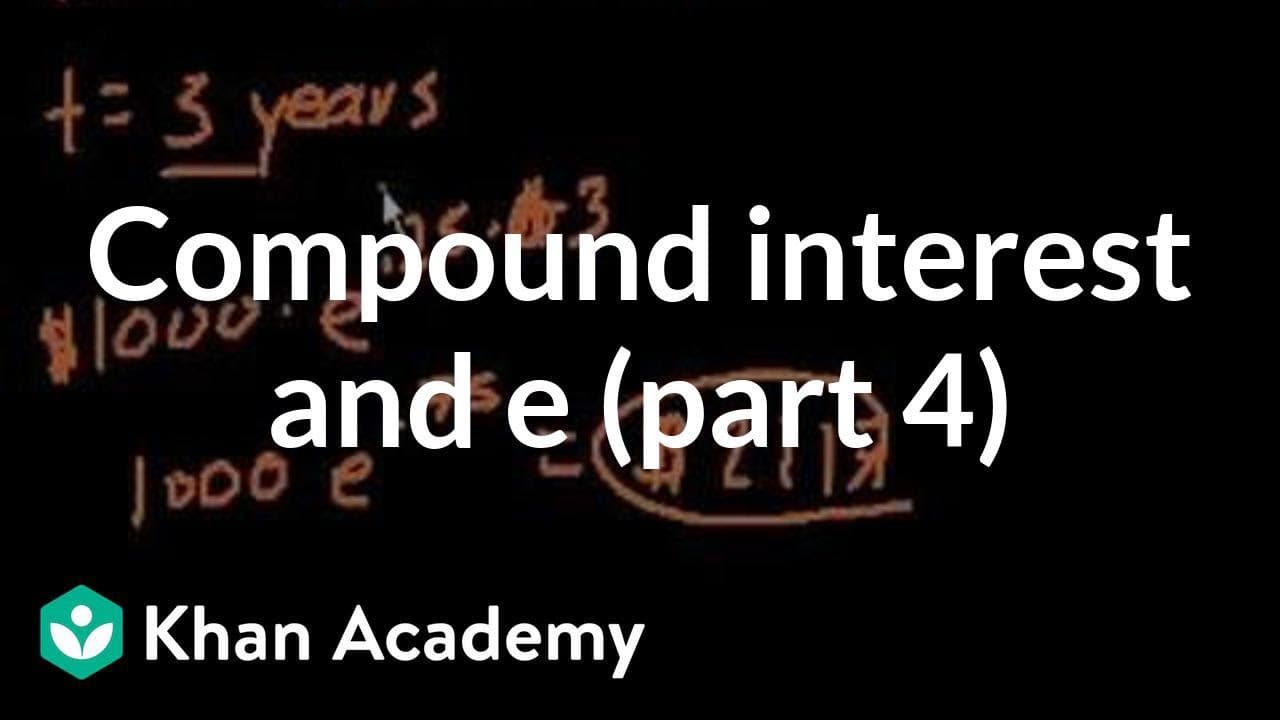
Two examples are provided to demonstrate the application of the formula, one involving borrowing $1,000 for three years at a 25% interest rate, and the other determining the interest rate when borrowing $50 for ten years and owing $500.
Read in Other Languages (beta)
Share This Summary 📚
Summarize YouTube Videos and Get Video Transcripts with 1-Click
Try YouTube Summary with ChatGPT & Claude or YouTube Transcript Generator
Explore More Summaries from Khan Academy 📚



Summarize YouTube Videos and Get Video Transcripts with 1-Click
Try YouTube Summary with ChatGPT & Claude or YouTube Transcript Generator