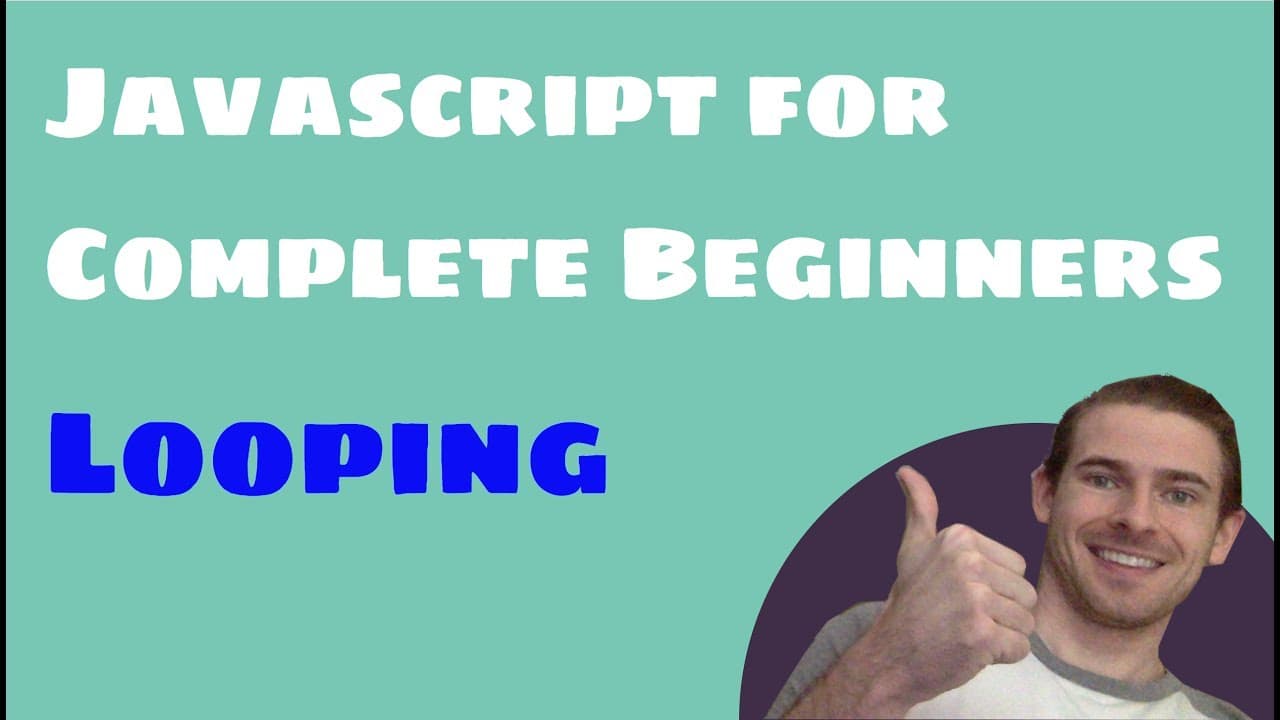
Javascript for Complete Beginners: Looping
TL;DR
This video explains three types of loops in JavaScript: do-while, while, and for loops.
Transcript
egg coders welcome to another video on JavaScript for complete beginners in this video we're going to be talking about looping which involves four loops while loops and do-while loops so if you watch the last video where we kind of talk about flow control let's go ahead and set up that same program which just runs iteratively from start to finish w... Read More
Key Insights
- 🔁 JavaScript supports multiple looping structures, including do-while, while, and for loops, each tailored to specific use cases.
- 🔁 Do-while loops execute the code block once before evaluating the loop condition, ensuring one iteration at minimum.
- 🔁 While loops evaluate conditions before executing, offering flexibility to terminate the loop before the first iteration if necessary.
- 👻 For loops allow for concise iteration through arrays and are particularly effective for scenarios with known iteration counts.
- 👣 Incrementing a counter (e.g., C++) is a common practice in loops to track progress through iterations.
- 💐 Visual aids like flow charts can greatly enhance understanding of loop logic and flow control.
- 🔁 Proper loop management prevents issues like infinite loops, which can cause programs to freeze or crash.
Install to Summarize YouTube Videos and Get Transcripts
Explore YouTube Video Summarizer or Get YouTube Transcript Extractor
Questions & Answers
Q: What is the purpose of using loops in programming?
Loops are utilized to repeatedly execute a block of code as long as a specified condition remains true. This capability is invaluable in scenarios like processing items in a list or performing repeated calculations without writing redundant code.
Q: How does a do-while loop differ from a while loop?
The key difference is that a do-while loop guarantees that the block of code will run at least once before the condition is tested, while a while loop checks the condition before executing the code. This means if the condition isn't met initially, a while loop may not execute at all.
Q: Can you give an example of how a for loop is structured?
Certainly! A for loop comprises three components: initialization (e.g., setting a counter variable), a condition to continue looping (e.g., checking if the counter is less than a certain number), and an increment statement (e.g., increasing the counter after each iteration). This makes it concise for iterating over arrays.
Q: Why is it important to understand the syntax of loops?
Understanding loop syntax is crucial because it allows programmers to effectively implement repetition in their code. Mastery of loop structures ensures that you can write efficient algorithms and avoid common pitfalls like infinite loops, improving overall program reliability.
Summary & Key Takeaways
-
The video introduces looping concepts in JavaScript, explaining their importance in iterating over arrays or lists, such as checking student grades.
-
Three types of loops are discussed: do-while loops, while loops, and for loops, each with distinct syntax and structure but achieving similar functionality.
-
A visual flow control representation is provided alongside syntax demonstrations to enhance understanding of how looping works in practical coding scenarios.
Read in Other Languages (beta)
Share This Summary 📚
Summarize YouTube Videos and Get Video Transcripts with 1-Click
Try YouTube Summary with ChatGPT & Claude or YouTube Transcript Generator
Explore More Summaries from Web Dev Cody 📚
Summarize YouTube Videos and Get Video Transcripts with 1-Click
Try YouTube Summary with ChatGPT & Claude or YouTube Transcript Generator