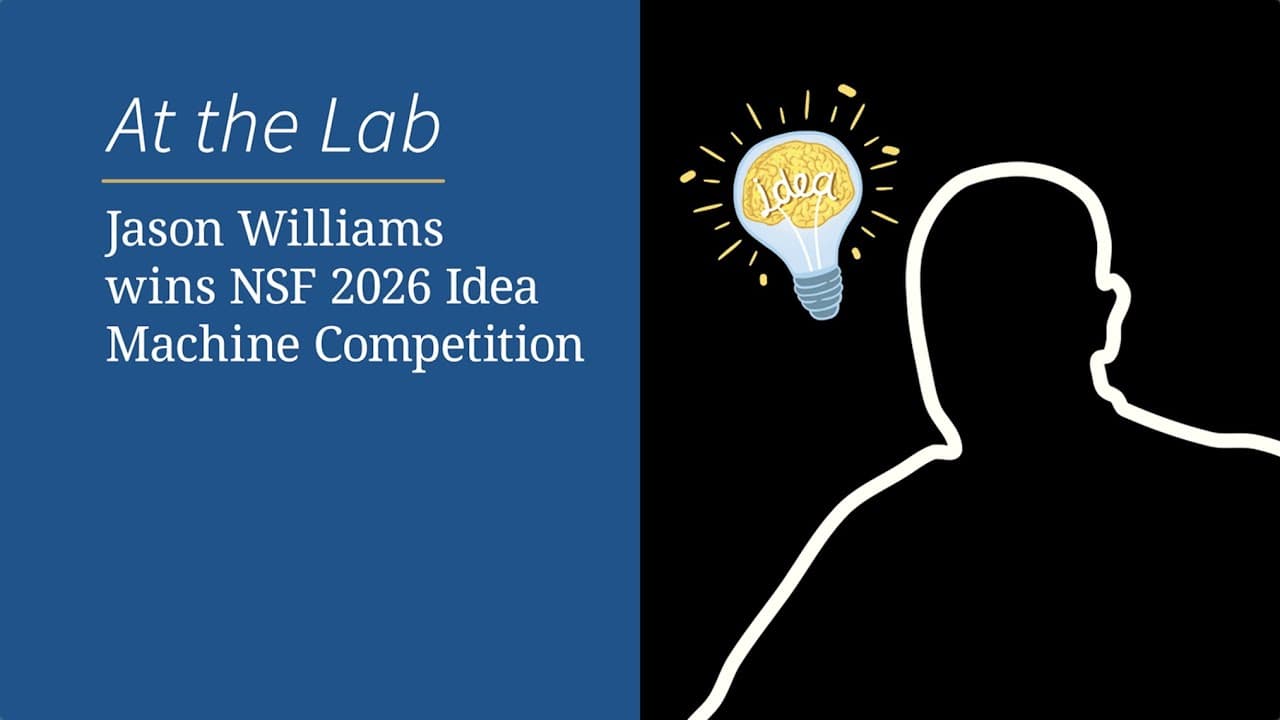
Jason Williams wins NSF 2026 Idea Machine Competition
TL;DR
Jason Williams wins for his idea on reinventing scientific talent.
Transcript
you know if there is a myth that scientists just know everything that should be dispelled we have trouble keeping up and we all feel it and so why not make that better so the NSF 2026 idea machine is designed around the u.s. is two hundred and fiftieth anniversary and it's a time where NSF is looking to update its priorities and its big ideas and a... Read More
Key Insights
- The NSF 2026 Idea Machine is designed to update NSF's priorities in light of the U.S.'s 250th anniversary, engaging researchers and the public to submit innovative research ideas.
- Jason Williams won a Meritorious Award for his concept of 'reinventing scientific talent,' highlighting the need for improved connectivity and resource sharing among scientists and educators.
- Williams emphasizes the rapid pace of scientific change and the challenge for researchers to keep up with new developments, especially those working in isolation.
- His idea stems from extensive experience in teaching and training researchers globally, identifying a common struggle in maintaining up-to-date skills and knowledge.
- The competition involved a year-long process of idea submissions, with Williams's proposal resonating strongly with the scientific community and NSF evaluators.
- Williams's role at Cold Spring Harbor Laboratory provides him a unique perspective on the challenges faced by scientists, contributing to his award-winning idea.
- The presentation of winning ideas will be made to both the NSF community and the National Science Board, aiming to influence future research directions.
- Williams's idea focuses on empowering educators and researchers to better connect and share resources, enhancing their ability to adapt to scientific advancements.
Install to Summarize YouTube Videos and Get Transcripts
Explore YouTube Video Summarizer or Get YouTube Transcript Extractor
Questions & Answers
Q: What is the NSF 2026 Idea Machine?
The NSF 2026 Idea Machine is a competition organized by the National Science Foundation to update its research priorities in light of the U.S.'s 250th anniversary. It invites researchers and the public to submit innovative ideas that could shape future scientific directions, with a focus on addressing current challenges and opportunities in science.
Q: What was Jason Williams's winning idea?
Jason Williams's winning idea is called 'reinventing scientific talent.' It focuses on improving the connectivity and resource sharing among scientists and educators, enabling them to better keep up with rapid scientific advancements. His proposal aims to empower researchers by providing them with the tools and networks needed to stay current in their fields.
Q: Why is keeping up with scientific advancements challenging for researchers?
Keeping up with scientific advancements is challenging due to the rapid pace of change in the field. Researchers often work in isolation, lacking access to the latest resources and networks. This isolation makes it difficult to stay updated with new developments, requiring better connectivity and resource sharing to enable continuous learning and adaptation.
Q: How did Williams's experience influence his proposal?
Williams's extensive experience in teaching and training researchers globally provided him with insights into the common struggles faced by scientists in maintaining up-to-date skills. His role at Cold Spring Harbor Laboratory allowed him to observe the challenges firsthand, leading to his proposal for improved connectivity and resource sharing to address these issues.
Q: What is the significance of the NSF 2026 Idea Machine Competition?
The NSF 2026 Idea Machine Competition is significant as it helps shape the future research priorities of the National Science Foundation by soliciting innovative ideas from researchers and the public. It provides a platform for addressing current challenges in science and encourages the development of solutions that can drive scientific progress and collaboration.
Q: How will the winning ideas be utilized?
The winning ideas from the NSF 2026 Idea Machine Competition will be presented to the NSF community and the National Science Board. These presentations aim to influence future research directions by highlighting innovative concepts that can address current scientific challenges and opportunities, potentially guiding NSF's future funding and program priorities.
Q: What role does connectivity play in Williams's proposal?
Connectivity plays a central role in Williams's proposal for reinventing scientific talent. By improving connectivity among scientists and educators, his idea aims to facilitate better resource sharing and collaboration, enabling researchers to stay current with scientific advancements and overcome the challenges posed by working in isolation.
Q: What impact could Williams's idea have on the scientific community?
Williams's idea could have a significant impact on the scientific community by enhancing the ability of researchers and educators to stay current with scientific advancements. By fostering better connectivity and resource sharing, his proposal could lead to more collaborative research efforts, improved access to information, and a more dynamic and adaptive scientific workforce.
Summary & Key Takeaways
-
Jason Williams, Assistant Director at the DNA Learning Center, has won a Meritorious Prize in the NSF 2026 Idea Machine Competition for his idea on reinventing scientific talent, which aims to improve connectivity among scientists and educators to keep up with rapid scientific advancements.
-
The NSF 2026 Idea Machine is an initiative to update the National Science Foundation's priorities in celebration of the U.S.'s 250th anniversary, encouraging researchers and the public to submit innovative research ideas over a year-long process.
-
Williams's proposal highlights the challenges researchers face in staying current with scientific developments, particularly those working in isolation, and suggests solutions to better connect and empower the scientific community through shared resources and improved communication.
Read in Other Languages (beta)
Share This Summary 📚
Summarize YouTube Videos and Get Video Transcripts with 1-Click
Try YouTube Summary with ChatGPT & Claude or YouTube Transcript Generator
Explore More Summaries from Cold Spring Harbor Laboratory 📚
Summarize YouTube Videos and Get Video Transcripts with 1-Click
Try YouTube Summary with ChatGPT & Claude or YouTube Transcript Generator