How to Graph Piecewise Functions Step by Step
TL;DR
To graph piecewise functions, separate the different function segments based on their defined intervals, graph each segment individually, and then combine them while considering open and closed circles. Remember, open circles indicate points not included in the graph, while closed circles indicate included points.
Transcript
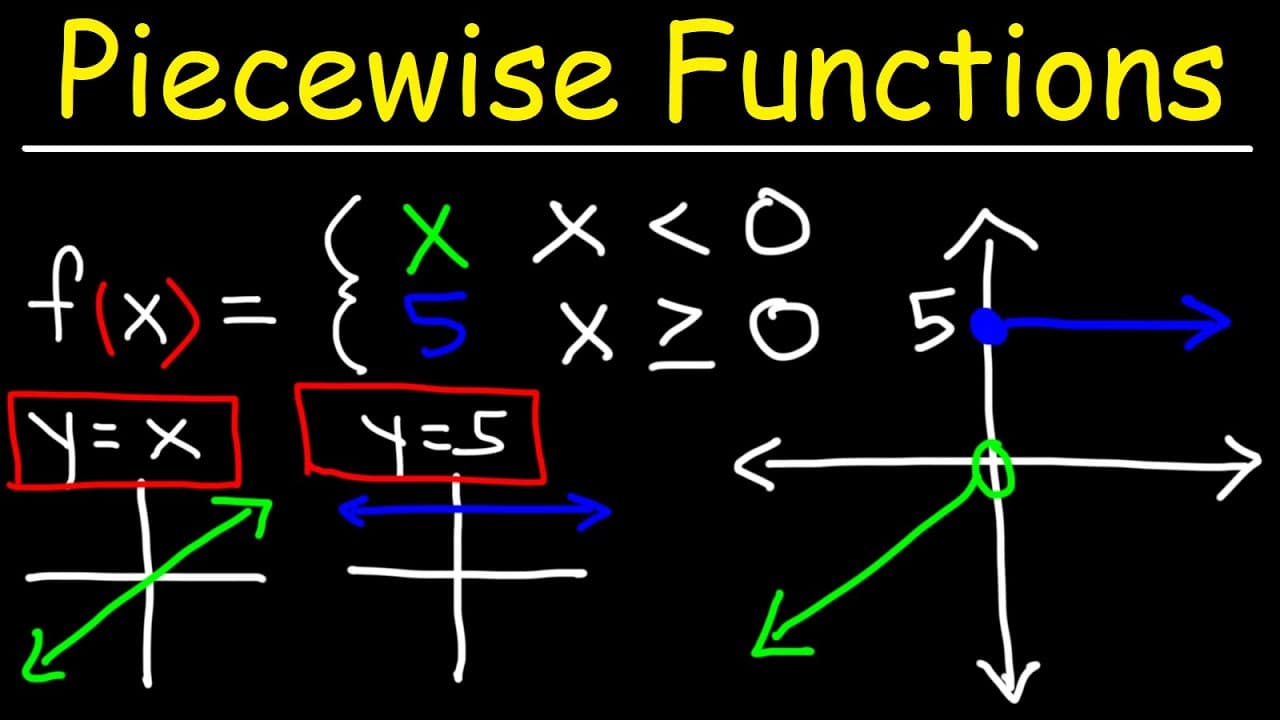
in this tutorial we're going to focus on graphing piecewise functions so let's start with this particular example f of x is equal to x when x is less than zero and it's equal to five when x is equal to or greater than zero now let's graph these two functions separately so we can get an idea of what they look like so the graph f of x equals x or y e... Read More
Key Insights
- 🥳 Piecewise functions involve graphing different parts of a function separately and then combining them.
- 😚 Graphing piecewise functions requires attention to open and closed circles, straight lines, curves, and slopes.
- 🫥 Linear piecewise functions involve connecting points with straight lines, while non-linear piecewise functions involve curves.
- ⭕ Open circles indicate that a point is not included in the function, while closed circles indicate inclusion.
- 🥳 Different parts of the graph may have different slopes and intercepts.
- 🥳 Piecewise functions can have both linear and non-linear parts.
- ⚾ The shape of the graph can change based on the conditions and equations of the function.
Install to Summarize YouTube Videos and Get Transcripts
Explore YouTube Video Summarizer or Get YouTube Transcript Extractor
Questions & Answers
Q: How do you graph a piecewise function?
To graph a piecewise function, first, graph each part of the function separately. Then, combine the different parts to create the complete graph. Pay attention to open circles, closed circles, and the different shapes of the graphs.
Q: What is the purpose of using open and closed circles in a piecewise function graph?
Open circles are used to indicate that a point is not included in the function, while closed circles are used to indicate that a point is included in the function. They help define the domain of the function.
Q: How do you graph a linear piecewise function?
To graph a linear piecewise function, plot the points that satisfy the condition of the function's equation. Connect the points with a straight line. Pay attention to whether the points should be connected with an open or closed circle.
Q: How do you graph a non-linear piecewise function?
Graphing a non-linear piecewise function involves plotting points that satisfy the equations for different parts of the function. Connect the points to create the shape of each part of the function. Be aware of open and closed circles as well.
Summary & Key Takeaways
-
The tutorial focuses on graphing piecewise functions, using examples of different functions.
-
Piecewise functions are graphed by separately graphing the different parts of the function and then combining them.
-
The graph of a piecewise function includes open circles, closed circles, straight lines, and curves.
Read in Other Languages (beta)
Share This Summary 📚
Summarize YouTube Videos and Get Video Transcripts with 1-Click
Try YouTube Summary with ChatGPT & Claude or YouTube Transcript Generator
Explore More Summaries from The Organic Chemistry Tutor 📚


Summarize YouTube Videos and Get Video Transcripts with 1-Click
Try YouTube Summary with ChatGPT & Claude or YouTube Transcript Generator