How Does PyTorch Enhance Deep Learning Development?
TL;DR
PyTorch streamlines deep learning with its efficient tensor manipulation, automatic gradient computation, and pre-built neural network modules. This framework simplifies the development process, enabling rapid prototyping and optimization of complex models while leveraging GPU capabilities for improved performance.
Transcript
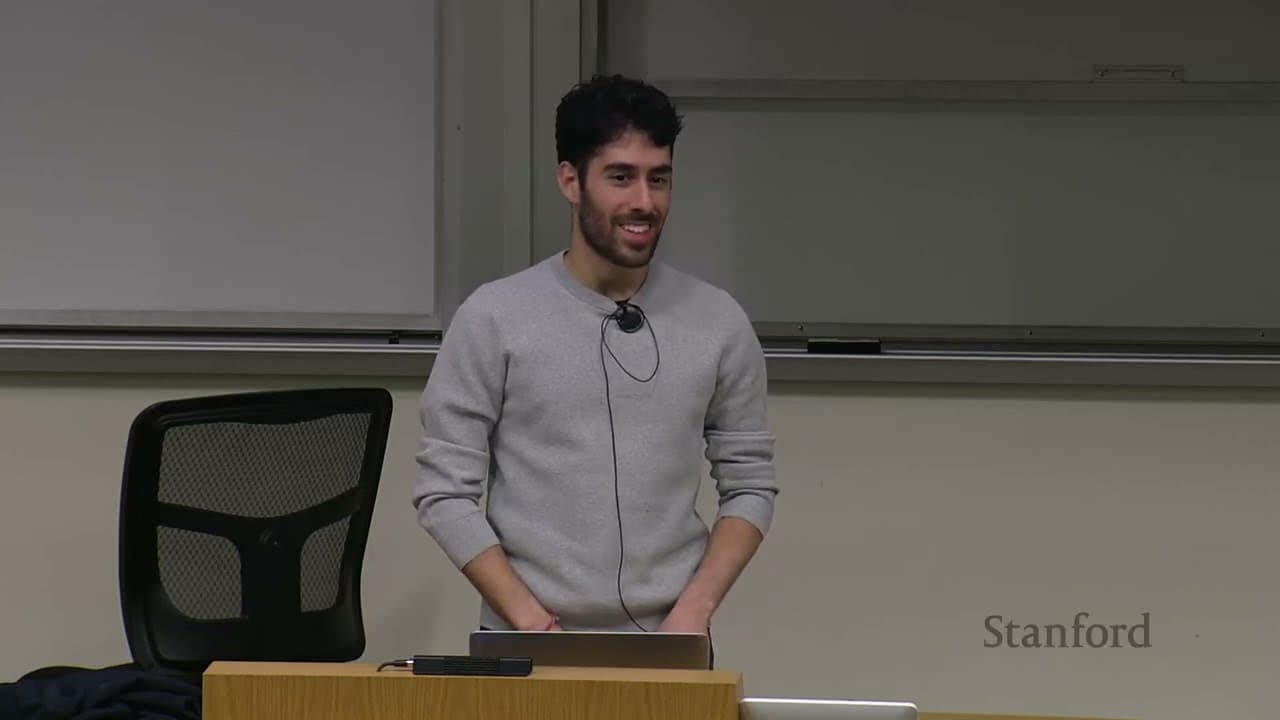
and so today I kind of just want to cover the fundamentals of Pi torch um really just kind of see what are the similarities between pi torch and numpy and python which you guys are used to at this point and see how we can build up a lot of the building blocks that we'll need in order to Define more complex models so specifically we're going to talk... Read More
Key Insights
- 💄 PyTorch simplifies tensor manipulation, GPU utilization, and neural network development, making it a powerful deep learning framework.
- ❓ AutoGrad in PyTorch automates gradient computation, enabling efficient backpropagation and optimization during training.
- 😑 PyTorch provides pre-built neural network modules, allowing for easy composition of different layers to create complex architectures.
- 🐎 PyTorch's seamless integration with GPUs enhances the speed and efficiency of deep learning computations.
- 👻 The flexibility of tensors in PyTorch allows for easy conversion between numpy arrays and tensors.
- 💠 Understanding tensor shapes and properly manipulating them is crucial for successful operations and debugging in PyTorch.
- ❓ Indexing and slicing tensors in PyTorch follows similar conventions as in numpy, enabling efficient manipulation of data.
- 🧭 Defining custom neural networks in PyTorch involves extending the NN.Module class and implementing the forward pass function.
- 🏛️ PyTorch's optimization package provides built-in optimizers like Adam, simplifying the training process.
- 🥺 The training Loop in PyTorch involves iterative forward pass, loss computation, gradient computation, and parameter updates, leading to model optimization.
Install to Summarize YouTube Videos and Get Transcripts
Explore YouTube Video Summarizer or Get YouTube Transcript Extractor
Questions & Answers
Q: What are tensors in PyTorch and how do they relate to numpy arrays?
Tensors in PyTorch are multi-dimensional arrays that can be manipulated and used for computation, similar to numpy arrays. They represent data in deep learning models and can be thought of as the equivalent of numpy arrays in PyTorch.
Q: How does PyTorch handle gradients and backpropagation?
PyTorch's AutoGrad feature automatically computes gradients, allowing for efficient backpropagation through the network. Gradients are stored for each tensor, and calling the backward() function propagates the gradients through the network. These gradients are then used to update the network parameters during optimization.
Q: What is the benefit of using PyTorch's neural network modules?
PyTorch provides pre-built neural network modules, such as linear layers, activation functions, and loss functions, which simplify the development of neural networks. These modules can be easily composed to create complex network architectures for specific use cases.
Q: How does PyTorch utilize GPUs for computation?
PyTorch leverages GPUs to accelerate computation in deep learning models. By utilizing the GPU, PyTorch can leverage its parallel processing capabilities, enhancing the speed and efficiency of training and inference processes.
Summary & Key Takeaways
-
PyTorch simplifies tensor manipulation and GPU utilization, allowing for efficient computation in deep learning models.
-
AutoGrad in PyTorch automatically computes gradients, enabling efficient backpropagation and optimization during training.
-
PyTorch provides building blocks for neural networks, such as linear layers, activation functions, and loss functions, simplifying the development process.
Read in Other Languages (beta)
Share This Summary 📚
Summarize YouTube Videos and Get Video Transcripts with 1-Click
Try YouTube Summary with ChatGPT & Claude or YouTube Transcript Generator
Explore More Summaries from Stanford Online 📚
Summarize YouTube Videos and Get Video Transcripts with 1-Click
Try YouTube Summary with ChatGPT & Claude or YouTube Transcript Generator