Matching radical functions with graphs exercise example | Algebra II | Khan Academy
TL;DR
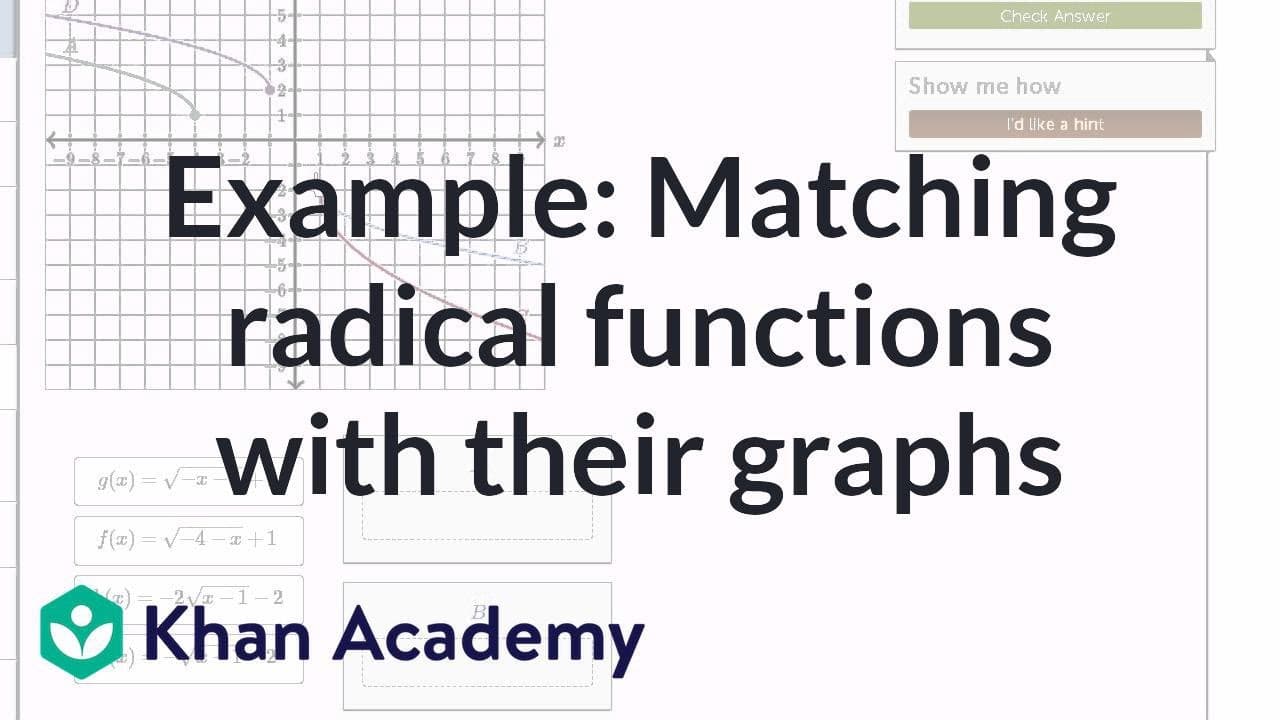
Determine the correct function-graph correspondences by analyzing reflections, shifts, and scaling factors of different functions.
Transcript
Match each function with its graph. And we have graph D, A, B, and C. And let's just start with the graph of B because, actually, this one looks the closest to the square root of x, which would look something like that. But it's clearly shifted. And it's flipped over the horizontal axis. The fact that it's flipped over the square horizontal axis, t... Read More
Key Insights
- 🧑🏭 Matching functions to their graphs involves analyzing shifts, reflections, and scaling factors.
- 👈 Observing the behavior of the function at key points, such as intersections with the x-axis, can aid in identifying the correct function.
- 🐬 Shifting vertically or horizontally and flipping over axes provide important clues about the function.
- ☠️ Comparing the rate of increase or decrease can help determine the scaling factor.
- ❎ Reflection over the horizontal axis indicates taking the negative square root.
- 🤘 Analyzing shifts and sign changes can confirm the matches between functions and graphs.
- 👈 Points of intersection with the x-axis reveal the roots of the function.
Install to Summarize YouTube Videos and Get Transcripts
Explore YouTube Video Summarizer or Get YouTube Transcript Extractor
Questions & Answers
Q: How can shifts in the position of a graph help in determining the corresponding function?
Shifts in the graph's position, whether vertically or horizontally, provide valuable clues about the function. These shifts can be identified by analyzing key points on the graph and comparing them to the properties of different functions.
Q: What role does the scaling factor play in matching a function to its graph?
The scaling factor determines how quickly the function approaches negative values or changes the slope of the graph. By examining the rate of decrease or increase in specific regions, it is possible to identify the correct function.
Q: How can points of intersection between the graph and the x-axis help in identifying the correct function?
Points of intersection with the x-axis help determine the root(s) of the function. By comparing the x-values of these points with the function's properties, it becomes easier to match the graph with the correct function.
Q: What does it mean when a graph is reflected over the horizontal axis?
When a graph is reflected over the horizontal axis, it indicates that the function is taking the negative square root. This reflection can help identify the correct function by considering the sign changes and relative positions of key points.
Summary & Key Takeaways
-
The video discusses how to match functions with their corresponding graphs by considering shifts, reflections, and scaling factors.
-
By analyzing the properties of the graphs, such as shifts in the horizontal and vertical directions, it becomes possible to identify the correct functions.
-
Comparing the behavior of the functions at specific points can also aid in correctly matching them with their respective graphs.
Read in Other Languages (beta)
Share This Summary 📚
Summarize YouTube Videos and Get Video Transcripts with 1-Click
Try YouTube Summary with ChatGPT & Claude or YouTube Transcript Generator
Explore More Summaries from Khan Academy 📚



Summarize YouTube Videos and Get Video Transcripts with 1-Click
Try YouTube Summary with ChatGPT & Claude or YouTube Transcript Generator