Statistical Learning: 10.R.1 Neural Networks in R and the MNIST data
TL;DR
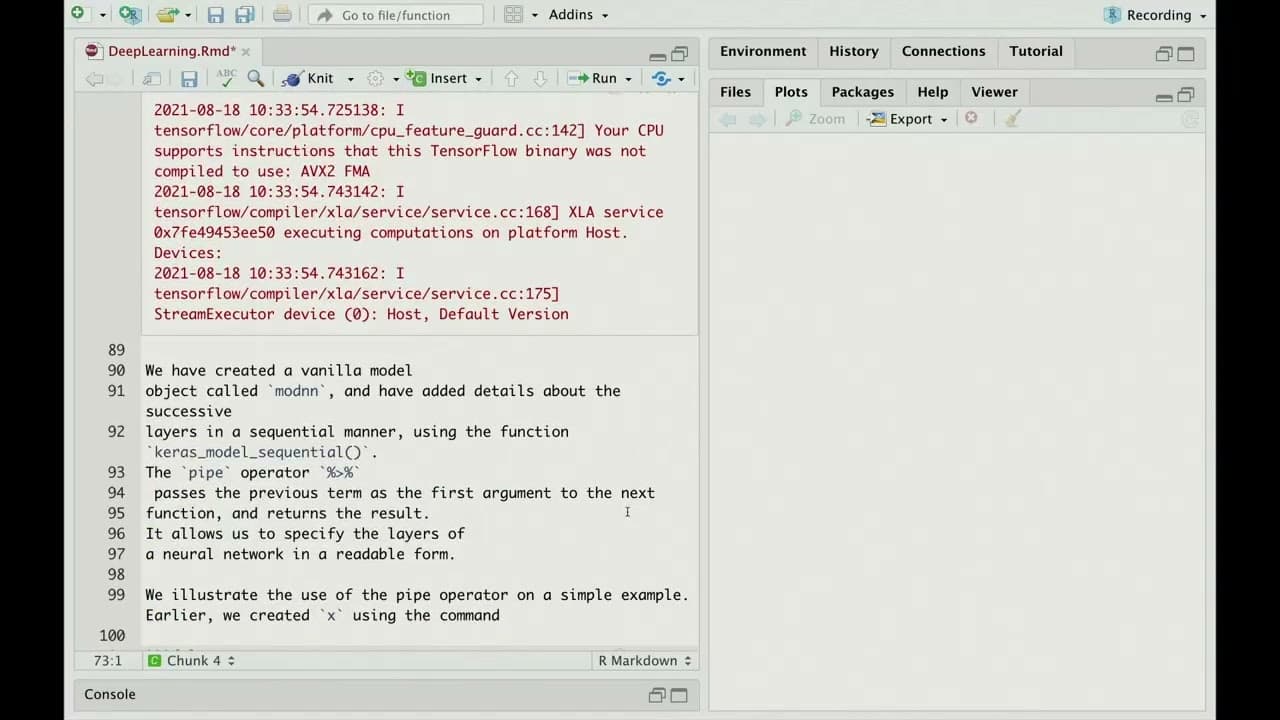
This lab demonstrates how to implement deep learning models using the Keras package in R, with a focus on fitting single layer and multi-layer neural networks.
Transcript
now we're going to do the lab on on deep learning for chapter 10 and we're going to show you how we fit the the models that we saw in the chapter so we implement deep learning through the keras package in r which is a front end to tensorflow which is the system developed at google and keras and tensorflow are implemented in python and so there are ... Read More
Key Insights
- 👨💻 Keras is a powerful package in R that allows for the implementation of deep learning models using Python code through R interfaces.
- 🦖 Deep learning models can be easily fitted using Keras in R, with options for single layer and multi-layer neural networks.
- ❓ Regularization techniques like dropout can be incorporated into neural network models to prevent overfitting and improve generalization.
- 🌸 Keras provides various activation functions and loss functions to tailor the neural network models to the specific problem.
- ❓ The ability to visualize the progress and performance of deep learning models is made convenient through the RStudio interface.
- ❓ Scaling and preprocessing of data is important before fitting deep learning models to ensure better convergence and performance.
- ✋ Deep learning models can achieve high accuracy on complex datasets, such as the MNIST digit dataset, outperforming traditional methods like logistic regression.
Install to Summarize YouTube Videos and Get Transcripts
Explore YouTube Video Summarizer or Get YouTube Transcript Extractor
Questions & Answers
Q: What is the significance of Keras in implementing deep learning models in R?
Keras is a front-end to TensorFlow, which is a deep learning system developed by Google. It allows R users to easily implement and train deep learning models using Python code through R interfaces.
Q: What are the recommended resources for learning deep learning with Keras in R?
The lab suggests getting a copy of the book "Deep Learning with R" by Francois Chollet and J.J. Allaire, as it follows the concepts and examples presented in the book. Additionally, the book's website provides instructions on installing Keras, TensorFlow, and Python on various machines.
Q: Why is it necessary to have a Python implementation on your machine to run Keras in R?
Keras and TensorFlow are implemented in Python, and the R interfaces to Keras utilize the Python code. Therefore, having a Python implementation on your machine is required to run Keras in R.
Q: How does the pipe operator (%>%) in R improve the readability of specifying neural network models using Keras?
The pipe operator allows for a more readable and intuitive way of specifying the layers in a neural network. Each layer and its properties can be written on a separate line, making the code easier to understand and modify.
Summary & Key Takeaways
-
The lab introduces the use of Keras package in R for implementing deep learning models.
-
It emphasizes the need for Python implementation, as Keras and TensorFlow are implemented in Python.
-
The lab covers fitting single layer neural networks on the "hitters" dataset and demonstrates how to compute test error.
-
It also covers fitting multi-layer neural networks on the MNIST digit dataset, showcasing the use of dropout regularization and achieving high accuracy.
Read in Other Languages (beta)
Share This Summary 📚
Summarize YouTube Videos and Get Video Transcripts with 1-Click
Try YouTube Summary with ChatGPT & Claude or YouTube Transcript Generator
Explore More Summaries from Stanford Online 📚


Summarize YouTube Videos and Get Video Transcripts with 1-Click
Try YouTube Summary with ChatGPT & Claude or YouTube Transcript Generator