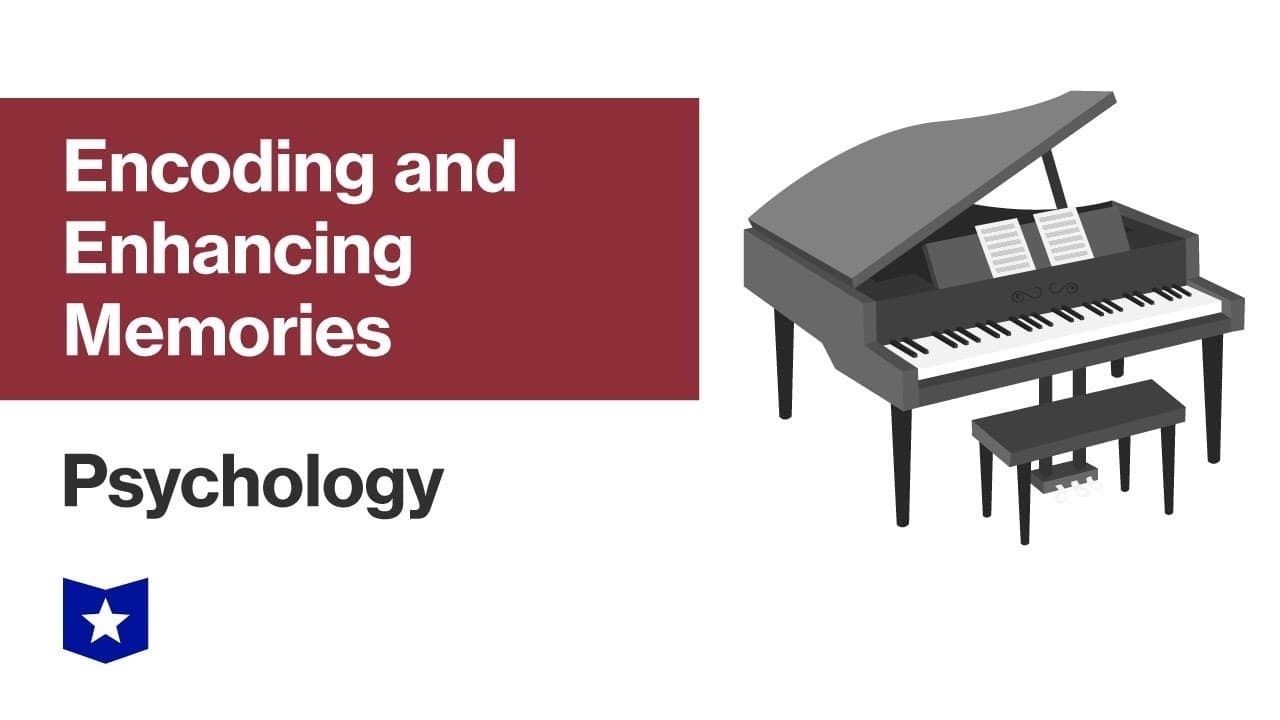
Encoding and Enhancing Memories | Psychology
TL;DR
Memory encoding is the process of transforming thoughts into explicit and implicit memories using strategies like chunking and distributed practice.
Transcript
encoding refers to the process of transforming thoughts feelings or perceptions into enduring mental structures and long-term memory long-term memory is divided into two broad subtypes explicit memory and implicit memory explicit memory also called declarative memory is stored information that can be consciously retrieved for example knowing that a... Read More
Key Insights
- 💭 Memory encoding involves transforming thoughts into long-term memories through explicit and implicit processes.
- ❓ Explicit memory consists of semantic and episodic memory, while implicit memory includes procedural memory and priming.
- 🦻 Strategies like maintenance rehearsal, elaborative rehearsal, and chunking aid in memory encoding.
- 💆 Distributed practice enhances memory retention compared to massed practice.
- 💁 Chunking improves the recall of complex information by grouping it into smaller units.
- ❓ Encoding strategies like mnemonic devices can facilitate learning and retrieval processes.
- ❓ Different memory retrieval methods can be optimized by matching the encoding strategies used.
Install to Summarize YouTube Videos and Get Transcripts
Explore YouTube Video Summarizer or Get YouTube Transcript Extractor
Questions & Answers
Q: What is the difference between explicit and implicit memory?
Explicit memory involves consciously retrieving stored information like facts and personal experiences, while implicit memory refers to learning and retrieving behaviors without conscious awareness.
Q: How does chunking help in memory encoding?
Chunking involves combining small pieces of information into larger units, making it easier to remember complex concepts or sequences like mathematical operations or mnemonics.
Q: What are the benefits of distributed practice over massed practice in memory encoding?
Distributed practice, with learning sessions spread out over time, leads to longer-lasting memories compared to massed practice, even when investing the same amount of time, as shown by research studies.
Q: How does elaborative rehearsal differ from maintenance rehearsal in memory encoding?
Elaborative rehearsal involves actively enhancing stored information by relating it to other knowledge, while maintenance rehearsal focuses on keeping information active in short-term memory through repetition.
Summary & Key Takeaways
-
Memory encoding involves transforming thoughts into explicit and implicit memories.
-
Explicit memory includes semantic and episodic memory, while implicit memory consists of procedural memory and priming.
-
Strategies like maintenance rehearsal, elaborative rehearsal, chunking, and distributed practice enhance memory encoding and retrieval.
Read in Other Languages (beta)
Share This Summary 📚
Summarize YouTube Videos and Get Video Transcripts with 1-Click
Try YouTube Summary with ChatGPT & Claude or YouTube Transcript Generator
Explore More Summaries from Course Hero 📚


Summarize YouTube Videos and Get Video Transcripts with 1-Click
Try YouTube Summary with ChatGPT & Claude or YouTube Transcript Generator