Unlocking Democracy: Voter Turnout and the Franchise in the United States
TL;DR
Despite the importance of the right to vote, voter turnout in the United States remains relatively low, influenced by factors like education, age, race, income, and political climate.
Transcript
the right to vote is often considered one of the most profound and fundamental rights in a democratic political system in the United States voting is often framed as both a duty of citizenship and a public good and yet in any given election only a portion of those eligible to cast a ballot actually do indeed if we look at voter turnout in president... Read More
Key Insights
- 🇺🇸 Voter turnout in the United States has remained relatively low, with an average of 57% in presidential elections since 1968.
- 🤕 Factors such as education level, age, race, income, employment status, marital status, social capital, and political efficacy influence voter turnout.
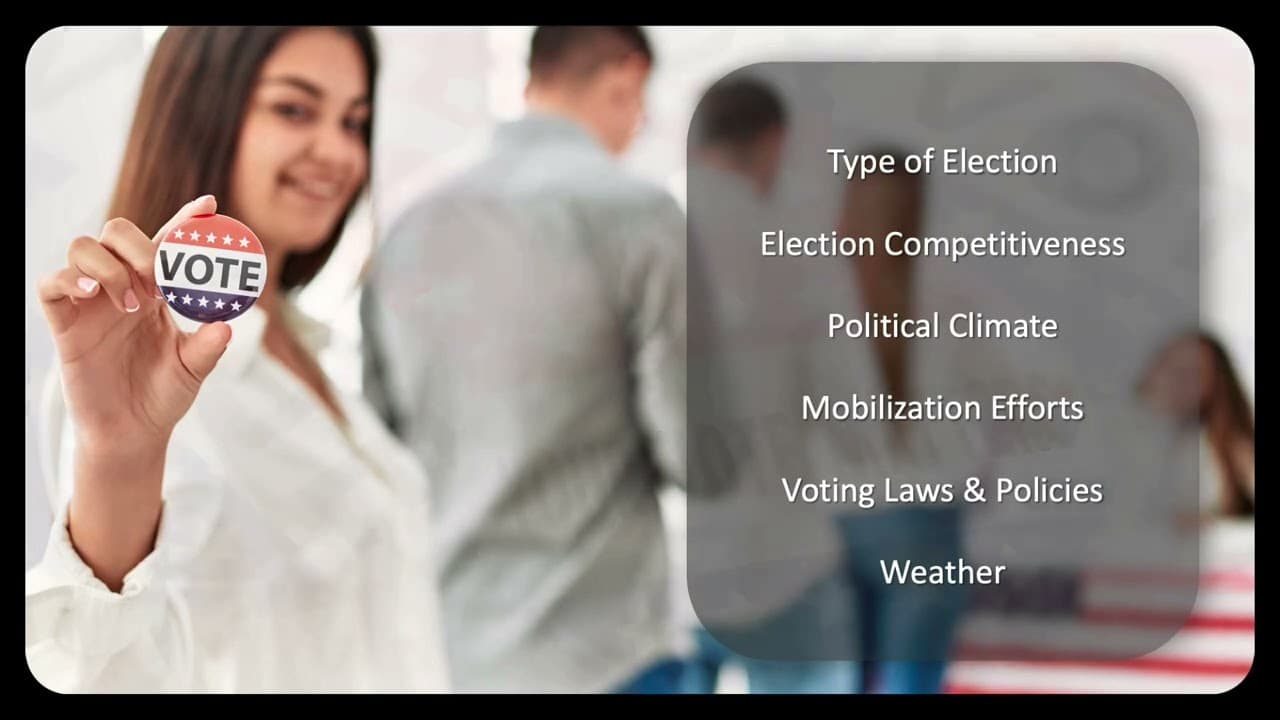
- 🥇 Election type, campaign efforts, policies, and accessibility of polling places also affect voter turnout.
- 🇺🇸 The expansion of voting rights in the United States has gradually included more citizens, but obstacles like voter registration rules, identification requirements, and availability of voting services can still hinder participation.
- ⛔ Disenfranchisement of felons disproportionately affects minority communities and limits civic participation.
- 👮 Debates over voter ID laws highlight the balance between preventing fraud and ensuring access to the voting process.
Install to Summarize YouTube Videos and Get Transcripts
Explore YouTube Video Summarizer or Get YouTube Transcript Extractor
Questions & Answers
Q: Why is voter turnout in the United States relatively low?
Several factors contribute to low voter turnout, such as lack of political awareness, limited resources to overcome voting barriers, disenfranchisement of racial and ethnic minorities, disillusionment with the political system, and a belief that individual votes do not make a difference.
Q: What are some demographic factors that influence voter turnout?
Demographic factors like education level, age, race, income, employment status, marital status, and social capital play a role in voter turnout. Higher levels of education, older age, higher income, being employed, being married, and having greater social capital tend to increase voter turnout.
Q: What are some non-demographic factors that influence voter turnout?
Non-demographic factors such as election type, competitive races, political climate, campaign efforts, policies like early voting and same-day registration, voter identification requirements, accessibility of polling stations, and external factors like weather can influence voter turnout.
Q: How has the right to vote been expanded over time in the United States?
The right to vote in the United States has gradually expanded over time. Property requirements were reduced or eliminated in the 1820s, the 15th Amendment prohibited denying citizenship based on race, the 19th Amendment granted women the right to vote, the Indian Citizenship Act granted Native Americans citizenship, and the Voting Rights Act of 1965 aimed to overcome barriers to voting for African-Americans and Native Americans.
Summary & Key Takeaways
-
Voter turnout in US presidential elections since 1968 has ranged from 52% to 66%, with an average of 57%.
-
Participation in midyear or off-term elections is even lower, with only 1/3 to 1/2 of eligible voters participating.
-
Factors influencing voter turnout include education level, age, race, income, employment status, marital status, social capital, political efficacy, election type, campaign efforts, and accessibility.
Read in Other Languages (beta)
Share This Summary 📚
Summarize YouTube Videos and Get Video Transcripts with 1-Click
Try YouTube Summary with ChatGPT & Claude or YouTube Transcript Generator
Explore More Summaries from Noah Zerbe 📚



Summarize YouTube Videos and Get Video Transcripts with 1-Click
Try YouTube Summary with ChatGPT & Claude or YouTube Transcript Generator