Standard Deviation Formula, Statistics, Variance, Sample and Population Mean
TL;DR
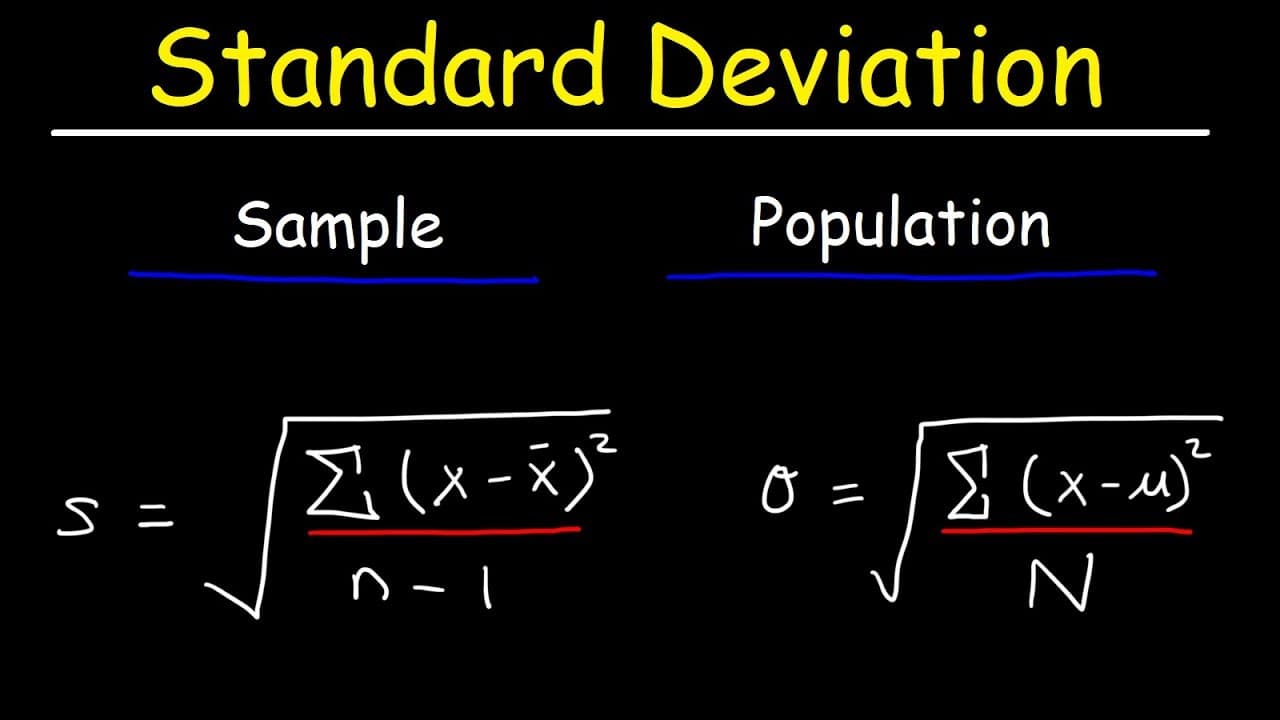
This video explains how to calculate the standard deviation for both populations and samples, as well as the difference between variance and standard deviation.
Transcript
in this video we're going to calculate the standard deviation of a set of numbers now there's two formulas you need to be aware of the first one is the population standard deviation now this formula is represented by the letter sigma that's the standard deviation it's equal to the sum of all the differences between every point in the data set and t... Read More
Key Insights
- 😥 Standard deviation measures the spread of data points around the mean.
- 😥 The population standard deviation formula calculates differences between data points and the population mean divided by n.
- 😒 The sample standard deviation formula uses n-1 as the denominator.
- ❎ Variance is the square of standard deviation and represents the average squared differences from the mean.
- ❓ The mean should be calculated before finding standard deviation.
- 😫 Standard deviation helps understand how far apart the numbers in a data set are from each other.
- 😥 Closer data points have a lower standard deviation, while spread-out points have a higher standard deviation.
Install to Summarize YouTube Videos and Get Transcripts
Explore YouTube Video Summarizer or Get YouTube Transcript Extractor
Questions & Answers
Q: What is the difference between population and sample standard deviation?
The population standard deviation is used when you have data for an entire population, while the sample standard deviation is used when you only have data for a sample of the population. The formulas are slightly different due to the different denominators (n vs. n-1).
Q: How is variance related to standard deviation?
Variance is calculated by squaring the standard deviation. It represents the average of the squared differences between each data point and the mean. In other words, variance measures the spread of data points around the mean.
Q: What does standard deviation tell us about a data set?
Standard deviation measures the dispersion or spread of data points from the mean. A higher standard deviation indicates more variation, while a lower standard deviation means the data points are closer to the mean.
Q: How do you calculate the mean before finding the standard deviation?
The first step is to calculate the mean by summing all the numbers and dividing by the total count. The mean represents the average value of the data set.
Summary & Key Takeaways
-
There are two formulas for calculating standard deviation: one for populations and one for samples.
-
The population standard deviation formula (using sigma) calculates the sum of differences between each data point and the population mean divided by the number of numbers, then taking the square root of the result.
-
The sample standard deviation formula (using s) is similar, but the differences are divided by n-1 instead of n.
Read in Other Languages (beta)
Share This Summary 📚
Summarize YouTube Videos and Get Video Transcripts with 1-Click
Try YouTube Summary with ChatGPT & Claude or YouTube Transcript Generator
Explore More Summaries from The Organic Chemistry Tutor 📚



Summarize YouTube Videos and Get Video Transcripts with 1-Click
Try YouTube Summary with ChatGPT & Claude or YouTube Transcript Generator