Comparing features of quadratic functions | Mathematics II | High School Math | Khan Academy
TL;DR
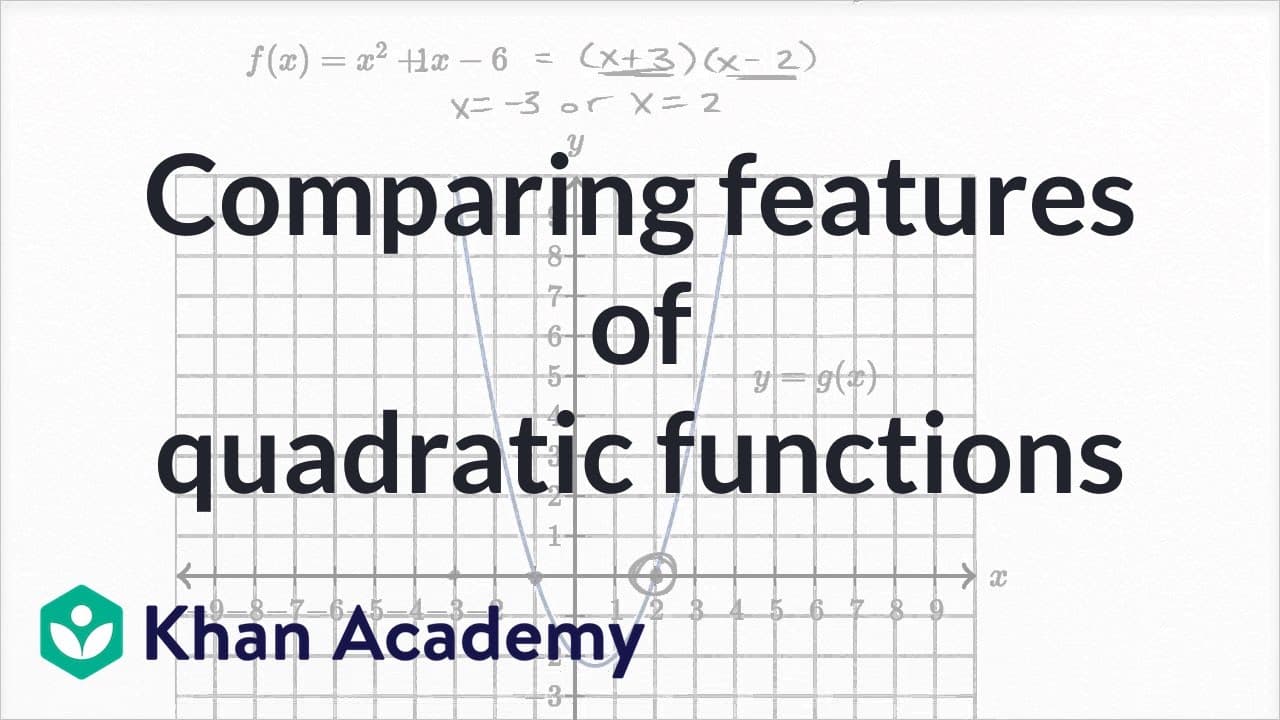
Determine which function has a greater y-intercept, find the number of roots they have in common, and determine if the functions have the same concavity.
Transcript
- [Voiceover] So we're asked which function has the greater y-intercept? So, the y-intercept is the y-coordinate when x is equal to zero. So, f of zero, when x is equal to zero, the function is equal to, let's see, f of zero is going to be equal to zero minus zero, plus four, is going to be equal to four. So this function right over here, it has a ... Read More
Key Insights
- ❣️ The y-intercept of a function is the y-coordinate when x is equal to zero.
- 😀 Function f(x) has a greater y-intercept compared to function g(x).
- 🫚 The number of roots in common between two functions can be determined by finding their shared zeros.
- ☺️ Concavity of a function is determined by the coefficient on the x squared term.
- 📈 Function f(x) is concave upwards, while function g(x) is concave downwards.
- 📈 The concavity of a function affects the shape of its graph.
- ☺️ Function f(x) has roots at x = -3 and x = 2.
Install to Summarize YouTube Videos and Get Transcripts
Explore YouTube Video Summarizer or Get YouTube Transcript Extractor
Questions & Answers
Q: Which function has a greater y-intercept?
Function f(x) has a y-intercept of 4, while function g(x) has a y-intercept of 3.
Q: How many roots do the functions have in common?
Both functions have one root in common, which is x = 2.
Q: What is concavity and do the functions have the same concavity?
Concavity refers to whether a graph opens upwards or downwards. The coefficient of the x squared term determines the concavity. Function f(x) is concave upwards, while function g(x) is concave downwards. They do not have the same concavity.
Q: How can we determine the roots of function f(x)?
To find the roots of function f(x), we can factor the equation. By factoring x^2 + x - 6, we find that f(x) has zeros at x = -3 and x = 2.
Summary & Key Takeaways
-
The y-intercept of function f(x) is 4, while the y-intercept of function g(x) is 3.
-
Both functions have one root in common, which is x = 2.
-
Function f(x) is concave upwards, while function g(x) is concave downwards.
Read in Other Languages (beta)
Share This Summary 📚
Summarize YouTube Videos and Get Video Transcripts with 1-Click
Try YouTube Summary with ChatGPT & Claude or YouTube Transcript Generator
Explore More Summaries from Khan Academy 📚




Summarize YouTube Videos and Get Video Transcripts with 1-Click
Try YouTube Summary with ChatGPT & Claude or YouTube Transcript Generator