Definite Integration Based on Property No1 Problem No 10
TL;DR
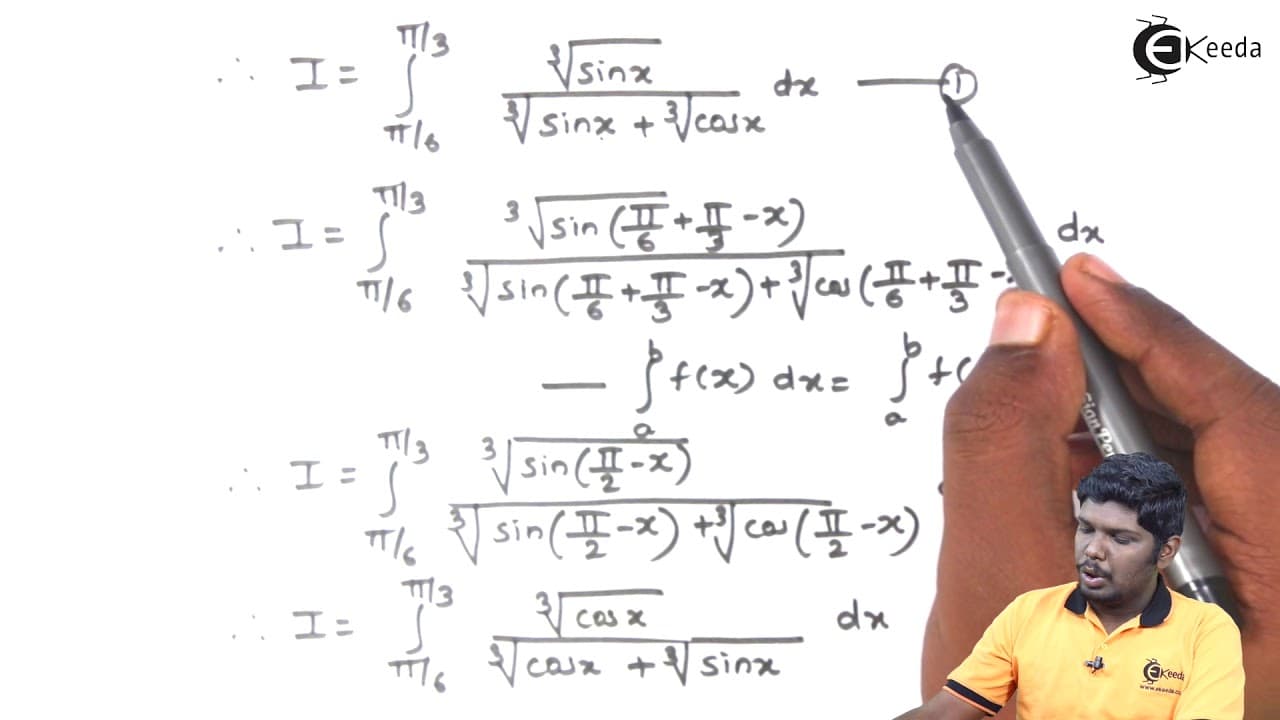
Learn how to solve a trigonometric equation using integral calculus, specifically by converting trigonometric functions into their corresponding sine and cosine values.
Transcript
click the bell icon to get latest videos from Akira now before considering this as equation number one you can convert cortex in terms of sine and cos using the interrelation partners of trigonometry that is cortex is equal to Cossacks upon sine X let us substitute the value of cortex and then further simplified I will be integral PI by 6 2 pi by 3... Read More
Key Insights
- 👨💼 Trigonometric relations can be used to convert tangent (cortex) into sine and cosine values.
- 👨💼 The integral can be written as a fraction involving cube roots of sine and cosine.
- 🤯 The properties of integration allow for simplification of the equation by replacing X with the lower limit plus the upper limit minus X.
- 😑 Complementary angle formulas can be used to simplify the equation further and express it in terms of cube roots of sine and cosine.
Install to Summarize YouTube Videos and Get Transcripts
Explore YouTube Video Summarizer or Get YouTube Transcript Extractor
Questions & Answers
Q: How can you convert tangent (cortex) into sine and cosine using trigonometric relations?
By utilizing the interrelation partners of trigonometry, we can express tangent (cortex) as cosine divided by sine.
Q: What do you do after substituting the value of tangent and simplifying the equation?
After substituting the value of tangent, the equation can be simplified by writing it as a fraction involving cube roots of sine and cosine.
Q: How can you simplify the integral using properties of integration?
The property states that the integral from A to B of f(x) dx is equal to the integral from A to B of f(a + b - x) dx. This property is used to replace X with the lower limit plus the upper limit minus X.
Q: What are the complementary angle formulas and how are they used in solving the equation?
The complementary angle formulas state that sine of (π/2 - θ) is equal to cosine θ, and cosine of (π/2 - θ) is equal to sine θ. By applying these formulas, the equation is further simplified and expressed in terms of cube roots of sine and cosine.
Summary & Key Takeaways
-
The content demonstrates the process of converting tangent (cortex) in terms of sine and cosine using trigonometric relations.
-
By substituting the value of tangent and simplifying the equation, the integral is written as a fraction of cube roots of sine and cosine.
-
The content explains the use of properties of integration and complementary angle formulas to further simplify the equation and find the value of the integral.
Read in Other Languages (beta)
Share This Summary 📚
Summarize YouTube Videos and Get Video Transcripts with 1-Click
Try YouTube Summary with ChatGPT & Claude or YouTube Transcript Generator
Explore More Summaries from Ekeeda 📚




Summarize YouTube Videos and Get Video Transcripts with 1-Click
Try YouTube Summary with ChatGPT & Claude or YouTube Transcript Generator