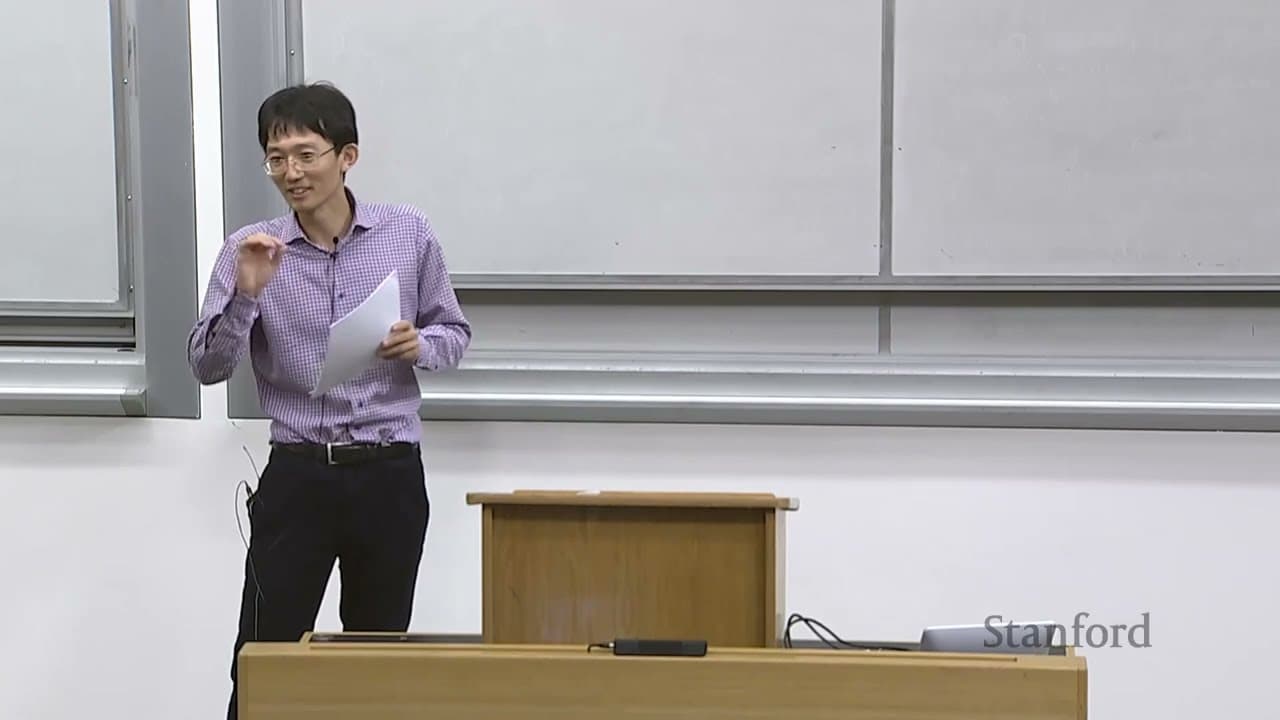
Stanford CS229 Machine Learning I Neural Networks 2 (backprop) I 2022 I Lecture 9
TL;DR
Back propagation is a crucial algorithm for computing the gradient in deep learning, allowing for efficient training of neural networks.
Transcript
so I guess the last time um Masha talked about um on deep learning uh the introduced deep learning new networks and today we are going to talk about back propagation which is probably the most important thing in deep learning like how do you complete a gradient and implement this algorithm of course there are many other kind of like decisions you h... Read More
Key Insights
- 👻 Back propagation is a fundamental algorithm in deep learning that allows for efficient training of neural networks by computing the gradient of the loss function.
- 🖱️ The algorithm uses the chain rule to compute the derivative of the loss function with respect to intermediate variables in the network.
- 💄 Back propagation can be implemented with vectorized notation, making it more efficient and easier to understand.
- 🏋️ The computed gradients are used to update the weights and biases in the network, improving its performance over time.
Install to Summarize YouTube Videos and Get Transcripts
Explore YouTube Video Summarizer or Get YouTube Transcript Extractor
Questions & Answers
Q: What is back propagation and why is it important in deep learning?
Back propagation is an algorithm used to compute the gradient of the loss function with respect to the parameters in a neural network. It is important in deep learning because it allows for efficient training of networks by iteratively updating the weights and biases based on the computed gradients.
Q: How does back propagation work?
Back propagation works by iteratively computing the gradient of the loss function with respect to the parameters in a neural network. It involves using the chain rule to compute the derivative of the loss function with respect to intermediate variables in the network.
Q: Are there alternative methods to compute the gradient besides back propagation?
Yes, there are alternative methods to compute the gradient, such as automatic differentiation algorithms. However, back propagation remains a widely used and important algorithm in deep learning due to its simplicity and effectiveness.
Q: What are the implications of back propagation in other areas besides deep learning?
The idea of computing gradients automatically, as done in back propagation, has implications in other areas such as optimization and machine learning. It allows for efficient computation of gradients for various functions, enabling faster optimization algorithms and improved performance in a wide range of applications.
Summary & Key Takeaways
-
Back propagation is an algorithm for computing the gradient, which is crucial for training deep learning networks. It allows for efficient optimization of neural network models.
-
The algorithm involves computing the gradient of the loss function with respect to the parameters in the network, such as weights and biases.
-
Back propagation can be implemented by using the chain rule to compute the derivative of the loss function with respect to intermediate variables in the network.
-
The gradient can be used to update the parameters of the network and improve its performance.
Read in Other Languages (beta)
Share This Summary 📚
Summarize YouTube Videos and Get Video Transcripts with 1-Click
Try YouTube Summary with ChatGPT & Claude or YouTube Transcript Generator
Explore More Summaries from Stanford Online 📚

Summarize YouTube Videos and Get Video Transcripts with 1-Click
Try YouTube Summary with ChatGPT & Claude or YouTube Transcript Generator