Introduction to photoelectron spectroscopy | AP Chemistry | Khan Academy
TL;DR
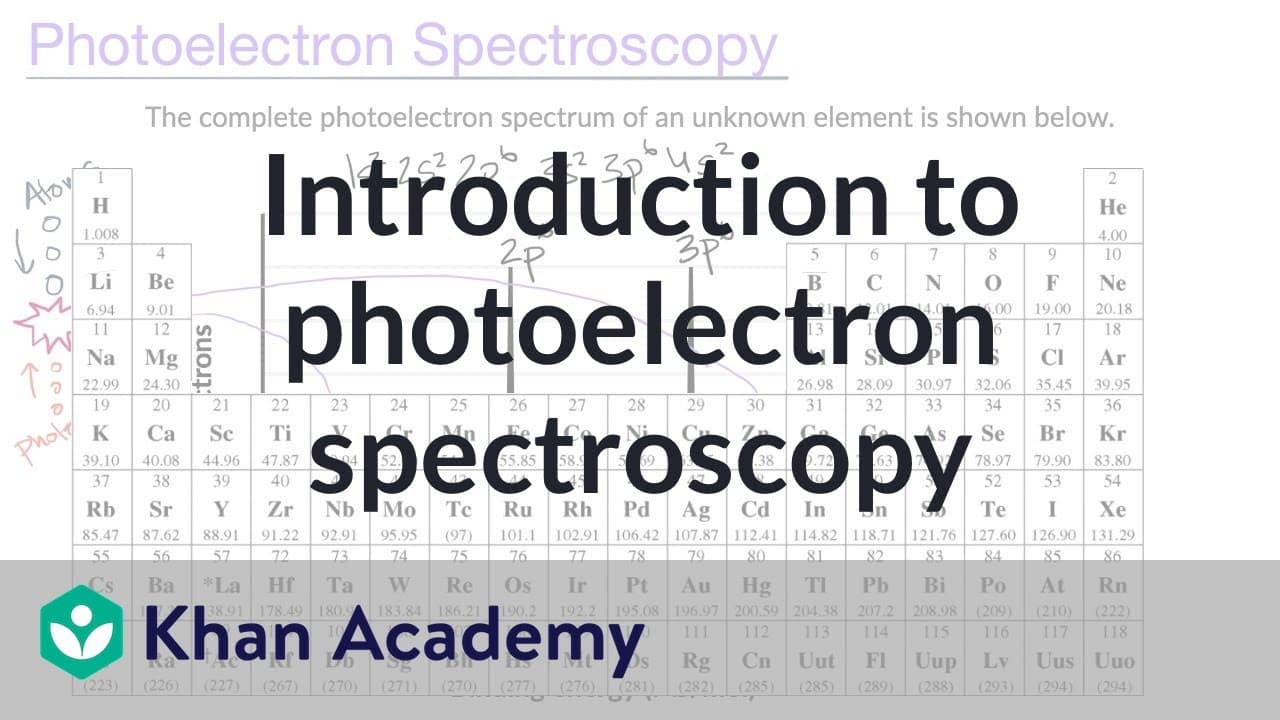
Photoelectron spectroscopy is a method of analyzing the electron configuration of an atom by bombarding it with high-energy photons and detecting the ejected electrons.
Transcript
- [Instructor] In this video, we're going to introduce ourselves to the idea of photoelectron spectroscopy. It's a way of analyzing the electron configuration of a sample of a certain type of atom. And so what you'll often see and you might see something like this on an exam, is a photoelectron spectrum that looks something like this. And so the fi... Read More
Key Insights
- 🫀 Photoelectron spectroscopy is a method used to analyze the electron configuration of atoms by measuring the kinetic energy of ejected electrons.
- 🐚 The photoelectron spectrum shows spikes that correspond to different electron shells, indicating the number and binding energies of electrons in each shell.
- 😘 The binding energy of an electron determines its kinetic energy when ejected from an atom, with higher binding energy leading to lower kinetic energy.
- 😘 The valence electrons, which are responsible for the chemical properties of an element, have the lowest binding energy and are the easiest to remove.
- ❓ The photoelectron spectrum can be used to determine the electron configuration and identify the element being analyzed.
- 😘 The photoelectron spectrum of potassium would be similar to that of calcium, but with slightly lower binding energies due to the lower positive charge in the nucleus.
Install to Summarize YouTube Videos and Get Transcripts
Explore YouTube Video Summarizer or Get YouTube Transcript Extractor
Questions & Answers
Q: How is a photoelectron spectrum generated?
A photoelectron spectrum is generated by bombarding a stream of atoms with high-energy photons, which knock off electrons with enough energy to overcome their binding energy. The ejected electrons are then deflected by a magnetic field and detected.
Q: What does the photoelectron spectrum tell us about the electron configuration?
The photoelectron spectrum provides information about the number of electrons and their binding energies in different shells. The spikes in the spectrum correspond to different electron shells, allowing us to determine the electron configuration of an element.
Q: How does the binding energy affect the kinetic energy of ejected electrons?
Electrons with higher binding energy require more energy to be knocked off, resulting in less kinetic energy. On the other hand, electrons with lower binding energy are easier to remove and have higher kinetic energy.
Q: How can we determine the valence electrons from the photoelectron spectrum?
The valence electrons are the outermost electrons with the lowest binding energy. They are the easiest to remove and have the highest kinetic energy. The spike with the lowest binding energy in the photoelectron spectrum represents the valence electrons.
Summary & Key Takeaways
-
Photoelectron spectroscopy involves analyzing the electron configuration of atoms by bombarding them with high-energy photons and measuring the kinetic energy of ejected electrons.
-
Electrons closer to the nucleus have higher binding energy, so they are knocked off with less kinetic energy and do not travel as far as the outer electrons.
-
The photoelectron spectrum gives information about the binding energies of electrons in different shells, allowing the determination of the electron configuration of an element.
Read in Other Languages (beta)
Share This Summary 📚
Summarize YouTube Videos and Get Video Transcripts with 1-Click
Try YouTube Summary with ChatGPT & Claude or YouTube Transcript Generator
Explore More Summaries from Khan Academy 📚



Summarize YouTube Videos and Get Video Transcripts with 1-Click
Try YouTube Summary with ChatGPT & Claude or YouTube Transcript Generator