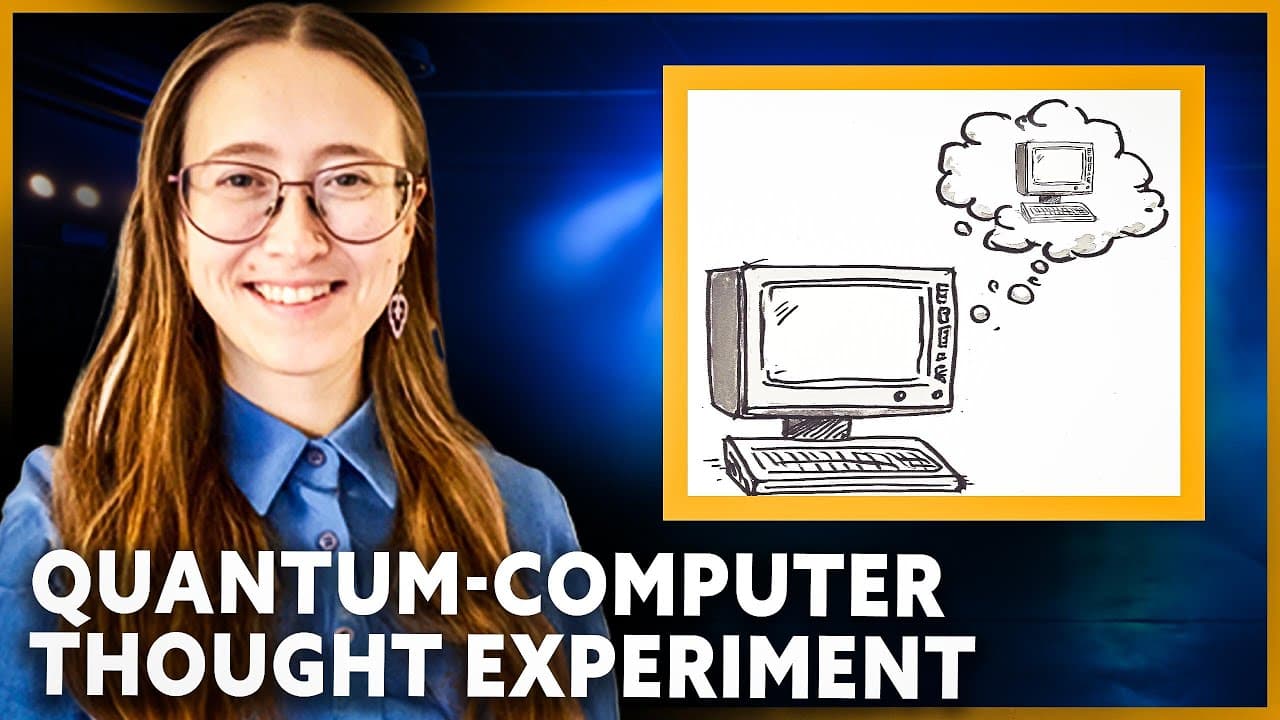
Thought experiments on a quantum computer, with Nuriya Nurgalieva
TL;DR
This content discusses a software package that allows for running thought experiments on quantum computers to test the consistency of reasoning among quantum agents.
Transcript
foreign information group and we will hear about thought experiments on a quantum computer Rick thanks a lot Marcus for introduction uh thanks a lot for having me here uh let me put this in a full screen mode uh and I'm gonna talk about uh a work that we've done recently with uh together with Simon Martis who was a master suit at a time Lydia and R... Read More
Key Insights
- 🤔 Thought experiments are frequently used in different scientific disciplines to explore theories and their limitations.
- 🤔 In the context of quantum mechanics, thought experiments help formulate no-go theorems and have implications for interpreting the theory.
- ❓ Consistent reasoning among quantum agents is crucial to ensure their conclusions do not contradict each other and that their knowledge is accurately represented.
Install to Summarize YouTube Videos and Get Transcripts
Explore YouTube Video Summarizer or Get YouTube Transcript Extractor
Questions & Answers
Q: How does the software package determine the consistency of reasoning among quantum agents?
The software package utilizes different assumptions about agents, such as their modeling, interpretation, and communication protocols. By running a given protocol with the input from these assumptions, the package determines whether the agents' reasoning leads to contradictions or consistency.
Q: Can the software package be used for automatic scenario discovery?
Currently, the software package requires users to manually write protocols and assumptions. However, in the future, there is potential to expand it to enable automatic scenario discovery and the identification of compelling contradictions among agents.
Q: What logical modules can be loaded into the software package?
The software package can accommodate various logical modules, including many-valued logics. Users can choose the number of quantum systems to model memory states and customize the interaction between these memories. Possibilistic versions of beginner's friend scenarios and other logical constraints are also potential avenues for exploration.
Q: Are inconsistencies among neo-Copenhagen observers indicative of losing bets?
Inconsistencies among neo-Copenhagen observers do not directly indicate losing bets. The software package focuses on the consistency of reasoning among agents rather than the physical results they obtain in a lab. Whether betting on knowledge-based contradictions or physical outcomes would lead to losing bets depends on the specific scenario and assumptions made.
Summary & Key Takeaways
-
The content introduces a software package that proposes a framework for running thought experiments on quantum computers, specifically in the context of consistent reasoning among quantum agents.
-
The software package allows users to explore different assumptions about agents, their modeling, reasoning, interpretations, and communication protocols to determine the consistency of the overall setup.
-
One of the testing examples presented is the Rahiger Renaissance experiment, which highlights the potential for contradictory conclusions among reasoning agents.
Read in Other Languages (beta)
Share This Summary 📚
Summarize YouTube Videos and Get Video Transcripts with 1-Click
Try YouTube Summary with ChatGPT & Claude or YouTube Transcript Generator
Explore More Summaries from Essentia Foundation 📚




Summarize YouTube Videos and Get Video Transcripts with 1-Click
Try YouTube Summary with ChatGPT & Claude or YouTube Transcript Generator