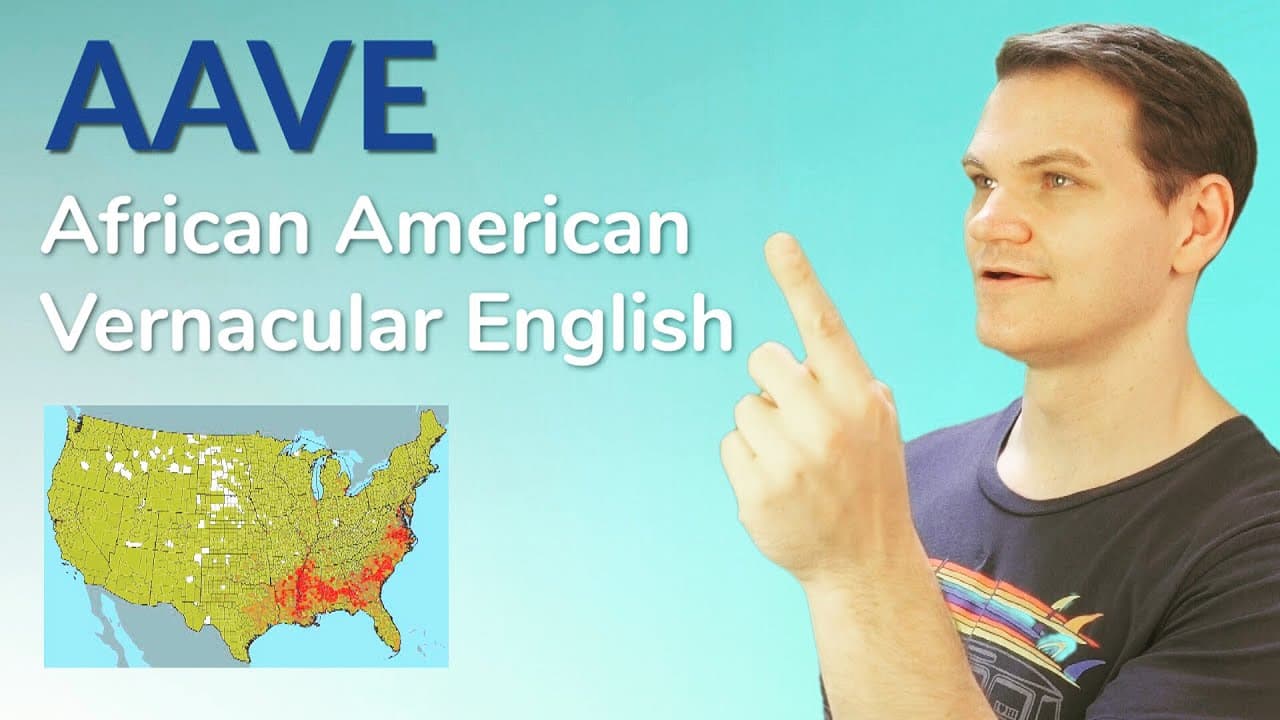
AAVE - African American Vernacular English
TL;DR
AAVE is a distinct, systematic dialect with unique grammar and pronunciation.
Transcript
hello everyone welcome to the Laing focused Channel and my name is Paul today we're going to talk about African American vernacular English African American vernacular English which you may also hear referred to as Ebonics is a group of dialects of English that developed among African American communities in the United States because of the express... Read More
Key Insights
- AAVE, also known as Ebonics, is a group of English dialects developed among African American communities in the U.S., influencing American and international English.
- Despite misconceptions, AAVE is not 'broken' English but a distinct, systematic dialect with its own grammatical rules and phonological features.
- AAVE developed from the interaction between West African languages and English dialects spoken by indentured servants and slave masters in the U.S.
- AAVE features unique grammatical structures, such as the habitual use of 'B,' the completive 'done,' and specific negation forms like 'ain't.'
- Pronunciation in AAVE includes characteristic features like Arless pronunciation, monophthongization of diphthongs, and specific consonant cluster reductions.
- AAVE vocabulary includes standard English words used differently and slang expressions that often cross into other English varieties.
- AAVE exists on a continuum with standard English, with speakers mixing elements depending on context, socioeconomic status, and perception of the dialect.
- The use of AAVE in various contexts, including informal and formal settings, reflects broader linguistic patterns seen in dialects worldwide.
Install to Summarize YouTube Videos and Get Transcripts
Explore YouTube Video Summarizer or Get YouTube Transcript Extractor
Questions & Answers
Q: What is African American Vernacular English (AAVE)?
African American Vernacular English (AAVE), also known as Ebonics, is a group of English dialects that developed among African American communities in the United States. It is characterized by unique grammatical structures, pronunciation features, and vocabulary that distinguish it from standard English. AAVE has significantly influenced both American and international English, particularly through its slang and idiomatic expressions.
Q: How did AAVE develop historically?
AAVE developed from the interaction between West African languages and the English dialects spoken by indentured servants and slave masters in the United States. This linguistic contact led to the formation of a distinct dialect group, similar to the development of English-based Creole languages in the Caribbean. Over time, AAVE evolved through processes like decreolization and convergence with standard English, while maintaining unique features that reflect its historical roots.
Q: What are some key grammatical features of AAVE?
Key grammatical features of AAVE include the habitual use of 'B' to indicate repeated actions, the completive 'done' to show completed actions, and specific negation forms like 'ain't.' AAVE also features unique constructions for expressing the future, such as 'finna' and 'imma,' and often lacks person-number agreement, as seen in phrases like 'he don't know.' These grammatical elements highlight the systematic nature of AAVE as a distinct dialect.
Q: How does AAVE pronunciation differ from standard English?
AAVE pronunciation includes several distinctive features, such as Arless pronunciation, where the 'r' sound is often dropped, and monophthongization, where diphthongs become single vowel sounds. Consonant cluster reductions are common, with final consonants often omitted, and th sounds are frequently replaced by f or d sounds. These phonological characteristics contribute to the unique sound of AAVE and distinguish it from other English dialects.
Q: What role does slang play in AAVE?
Slang plays a significant role in AAVE, with many expressions crossing over into other varieties of English through music and media. Words like 'dis' (disrespect), 'beef' (conflict), and 'squash' (end something) are examples of AAVE slang. However, slang is not representative of the entire dialect, as the majority of AAVE vocabulary consists of standard English words used with different meanings or forms.
Q: How does AAVE relate to standard English?
AAVE exists on a continuum with standard English, with speakers often mixing elements of both dialects depending on context, socioeconomic status, and perception of the dialect. While AAVE is distinct from standard English, it is not inferior. Many speakers switch between AAVE and standard English in different settings, reflecting a broader linguistic pattern seen in dialects worldwide, where non-standard varieties coexist with the standard language.
Q: What are some misconceptions about AAVE?
A common misconception about AAVE is that it is 'broken' or 'bad' English. In reality, AAVE is a systematic and rule-governed dialect with its own grammatical and phonological features. Another misconception is that all African Americans speak AAVE, or that only African Americans speak it. In fact, not all African Americans use AAVE, and some non-African Americans do speak it, highlighting the dialect's complexity and diversity.
Q: Why is AAVE important to study and understand?
Studying and understanding AAVE is important for several reasons. It provides insights into the linguistic diversity and cultural history of African American communities. AAVE has also significantly influenced American and international English, particularly through its slang and idiomatic expressions. Recognizing AAVE as a legitimate dialect challenges stereotypes and promotes appreciation for linguistic diversity, fostering better communication and understanding across different segments of society.
Summary & Key Takeaways
-
African American Vernacular English (AAVE) is a distinct dialect group that developed among African American communities in the U.S. It is often misunderstood as 'broken' English but is a systematic dialect with unique grammar and pronunciation features.
-
AAVE's historical development is linked to the interaction between West African languages and English dialects spoken by indentured servants and slave masters. Its influence extends to American and international English, particularly through slang and idiomatic expressions.
-
Key grammatical features of AAVE include habitual 'B,' completive 'done,' and specific negation forms like 'ain't.' Its pronunciation features include Arless pronunciation, monophthongization, and consonant cluster reductions, distinguishing it from standard English.
Read in Other Languages (beta)
Share This Summary 📚
Summarize YouTube Videos and Get Video Transcripts with 1-Click
Try YouTube Summary with ChatGPT & Claude or YouTube Transcript Generator
Explore More Summaries from Langfocus 📚




Summarize YouTube Videos and Get Video Transcripts with 1-Click
Try YouTube Summary with ChatGPT & Claude or YouTube Transcript Generator